- Plants
- ›Vascular Plants
- ›flowering plants
- ›Dicots
- ›Mints, Plantains, Olives, and Allies
- ›Mint Family
- ›Nepetoideae
- ›Mentheae
- ›balms, mints, and thymes
- ›Mentha
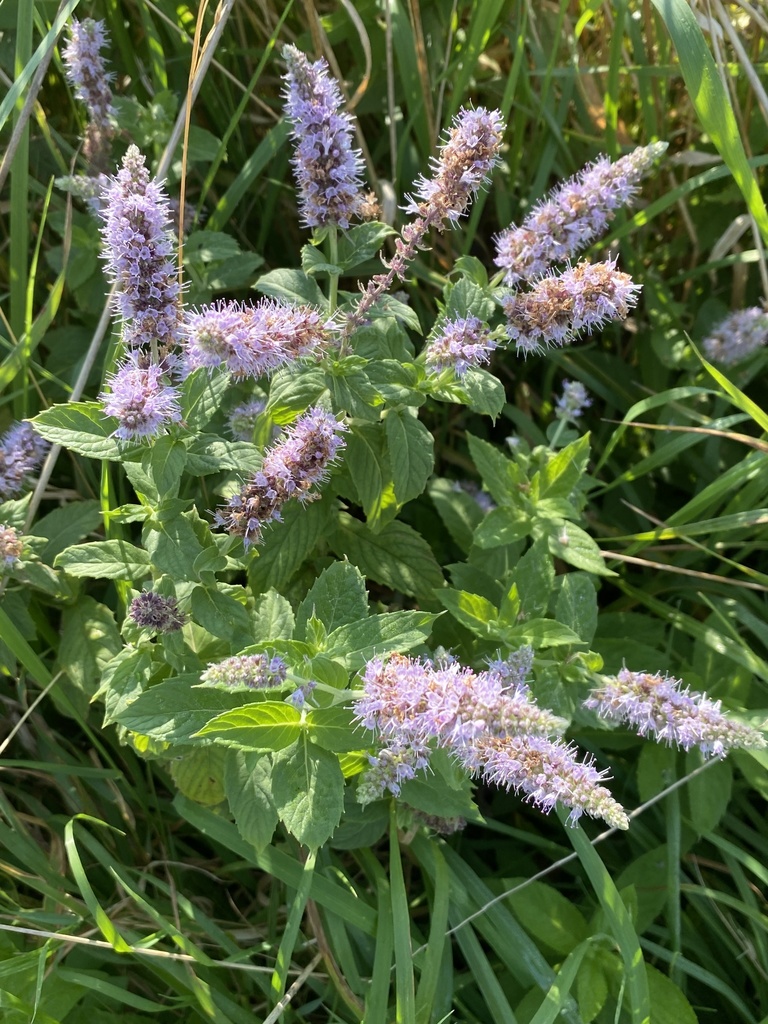
Horse Mint
Mentha longifolia
Mentha longifolia (horse mint; syn. M. spicata var. longifolia L., M. sylvestris L., M. tomentosa D'Urv, M. incana Willd.) is a species in the genus Mentha (mint) native to Europe excluding Britain and Ireland, western and central Asia (east to Nepal and the far west of China), and northern and southern (but not tropical) Africa. It is a very variable herbaceous perennial plant with a peppermint-scented aroma. Like many mints, it has a creeping rhizome, with
From the article Mentha longifolia on Wikipedia (CC BY-SA), quoted section by section
Description
It is a very variable herbaceous perennial plant with a peppermint-scented aroma. Like many mints, it has a creeping rhizome, with erect to creeping stems 40–120 cm (16–47 in) tall. The leaves are oblong-elliptical to lanceolate, 5–10 cm (2.0–3.9 in) long and 1.5–3 cm (0.6–1.2 in) broad, thinly to densely tomentose, green to greyish-green above and white below. The flowers are 3–5 mm long, lilac, purplish, or white, produced in dense clusters (verticillasters) on tall, branched, tapering spikes; flowering in mid to late summer. It spreads via rhizomes to form clonal colonies.
At the table
Nicholas Culpeper's Complete Herbal (1653) states that "It is good for wind and colic in the stomach ... The juice, laid on warm, helps the King's evil or kernels in the throat ... The decoction or distilled water helps a stinking breath, proceeding from corruption of the teeth, and snuffed up the nose, purges the head. It helps the scurf or dandruff of the head used with vinegar." Additionally, M. longifolia, like other Mentha species, may have medicinal properties.
Wikipedia: “Uses”
How it is grown
Like almost all mints, Mentha longifolia can be invasive. Care needs to be taken when planting it in non-controlled areas.
Wikipedia: “Cultivation”
Where it lives
Recorded sightings
—
geo-referenced records in GBIF, from museums, herbaria and field observers.
Drag the globe to turn it. Dots are where records exist, not a range map; darker means more records.
In the old herbals & bestiaries

In the stacks
Searching the stacks…
Every page naming Mentha longifolia in the Biodiversity Heritage Library →
This page is assembled live from iNaturalist, GBIF, Wikipedia, the Source Library and the Internet Archive. It is not yet part of the hand-edited codex. iNaturalist taxon 77992.