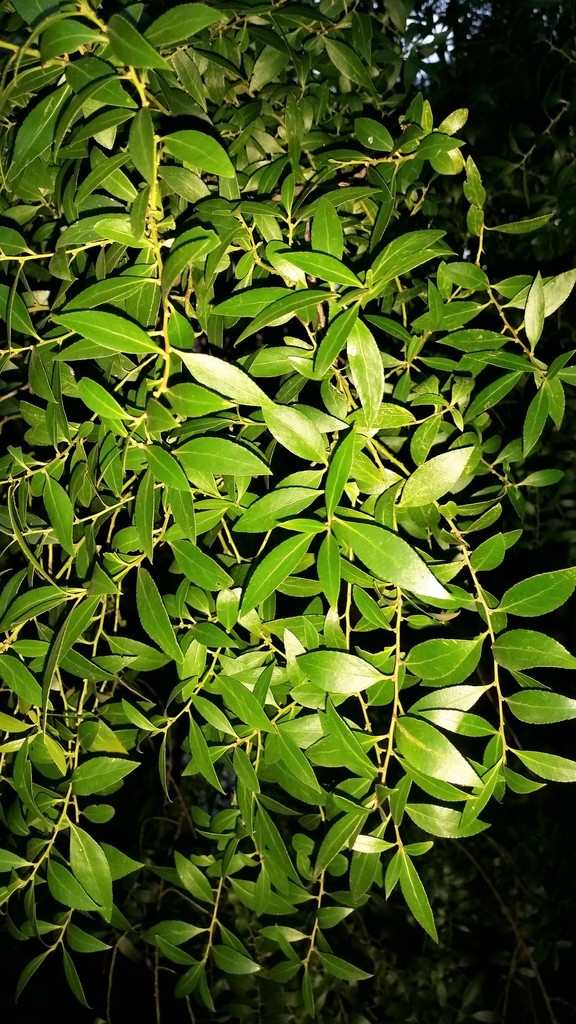
Maiten tree
Maytenus boaria
Maytenus boaria, commonly known as Maitén, is an evergreen tree in the family Celastraceae. It is native to southern South America (Chile, Argentina, Bolivia and southern Brazil). In Chile, it occurs approximately from 30 to 50°S. It can reach dimensions up to 20 m (66 ft) high and 80 cm (31 in) diameter, with a straight trunk.
From the article Maytenus boaria on Wikipedia (CC BY-SA), quoted section by section
Description
Its leaves are small, alternate, elliptical, fine serrate margins, light green color, about 2.5 and 5 cm long. The flowers are small; male flowers are brownish yellow and female are green with purple lines. Its fruit is a yellow bivalve capsule, which contains one or two seeds, and is covered by a red-colored membrane. Its seeds are easy to germinate.
At the table
From its seeds oil is obtained in order to elaborate varnish. The hard wood is used in tool handles and as both ornamental in gardens and reforestation of Chile. European bees produce a very delicious honey from its flowers. Its tender leaves are used to feed cattle, In fact, the name boaria means bovine, because cattle enjoy feeding on them. It is easy to plant by seed. Mayten tree is fully naturalized in New Zealand where it is spreading very rapidly in the Canterbury region, it now classed as an invasive species and illegal to sell or distribute in NZ. A small number of trees have been planted in gardens of California and private collections in Spain, and all of them have acclimatized in those lands. It has been planted in the North Pacific Coast of the United States as far north as Seattle, Washington, and Vancouver, British Columbia.
Wikipedia: “Cultivation and uses”
Where it lives
Recorded sightings
—
geo-referenced records in GBIF, from museums, herbaria and field observers.
Drag the globe to turn it. Dots are where records exist, not a range map; darker means more records.
In the stacks
Searching the stacks…
Every page naming Maytenus boaria in the Biodiversity Heritage Library →
This page is assembled live from iNaturalist, GBIF, Wikipedia, the Source Library and the Internet Archive. It is not yet part of the hand-edited codex. iNaturalist taxon 77969.