- Plants
- ›Vascular Plants
- ›flowering plants
- ›Dicots
- ›Legumes, Milkworts, and Allies
- ›Legumes
- ›Faboideae
- ›brooms, lupines, and allies
- ›Lupinus
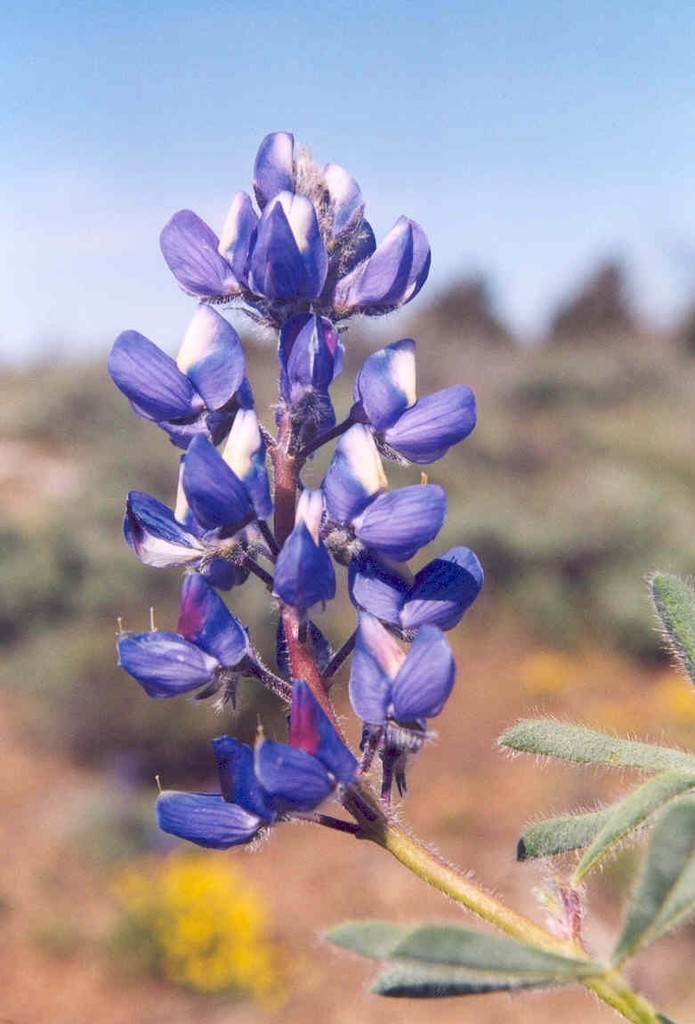
rock lupine
Lupinus saxosus
Lupinus saxosus is a species of lupine known by the common name rock lupine. It is native to the Pacific Northwest and Great Basin of the United States, where it grows in sagebrush and other habitat. This is a perennial herb growing erect 20 to 30 centimeters tall. Each palmate leaf is made up of 7 to 13 hairy leaflets 1 to 4 centimeters long. The inflorescence is a dense raceme of many flowers sometimes arranged...
From the article Lupinus saxosus on Wikipedia (CC BY-SA), quoted section by section
Description
This is a perennial herb growing erect 20 to 30 centimeters (7.9 to 11.8 in) tall. Each palmate leaf is made up of 7 to 13 hairy leaflets 1 to 4 centimeters (0.39 to 1.57 in) long. Stiff long hairs are found on the undersides and edges of the leaves, with no hair on top. The inflorescence is a dense raceme of many flowers sometimes arranged in whorls. The flower is between 1 and 2 centimeters (0.39 and 0.79 in) long and blue in color with a yellowish or violet patch on its banner. The fruit is a shaggy-haired legume pod up to 4 centimeters (1.6 in) in length. The flowering time is early spring. The 8 to 12 leaflets have acute or rounded tips. It is shorter than most lupine species. The bloom period is between the months of May and June. You shouldn’t eat any part of the lupine. It is most commonly found between the elevations of 4,000 to 6,000 feet (1,200 to 1,800 m). 52.3% of the time it was found, it was found in May, and 19.8% of the time, it was found in June.
Range & habitat
This lupine grows in poor rocky soils and is often found in shallow soils that are dry to basalt bedrock by midsummer.
Wikipedia: “Habitat”
Where it lives
Recorded sightings
—
geo-referenced records in GBIF, from museums, herbaria and field observers.
Drag the globe to turn it. Dots are where records exist, not a range map; darker means more records.
In the stacks
Searching the stacks…
Every page naming Lupinus saxosus in the Biodiversity Heritage Library →
This page is assembled live from iNaturalist, GBIF, Wikipedia, the Source Library and the Internet Archive. It is not yet part of the hand-edited codex. iNaturalist taxon 77888.