- Plants
- ›Vascular Plants
- ›flowering plants
- ›Dicots
- ›Nances, Willows, and Allies
- ›St. John's wort family
- ›St. John's worts tribe
- ›Hypericum
- ›Androsaemum
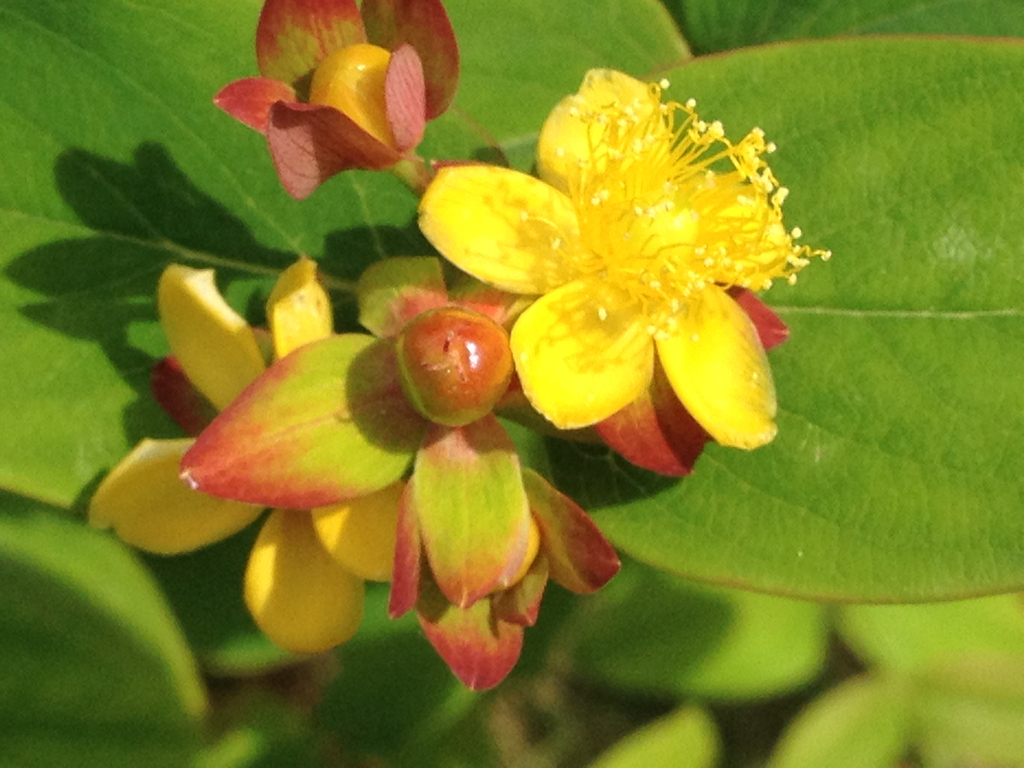
Tutsan
Hypericum androsaemum
Hypericum androsaemum, the shrubby St. John's wort, is a species of flowering plant in the family Hypericaceae. It is commonly called tutsan or sweet-amber. It forms a shrub with oval-shaped leaves and yellow flowers.
The species has been known since before the modern system of taxonomy was developed, and was first described by Carl Linnaeus in 1763. Since then, it has been invalidly published under several synonyms, and was repeatedly placed in its own genus named Androsaemum. When Norman Robson published his monograph of the genus Hypericum in 1996, the species was definitively placed within Hypericum sect. Androsaemum, a small section including several other closely related species.
From the article Hypericum androsaemum on Wikipedia (CC BY-SA), quoted section by section
Description
Hypericum androsaemum is a small bushy shrub, reaching 30–70 centimetres (12–28 in) tall. It has many stems which remain upright and erect instead of creeping over the ground. It has many oval-shaped leaves along its stems which are typically green with a red tint. The leaves have small glands on their surface that can be seen upon close inspection; these are filled with a red pigment. The plant has yellow flowers 1.5–2.5 cm in diameter with five petals and numerous stamens. Uniquely among Hypericum, its berries turn from red to black and remain soft and fleshy even after ripening. The plant's stems are cylindrical in shape when the plant is mature. The bark on the stems has longitudinal grooves or scale-like patterns.
Foliage. The leaves are arranged in opposite pairs without stipules and lack petioles. The leaf blade is 4–12 cm (1.6–4.7 in) long by 2–8 cm (0.8–3.1 in) wide. The leaves lack hairs on either surface and have small oil glands across their surface. When these glands are crushed, they give off a pungent aroma and leak red pigment. There are other translucent glands that are dispersed throughout the mesophyll at differing depths. There are four or five symmetrical pairs of main veins along the leaf that point in the direction of the tip.
Inflorescence. …
Range & habitat
The species has a wide native distribution, but is most densely found in Western Europe. It is particularly abundant across the British Isles (except for in the Scottish Highlands), in the Ardennes forest of Belgium and France, and on the western French coast. Other European populations include the Pyrenees Mountains, across northern Spain and Portugal, and around Genoa and parts of central Italy. Scattered sightings have been reported through Germany and as far north as Denmark, as well as in Switzerland, Austria, and the Balkans. Outside of Europe, H. androsaemum is found in northern Turkey, the North African coast, the Caucasus, and Iran. While it may have at one point been native to the island of Corsica, it is now believed to be extinct there. Hypericum androsaemum has become naturalized or invasive in regions to which it is not native. In Australia, it is densely found in the Otway Ranges, South Gippsland Hills, Dandenong Ranges, the Blue Mountains, and in the area around Mansfield. There are also a few scattered populations on Tasmania, but it is not troublesome there. In New Zealand, it is found on both islands frequently enough to be an encroaching weed. The plant is found in damp and shady areas at a great range of elevations, from low-lying regions up to 1,800 m (5,900 ft). It requires heavy rainfall, typically greater than 750 mm (30 in) of annual precipitation.
Wikipedia: “Distribution and habitat”
What it does
Seeds of H. androsaemum germinate in the fall. They flower when the plant is between 18 and 24 months old, typically from late spring to early summer, with the fruit ripening by late summer. The plant is partially deciduous, losing most of its foliage in the fall but with rapid regrowth every spring.
Invasiveness. In the late 19th century, H. androsaemum was a popular ornamental plant, leading to its widespread dispersal in non-native regions. While its seeds don't have any other special properties that increase their potential for dispersal, they are small and extremely numerous. This allows the seeds to easily contaminate cargo, animals, clothing, vehicles, or other transported items. The species was invasively introduced to Australia in 1865 via the Royal Horticultural Society's botanical garden in Hobart, apparently for use as an ornamental species because of its reddish leaves and bright yellow flowers. In New Zealand, the primary method of invasive dispersal is reportedly by birds. In 2008, Landcare Research began investigating the feasibility of a biological control for the species. The seed and leaf-tip eating moth Lathronympha strigana and the leaf-feeding beetle Chrysolina abchasica were tested and found to be sufficiently host specific and not a risk to native plant species. …
Wikipedia: “Ecology”
At the table
Like many other Hypericum species, H. androsaemum is a medicinal plant used in folk medicine. For example, it is used as a diuretic, to treat sciatica and gout, and to stem bleeding and accelerate healing from burns and minor wounds. Because H. androsaemum does not contain hypericin, a chemical present in other Hypericum species that can cause skin irritation and other undesirable side effects, the plant is more widely used in topical applications and skincare. This trait makes the species useful as an antidepressant as well, and testing has demonstrated that it appears to be at least as effective as H. perforatum in that regard. In Portugal, the leaves are used to treat liver, kidney, and bladder ailments, while in England they are mixed with lard to make an ointment to put on cuts or other wounds. The antioxidant properties of the berries of H. androsaemum have been confirmed in laboratory testing, lending credence to their use in teas as antihepatotoxics or diuretics.
== References ==
Wikipedia: “Uses”
How it is grown
When cultivated, Hypericum androsaemum requires minimal maintenance. The species is generally pest and disease free, and is deer resistant. However, it can be prone to nematodes, which cause root rot; pest insects such as thrips and scale have been noted. Additionally, in hot and humid climates the species is susceptible to wilting and unrelated root rot. It is tolerant of moderately acidic and alkaline soils, and can withstand drought and freezing temperatures down to −20 °C (−4 °F). While the plant performs best if spaced roughly 90 cm (3 ft) apart from others, it will self-sow via seed in its area if allowed, creating ground cover. After the plant has lost its leaves in the fall, it can be cut back if needed and will regrow from the base in the spring. Most Hypericum species are difficult to germinate because of heavy seed dormancy. Hypericum androsaemum exhibits both physiological dormancy and chemical dormancy, meaning that seed germination can be kickstarted by both physical and chemical factors. In particular, room-temperature water or the plant hormone gibberellic acid are most effective at bringing its seeds out of a dormant state.
New specimens are propagated by sowing non-dormant seeds in a 10 °C (50 °F) greenhouse in the spring under a very light layer of soil. Once the seedlings are large enough to handle (after 1–3 months), they are moved into individual pots. …
Wikipedia: “Cultivation”
In human culture
Hypericum androsaemum was known and studied long before the modern system of taxonomy was developed. The species was first formally described in the modern system by Carl Linnaeus. He described the species as Hypericum androsaemum in the second volume of his Species Plantarum in 1763 alongside around twenty other Hypericum species. Compiling several brief notes from other authorities, Linnaeus gave the following description for the plant:In the same entry, Linnaeus noted the species' presence in England and its tendency to be found around fences. This original description and type specimen analysis by Linnaeus remains the basis for the modern definition of the species. However, since that original description numerous illegitimate synonyms have been created for various reasons. In fact, while there is now solid consensus that H. androsaemum belongs within the genus Hypericum, it was placed into a separate genus called Androsaemum as recently as 1893. In 1796, the garden of Chapel Allerton published a list of their plant specimens, noting Hypericum androsaemum as being in their collection, along with the fact it had been described by Linnaeus. However, they still applied two superfluous names (Androsaemum floridum and Hypericum floridum) to their specimens; these names were never accepted as legitimate. …
Wikipedia: “History”
Where it lives
Recorded sightings
—
geo-referenced records in GBIF, from museums, herbaria and field observers.
Drag the globe to turn it. Dots are where records exist, not a range map; darker means more records.
In the old herbals & bestiaries

Notable Commentaries on the History of Plants
Leonhart Fuchs · 1542 · p.110

Notable Commentaries on the History of Plants
Leonhart Fuchs · 1549 · p.108

On Medical Materials in Six Books
Dioscorides · 1550 · p.500

De medicinali materia libri sex
Dioscorides · 1552 · p.508

A New Herbal, or History of Plants
Rembert Dodoens (trans. Henry Lyte) · 1578 · p.91

Six Groups of the History of Plants
Rembert Dodoens · 1583 · p.99
In the stacks
Searching the stacks…
Every page naming Hypericum androsaemum in the Biodiversity Heritage Library →
This page is assembled live from iNaturalist, GBIF, Wikipedia, the Source Library and the Internet Archive. It is not yet part of the hand-edited codex. iNaturalist taxon 77480.