- Plants
- ›Vascular Plants
- ›flowering plants
- ›Dicots
- ›Heathers, Balsams, Primroses, and Allies
- ›phlox family
- ›Gilia
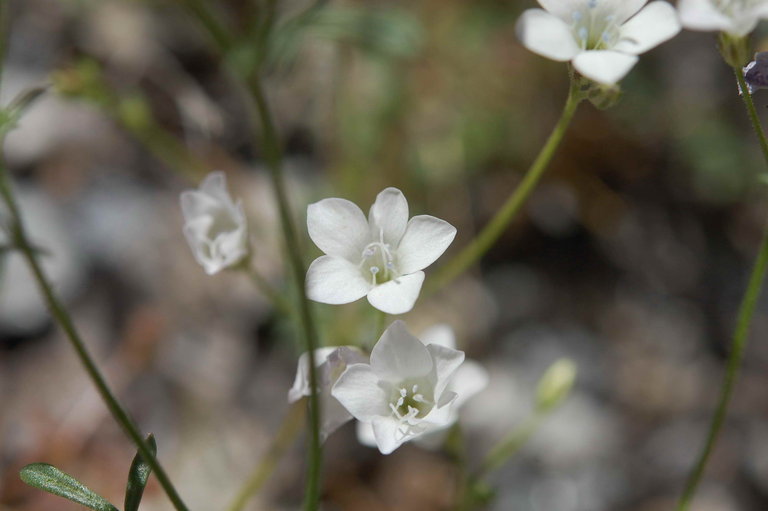
monarch gilia
Gilia yorkii
Gilia yorkii is a rare species of flowering plant in the phlox family known by the common names Boyden Cave gilia and monarch gilia. It is endemic to Fresno County, California, where it is known from only one location in the southern Sierra Nevada. This plant grows in rock cracks in the limestone cliffs and outcrops in the chaparral and woodlands of the canyon.
From the article Gilia yorkii on Wikipedia (CC BY-SA), quoted section by section
Description
This is an annual herb with a hairy, glandular stem up to 25 centimeters tall. The leaves are divided into smooth or toothed lobes, the largest leaves near the base of the plant measuring up to 2.5 centimeters long and the uppermost tiny and reduced. The inflorescence bears several flowers on threadlike, gland-studded pedicels. Each flower has a calyx of green sepals and white or pale blue or lavender tubular corolla just under a centimeter long. The pale color of the corolla helps the plant blend into the rocky surroundings, making it easy to miss.
Range & habitat
It was first discovered on July 31, 1995, near Boyden Cave in the Kings River Canyon, and described to science as a new species in 1998. To date there are only three documented occurrences in the vicinity of Boyden Cave.
Wikipedia: “Distribution”
Where it lives
Recorded sightings
—
geo-referenced records in GBIF, from museums, herbaria and field observers.
Drag the globe to turn it. Dots are where records exist, not a range map; darker means more records.
In the stacks
Searching the stacks…
Every page naming Gilia yorkii in the Biodiversity Heritage Library →
This page is assembled live from iNaturalist, GBIF, Wikipedia, the Source Library and the Internet Archive. It is not yet part of the hand-edited codex. iNaturalist taxon 77278.