- Plants
- ›Vascular Plants
- ›flowering plants
- ›monocots
- ›lilies, supplejacks, and allies
- ›lily family
- ›true lily subfamily
- ›true lilies and allies
- ›Erythronium
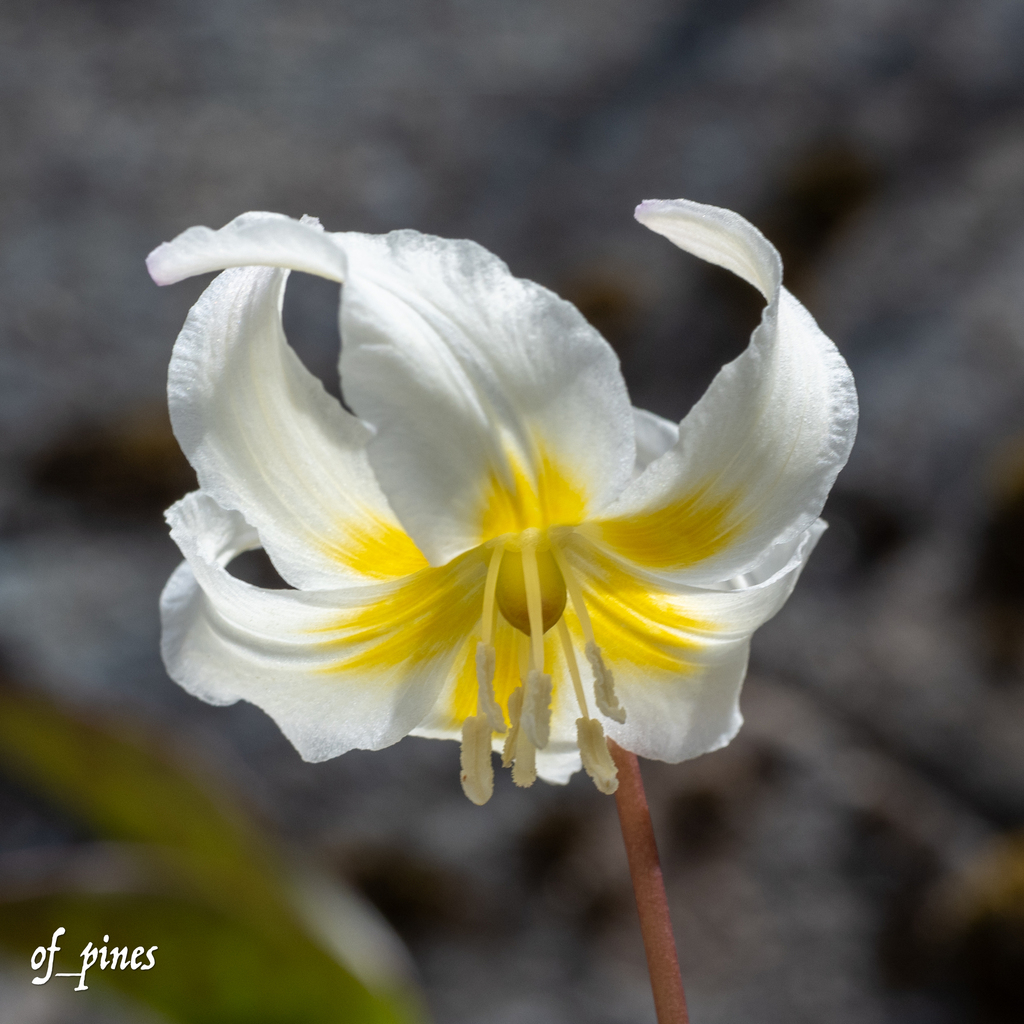
Cream Fawn Lily
Erythronium citrinum
Erythronium citrinum, also known as citrus fawn lily or cream fawn lily, is a member of the lily family that is endemic to the Klamath Mountains. It is found in southwest Oregon and adjacent northwest California. The genus Erythronium, which can be found across northern North America, Europe and Asia, is most diverse in California, which is home to fifteen of about twenty-eight members of the genus.
From the article Erythronium citrinum on Wikipedia (CC BY-SA), quoted section by section
Description
The flowers of Erythronium citrinum are borne on stems that are six to eight inches tall. It has a pair of broad mottled leaves up to about six inches long. The stigma is very shallowly three lobed, and its anthers are white. It grows in the vicinity of Erythronium oregonum, Erythronium howellii, and Erythronium hendersonii. The flower of cream fawn lily is creamy-white with a yellow center. The tips of the tepals turn pinkish as they age. The very similar E. howellii is more restricted in its range and can be distinguished by its lacking of nectariferous appendages on the bases of the inner petals. E. hendersonii, which has a distribution that ends just at the northern boundary of the cream fawn lily, is fairly similar, but is easily distinguished by its purple flowers. E. oregonum, which is wide ranging and fairly abundant in southwest Oregon can be distinguished by its deeply divided three-lobed stigma (whereas E. citrinum is narrowly divided).
Range & habitat
Erythronium citrinum grows in open woods and shrubby slopes, and is more or less confined to serpentine soils. It blooms in early spring and can sometimes be seen blooming in profusion.
Wikipedia: “Distribution and habitat”
Where it lives
Recorded sightings
—
geo-referenced records in GBIF, from museums, herbaria and field observers.
Drag the globe to turn it. Dots are where records exist, not a range map; darker means more records.
In the stacks
Searching the stacks…
Every page naming Erythronium citrinum in the Biodiversity Heritage Library →
This page is assembled live from iNaturalist, GBIF, Wikipedia, the Source Library and the Internet Archive. It is not yet part of the hand-edited codex. iNaturalist taxon 77075.