- Plants
- ›Vascular Plants
- ›flowering plants
- ›Dicots
- ›Roses, Elms, Figs, and Allies
- ›rose family
- ›Amygdaloideae
- ›Maleae
- ›Eriobotrya
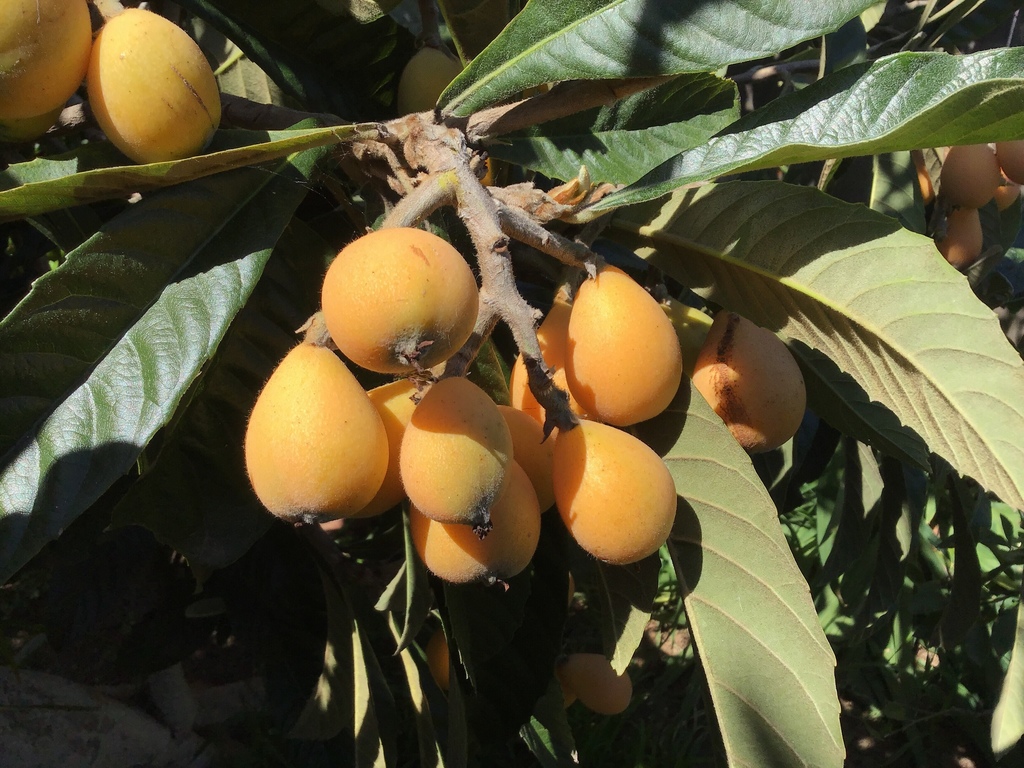
Loquat
Eriobotrya japonica
The loquat (Eriobotrya japonica) (from Cantonese Chinese: 盧橘; Jyutping: lou4gwat1, nowadays called Chinese: 枇杷; pinyin: pípá; Jyutping: pei paa) is a species of flowering plant in the family Rosaceae, a native to the cooler hill regions of China to south-central China. It is also quite common in Japan, Korea, hilly Regions of India (Himachal), Northern Areas of Pakistan and some can be found in some Northern part of the Philippines, and hill country in Sri Lanka.
From the article Loquat on Wikipedia (CC BY-SA), quoted section by section
Description
E. japonica is a large, evergreen shrub or small tree, with a rounded crown, short trunk, and woolly new twigs. The tree can grow to 5–10 m (16–33 ft) tall but is often smaller, about 3–4 m (10–13 ft). The fruit begins to ripen during spring to summer, depending on the temperature in the area. The leaves are alternate, simple, 10–25 cm (4–10 in) long, dark green, and tough and leathery in texture, with a serrated margin, and densely velvety-hairy below with thick yellow-brown pubescence; the young leaves are also densely pubescent above, but this soon rubs off.
Fruit. Loquats are unusual among fruit trees in that the flowers appear in the autumn or early winter, and the fruits are ripe at any time from early spring to early summer. The flowers are 2 cm (3⁄4 in) in diameter, white, with five petals, and produced in stiff panicles of three to 10 flowers, which have a sweet, heady aroma that can be smelled from a distance. Loquat fruits, growing in clusters, are oval, rounded, or pear-shaped, 3–5 cm (1+1⁄8–2 in) long, with a smooth or downy, yellow or orange, sometimes red-blushed skin. The succulent, tangy flesh is white, yellow, or orange and sweet to subacid or acid, depending on the cultivar. Each fruit contains up to ten ovules, with three to five being the most common. …
Range & habitat
The plant is originally from China, where related species can be found growing in the wild. It grows in places where suitable winter temperatures are generally above 10°F or -12°C, such as Georgia, Argentina, Armenia, Afghanistan, Australia, Azerbaijan, Bermuda, Brazil, Chile, Colombia, Greece, Kenya, Syria, India, Iran, Iraq, Lebanon, Türkiye, Israel, Palestine, Jordan, South Africa, the whole Mediterranean Basin, Pakistan, New Zealand, Réunion, Tonga, Central America, Mexico, South America and warmer parts of the United States such as Hawaii, California, Texas, Louisiana, Mississippi, Alabama, Florida, Georgia, South Carolina, with a maximal range comprising coastal Oregon and Washington, southern Tennessee, and most of North Carolina, in places with a favorable humid subtropical climate with relatively mild winters. China is the largest producer worldwide (400,000 t annually), with Spain being the second with 41,487 t annually, half of which is destined for export markets.
Wikipedia: “Distribution and habitat”
At the table
The loquat is low in sodium and high in vitamin A, vitamin B6, dietary fiber, potassium, and manganese. Like most related plants, the seeds (pips) and young leaves of the plant are slightly poisonous, containing small amounts of cyanogenic glycosides (including amygdalin) which release cyanide when digested, though the low concentration and bitter flavour normally prevent enough being eaten to cause harm.
Wikipedia: “Nutrition”
In human culture
The name loquat derives from Cantonese lou4 gwat1 (Chinese: 盧橘; pinyin: lújú; lit. 'black orange'). In Louisiana, many refer to loquats as "misbeliefs" (from the Louisiana Creole word for the tree, mísplís) and they grow in the yards of many homes.
Wikipedia: “Etymology”
Where it lives
Recorded sightings
—
geo-referenced records in GBIF, from museums, herbaria and field observers.
Drag the globe to turn it. Dots are where records exist, not a range map; darker means more records.
In the old herbals & bestiaries

Compendium of Materia Medica
李時珍 · 1596 · p.42

Sancai Tuhui (Vol. 105)
王圻, 王思義 · 1609 · p.50

Flora Sinensis (Chinese-Latin Natural History)
Michał Boym · 1656 · p.41

Selected Illustrations of Plants Collected in Japan
Engelbert Kaempfer · 1712 · p.52

Illustrated Investigation of the Names and Realities of Plants
吳其濬 · 1848 · p.48
In the stacks
Searching the stacks…
Every page naming Eriobotrya japonica in the Biodiversity Heritage Library →
This page is assembled live from iNaturalist, GBIF, Wikipedia, the Source Library and the Internet Archive. It is not yet part of the hand-edited codex. iNaturalist taxon 76949.