- Plants
- ›Vascular Plants
- ›flowering plants
- ›Dicots
- ›Sunflowers, Bellflowers, Fanflowers, and Allies
- ›Sunflowers, Daisies, Asters, and Allies
- ›Asteroideae
- ›asters and allies
- ›Conyzinae
- ›Erigeron
- ›Conyza
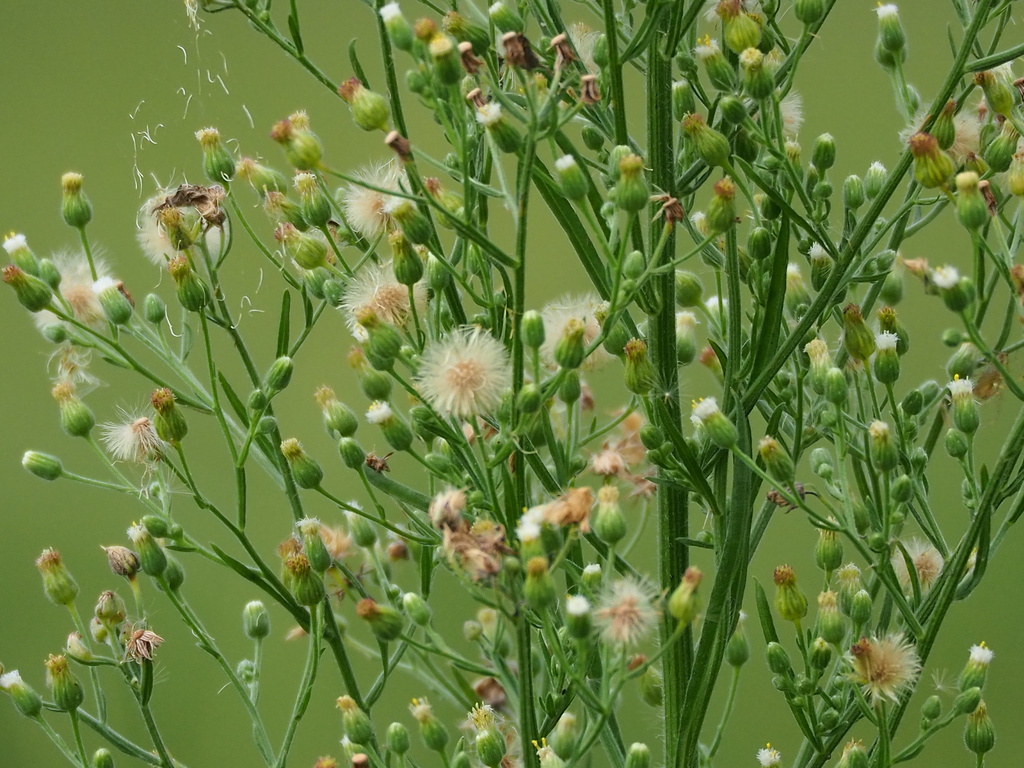
tropical horseweed
Erigeron sumatrensis
Erigeron sumatrensis (syn. Conyza sumatrensis) is an annual herb probably native to South America, but widely naturalised in tropical and subtropical regions, and regarded as an invasive weed in many places.It is a perennial in the Western Cape of South Africa.
In the British Isles it is known as Guernsey fleabane. Other common names include fleabane, tall fleabane, broad-leaved fleabane, white horseweed, and Sumatran fleabane.
From the article Erigeron sumatrensis on Wikipedia (CC BY-SA), quoted section by section
Description
When fully grown (in summer or autumn), Erigeron sumatrensis reaches 1 to 2 metres (3.3 to 6.6 ft) in height. Flowers are white rather than purple-pink. Its leaves are like dandelion leaves, but longer, thinner and more like primrose leaves in colour and texture. Its seeding heads are like dandelions, but straw coloured and smaller. In certain countries the plant has started to exhibit resistance to herbicides.
Range & habitat
It probably originates from South America, but is now naturalised in North America, Europe, Africa, Asia, and Australasia. It poses a significant threat to wildlife conservation areas and other reserves. In Britain, of the non-native former Conyza species, it is the second most abundant (after Erigeron canadensis) and is typically found in London and the South East of England. It was first recorded in London by Brian Wurzell in 1984, and noted in France at Saint-Sozy (Dordogne) in 2006.
Wikipedia: “Distribution”
Where it lives
Recorded sightings
—
geo-referenced records in GBIF, from museums, herbaria and field observers.
Drag the globe to turn it. Dots are where records exist, not a range map; darker means more records.
In the stacks
Searching the stacks…
Every page naming Erigeron sumatrensis in the Biodiversity Heritage Library →
This page is assembled live from iNaturalist, GBIF, Wikipedia, the Source Library and the Internet Archive. It is not yet part of the hand-edited codex. iNaturalist taxon 76943.