- Plants
- ›Vascular Plants
- ›flowering plants
- ›Dicots
- ›Sunflowers, Bellflowers, Fanflowers, and Allies
- ›Sunflowers, Daisies, Asters, and Allies
- ›Asteroideae
- ›asters and allies
- ›Conyzinae
- ›Erigeron
- ›Karvinskia
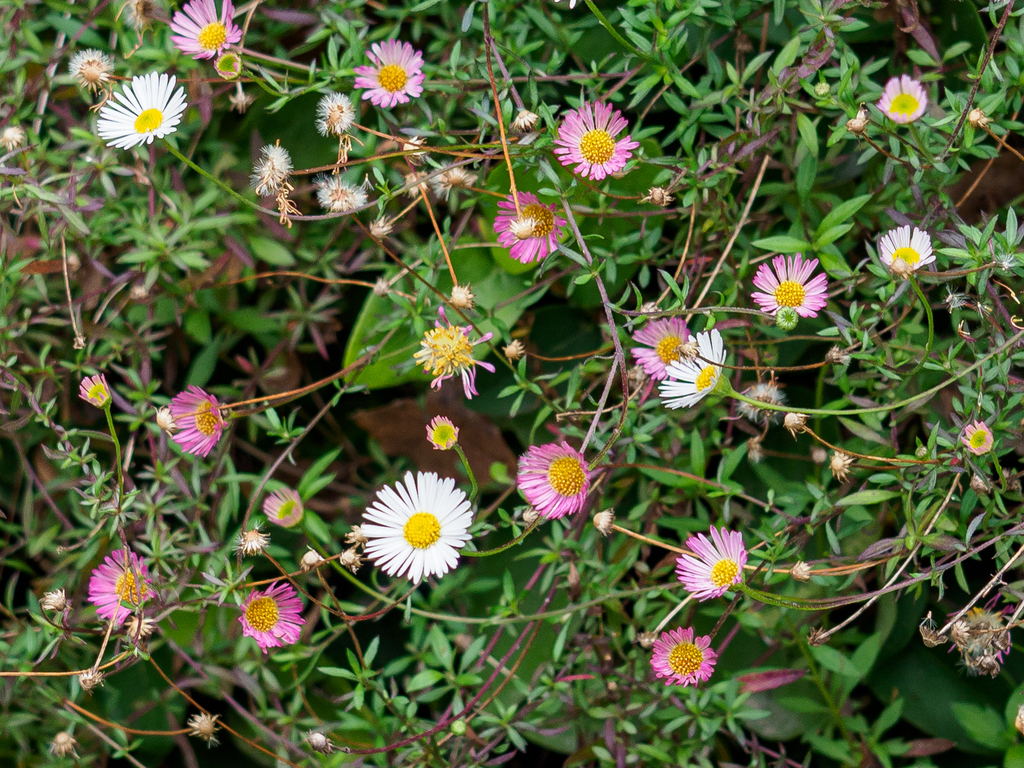
Mexican Fleabane
Erigeron karvinskianus
Erigeron karvinskianus, the Mexican fleabane, is a species of daisy-like flowering plant in the family Asteraceae, native to Mexico and parts of Central America.
Other common names include Latin American fleabane, Santa Barbara daisy, Spanish daisy, Karwinsky's fleabane, or bony-tip fleabane.
From the article Erigeron karvinskianus on Wikipedia (CC BY-SA), quoted section by section
Description
It is a vigorous, spreading perennial plant growing from woody rhizomes to a maximum height of 15 cm (5.9 in). Its leaves are located along the stem, the basal leaves dying off as the plant bolts. They are sometimes slightly toothed or lobed near the tips. The inflorescences hold one or more flower heads which are each about 1 cm (0.4 inches) wide. They have golden yellow disc florets in the center surrounded by a fringe of up to 80 white to pinkish ray florets.
Range & habitat
Erigeron karvinskianus is native to much of Mexico, Central America, Colombia and Venezuela. and is naturalized in many other places, including parts of Africa and Europe, Australia, Hong Kong, Chile, the west coast of the United States, and New Zealand, where it is a weed species that impacts native forest restoration.
Wikipedia: “Distribution”
How it is grown
Erigeron karvinskianus is also cultivated for its daisy-like blooms, and is often confused with the closely related true daisy Bellis perennis. It is frequently grown in crevices in walls or paving, where it rapidly spreads to provide a carpet of flowers. It has gained the Royal Horticultural Society's Award of Garden Merit. It was used to colonise the concrete terraces of the football stadium (Estadio Azteca) built in Mexico City for the 1970 World Cup.
Wikipedia: “Cultivation”
Where it lives
Recorded sightings
—
geo-referenced records in GBIF, from museums, herbaria and field observers.
Drag the globe to turn it. Dots are where records exist, not a range map; darker means more records.
In the stacks
Searching the stacks…
Every page naming Erigeron karvinskianus in the Biodiversity Heritage Library →
This page is assembled live from iNaturalist, GBIF, Wikipedia, the Source Library and the Internet Archive. It is not yet part of the hand-edited codex. iNaturalist taxon 76923.