- Plants
- ›Vascular Plants
- ›flowering plants
- ›Dicots
- ›Sunflowers, Bellflowers, Fanflowers, and Allies
- ›Sunflowers, Daisies, Asters, and Allies
- ›Asteroideae
- ›asters and allies
- ›Pentachaetinae
- ›Ericameria
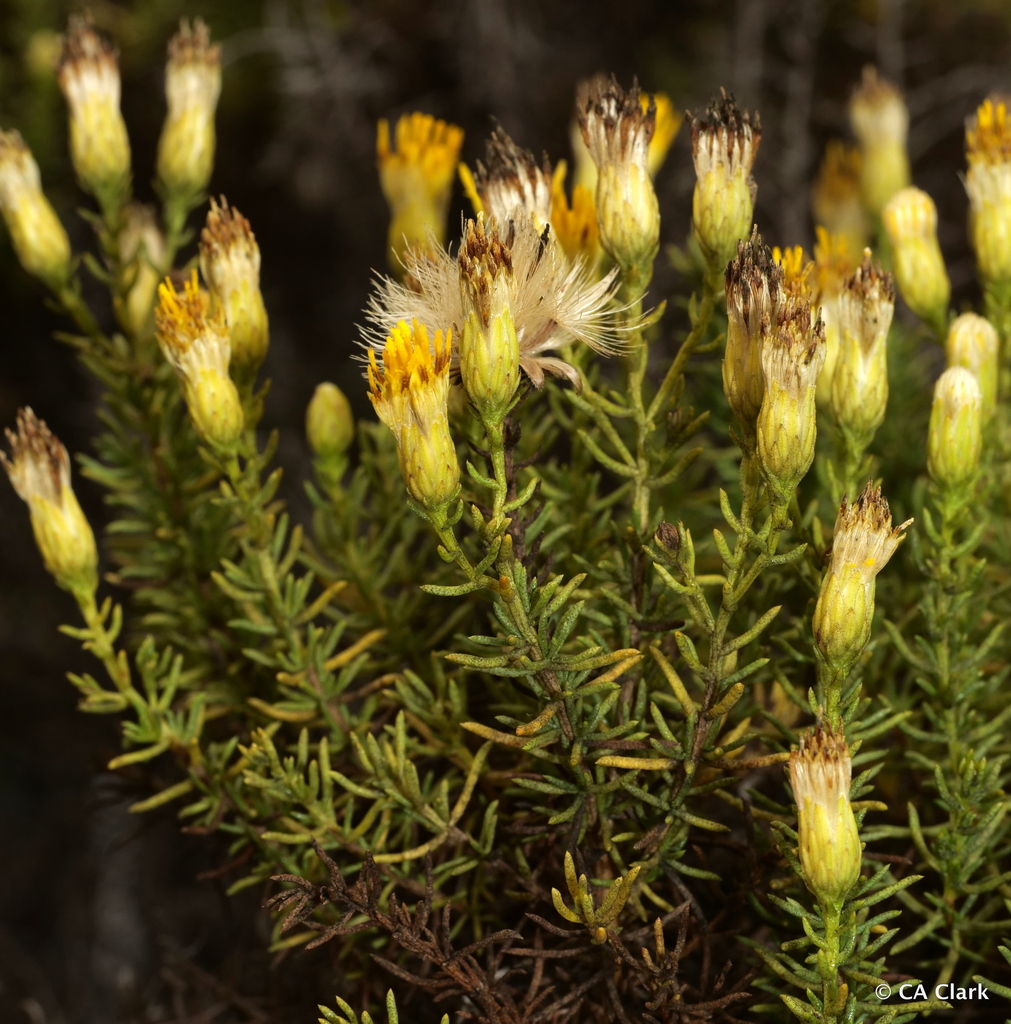
Eastwood's goldenbush
Ericameria fasciculata
Ericameria fasciculata is a rare species of flowering shrub in the family Asteraceae known by the common name Eastwood's goldenbush. It is endemic to northern California, where it is known from fewer than twenty locations. Many sources described it as found only in Monterey County, but the Calflora database maintained by the University of California reports additional collections from nearby Santa Cruz and Santa Clara Counties. These collections are, however, from inhabited regions and might represent either introductions or cultivated specimens.
Ericameria fasciculata grows on sandy soils in chaparral, woodland, and scrub habitat, and sometimes appears in disturbed habitat along roadsides. This is a dense, bushy shrub approaching 50 cm (20 inches) in maximum height, its many glandular branches lined with needlelike leaves 1 to 2 centimeters (0.4-0.8 inches) long. The inflorescence consists of one or more small, cylindrical flower heads lined with yellowish phyllaries. Each head contains many yellow disc florets and sometimes one or two ray florets as well. The fruit is an achene a few millimeters long topped with a brown or white pappus.
Where it lives
Recorded sightings
—
geo-referenced records in GBIF, from museums, herbaria and field observers.
Drag the globe to turn it. Dots are where records exist, not a range map; darker means more records.
In the stacks
Searching the stacks…
Every page naming Ericameria fasciculata in the Biodiversity Heritage Library →
This page is assembled live from iNaturalist, GBIF, Wikipedia, the Source Library and the Internet Archive. It is not yet part of the hand-edited codex. iNaturalist taxon 76882.