- Plants
- ›Vascular Plants
- ›flowering plants
- ›Dicots
- ›saxifrages, stonecrops, and allies
- ›stonecrop family
- ›Sempervivoideae
- ›Sedeae
- ›Dudleya
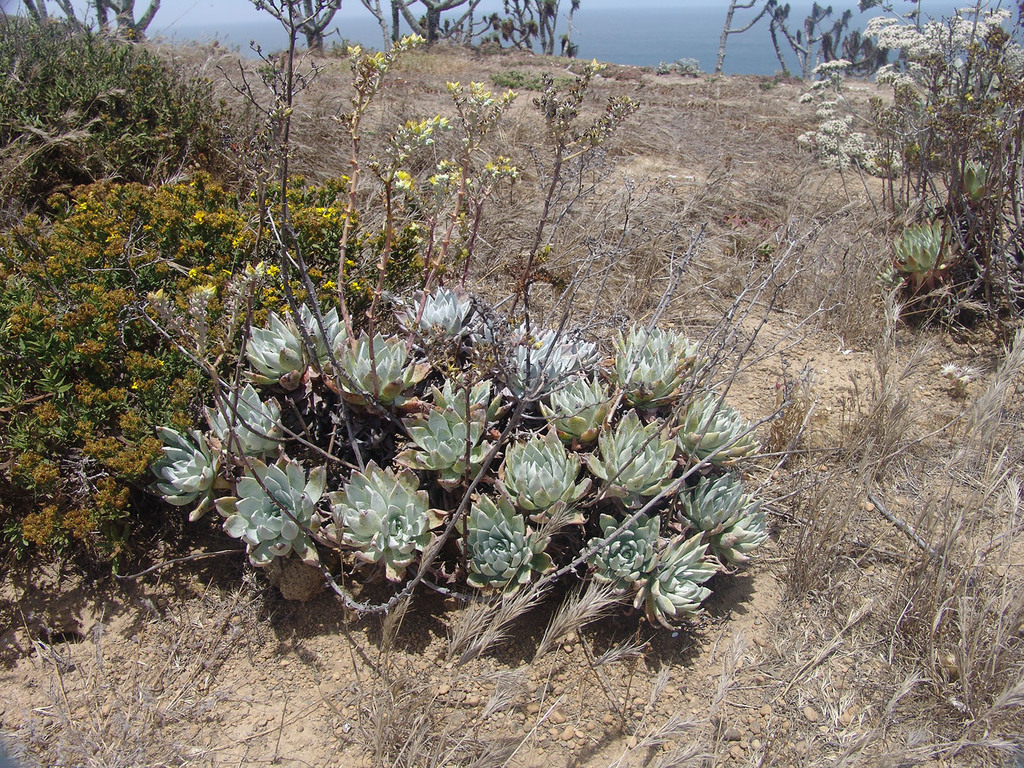
Santa Barbara Island Dudleya
Dudleya traskiae
Dudleya traskiae (originally spelled Dudleya traskae) is a rare succulent plant known by the common name Santa Barbara Island liveforever. This Dudleya is endemic to Santa Barbara Island, one of the Channel Islands of California, where it grows on rocky bluffs. The plant has a basal rosette of flat, spade-shaped fleshy leaves up to 15 centimeters long, which are pale green to yellowish. It erects tall stems bearing dense, rounded inflorescences of many bright yellow flowers.
From the article Dudleya traskiae on Wikipedia (CC BY-SA), quoted section by section
Description
Dudleya traskiae is a perennial succulent herb with foliage leaves in a basal rosette. The plants are evergreen, with a branched primary stem (caudex) and are composed of one to several hundred rosettes. The branching of the stem is dichotomous. The rosette leaves number 25–35, are strap-shaped - oblanceolate to subacuminate and are 4–15 cm long and 1–4 cm wide. Leaves may be green or glaucous with a waxy covering. The flowering stems are axillary and flowering is indeterminate in paniculate or cymose clusters. The petals (5) are bright yellow, often with red veins, fused below and curving outward in the upper half. Stamens (10) are borne on the corolla tube. The fruit is composed of 5 carpels that are spreading in age, 7–8 mm long. Seeds are many and minute, narrow and pointed. Dudleya traskiae is tetraploid with a chromosome number of 34. Flowering most commonly occurs from May–July, although flowering may begin as early as mid-February.
Range & habitat
The genus Dudleya is primarily Californian, though it also extends north into southern Oregon, east to central Arizona and southern Nevada, and south to the tip of Baja California, Mexico. Dudleya taxa occur on each of the eight Channel Islands. Dudleya traskiae is known only from Santa Barbara Island, California.
There are ten occurrences on this 652-acre island. All of the known sites supporting Dudleya traskiae are in rocky areas on the steep slopes of the island's perimeter or on outcrops within shallow canyons where vegetation is low-growing. With the exception of a small population on the far western portion of the island, all locations, historic as well as present day (as of 1989) occur on the eastern, southeastern and southwestern slopes of the island. No Dudleya traskiae plants presently occur on the northern and north-western sides of the island although they do occur elsewhere on north-facing slopes. The habitat of Dudleya traskiae has been described as a maritime cactus scrub, and by Holland (1986) as southern coastal bluff scrub. This assemblage of plants, characterized by cholla (Cylindropuntia prolifera), prickly pear (O. oricola and O. littoralis), boxthorn (Lycium californicum), Santa Barbara Island buckwheat (Eriogonum giganteum ssp. compactum) and annual forbs and grasses, is restricted to the perimeter of the island and south-facing slopes of the canyons.
Wikipedia: “Distribution and habitat”
Where it lives
Recorded sightings
—
geo-referenced records in GBIF, from museums, herbaria and field observers.
Drag the globe to turn it. Dots are where records exist, not a range map; darker means more records.
In the stacks
Searching the stacks…
Every page naming Dudleya traskiae in the Biodiversity Heritage Library →
This page is assembled live from iNaturalist, GBIF, Wikipedia, the Source Library and the Internet Archive. It is not yet part of the hand-edited codex. iNaturalist taxon 76740.