- Plants
- ›Vascular Plants
- ›flowering plants
- ›Dicots
- ›saxifrages, stonecrops, and allies
- ›stonecrop family
- ›Sempervivoideae
- ›Sedeae
- ›Dudleya
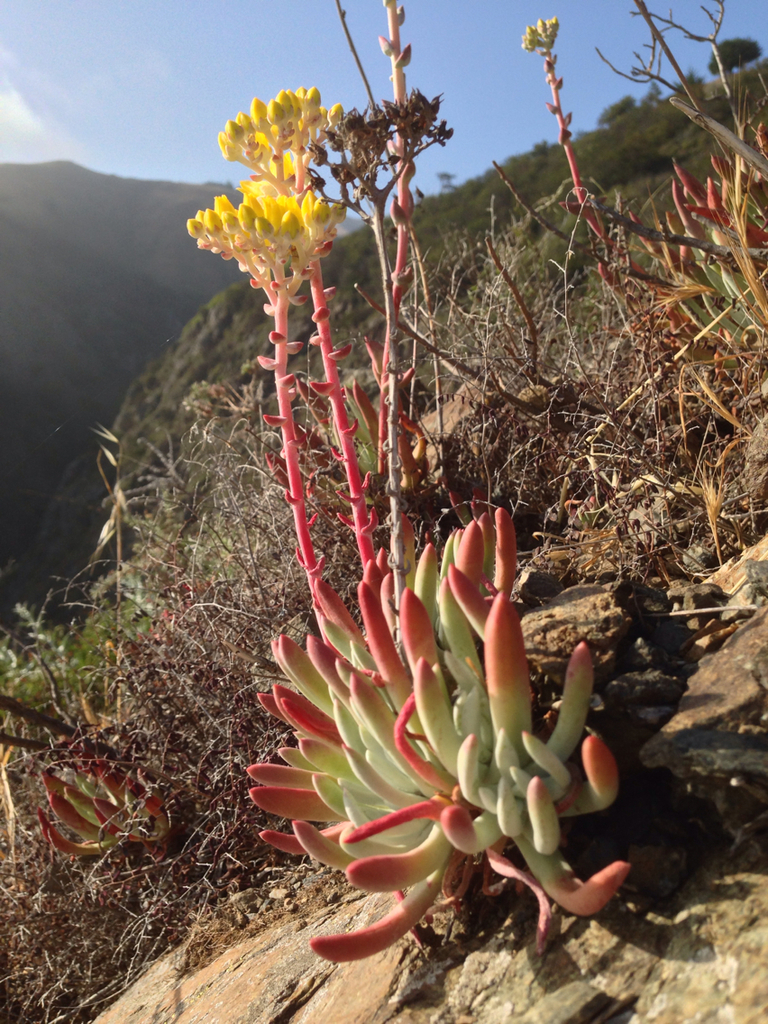
Coast Dudleya
Dudleya cespitosa
Dudleya caespitosa is a succulent plant known by several common names, including sea lettuce, sand lettuce, and coast dudleya. It is endemic to California, where it grows along the coastline in the southern half of the state. Taxonomically, this species is a highly variable complex of polymorphic and polyploid plants, closely related to numerous neighboring species such as Dudleya farinosa, Dudleya greenei and Dudleya palmeri. It is delimited from neighboring species on an arbitrary basis of distribution and chromosome number, and may not be immediately separable from the other species it approaches.
From the article Dudleya caespitosa on Wikipedia (CC BY-SA), quoted section by section
Range & habitat
This plant is common and is found along the coast of California. Because the delimitation of the plant is based on arbitrary characteristics, the exact biogeographical distribution is difficult to pin down. The 2012 Jepson Treatment places the northern limit on the southern North Coast of the California Floristic Province. Plants identified with Dudleya caespitosa are found in the north from Point Reyes south to Malibu.
Wikipedia: “Distribution and habitat”
What it does
On the central coast of California near Santa Maria, numerous oil refineries exist, pumping phytotoxic sulfur dioxide. While plants like Salvia mellifera (black sage) were affected, Dudleya caespitosa proved to be somewhat tolerant of the emissions. This is likely due to the fact that Dudleya caespitosa uses CAM photosynthesis, which means their stomata open in the evening hours. Combined with the effect of southeast winds at night that blow away the emissions, the Dudleya avoid the phytotoxic emissions through this combination of meteorological conditions and CAM photosynthesis.
Wikipedia: “Ecology”
In human culture
The plant was first described in 1803 by Adrian Hardy Haworth as Cotyledon caespitosa (the basionym). The original text erroneously cited it as from the Cape of Good Hope. The same species would later be described again as Sedum cotyledon by Joseph Franz von Jacquin and as Cotyledon linguiformis by Brown, both in 1811. In 1849, Lindley described the plant as Echeveria laxa, noting it as a very distinct looking plant, "but not one that is handsome." The plant was described in its current form by Nathaniel Lord Britton and Joseph Nelson Rose in their revision of North American Crassulaceae, which created the genus Dudleya.
Wikipedia: “Taxonomic history”
Where it lives
Recorded sightings
—
geo-referenced records in GBIF, from museums, herbaria and field observers.
Drag the globe to turn it. Dots are where records exist, not a range map; darker means more records.
In the stacks
Searching the stacks…
Every page naming Dudleya cespitosa in the Biodiversity Heritage Library →
This page is assembled live from iNaturalist, GBIF, Wikipedia, the Source Library and the Internet Archive. It is not yet part of the hand-edited codex. iNaturalist taxon 76727.