- Plants
- ›Vascular Plants
- ›flowering plants
- ›Dicots
- ›Legumes, Milkworts, and Allies
- ›Legumes
- ›Faboideae
- ›Amorpheae
- ›Dalea
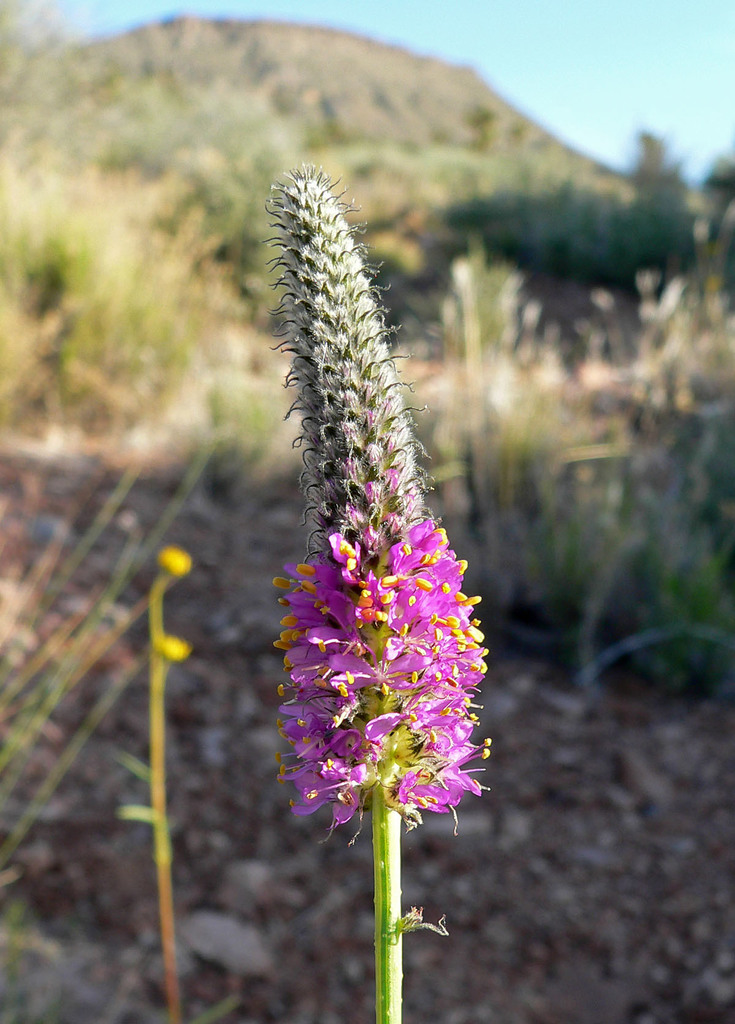
Searls' Prairie Clover
Dalea searlsiae
Dalea searlsiae, commonly known as Searls' prairie clover, is a perennial legume species belonging to the Dalea genus. The species is found through arid regions of the southwestern United States and can survive in low moisture conditions. The species forms symbiotic relationships with nitrogen-fixing bacteria that can improve soil nutrient levels. Its large inflorescence attracts many species of pollinators, and it lacks toxins found in similar legume species. As a result, the species has been considered for use in rangeland restoration and revegetation projects.
From the article Dalea searlsiae on Wikipedia (CC BY-SA), quoted section by section
Range & habitat
Searls’ prairie clover is native to the southwestern United States. While the plant is rarer than many legume species, metapopulations can be found in southeastern California, Utah, Nevada, and Arizona. Little is known about their distribution south of US-Mexico border.
Wikipedia: “Geographical distribution”
What it does
Most of the ecology of Searls' prairie clover has been studied in relation to symbioses and herbivory.
Rhizobial symbiosis. As with most legumes, Searls’ prairie clover forms symbiotic associations with nitrogen-fixing Rhizobia bacteria. This symbiosis improves soil nitrogen content and adds to the nutritional forage quality for herbivorous animals. Commercial inoculant is available for D. searlsiae, but little research has been done to study the rhizobial-legume symbiosis of the species.
Pollination. While the species is capable of self-pollinating in the absence of pollinators, it prefers to cross-pollinate when possible. Pollination studies have shown self-pollination leads to a significantly reduced seed count with most seeds being inviable. Presence of Searls' prairie clover leads to a diverse pollinator community in the ecosystem. Bee species are the primary pollinator of D. searlsiae. Twenty-two species of native bees have been identified as main pollinators of Searls' prairie clover. These include species of potter bees (Anthidium spp.), bumblebees (Bombus spp.), plaster bees (Colletes spp.), and long-horned bees (Eucera and Melissodes spp.). In addition, various species of wasps, flies, and butterflies are also important non-bee pollinators.
Herbivory. Compared to other legumes, Searls’ prairie clover is a suitable herbivore food source as it lacks toxic compounds. …
Wikipedia: “Ecology”
How it is grown
Dalea searlsiae is typically found in desert shrublands and forested woodlands. Among forested regions of the southwestern United States, it is abundant in pine-juniper forests and rarer in spruce-fir forests. They are capable of surviving in a wide variety of soil conditions ranging from clay-rich to sandy substrates to rocky flats, however their biological fitness and yield declines in high clay. They are most common in lime-rich soils. D. searlsiae, being an interior species, is found at elevations ranging between 1000-2800m above sea level.
Wikipedia: “Habitat and growing conditions”
In human culture
Self-taught British botanist Rupert Charles Barneby formally named the species and is responsible for characterizing much of the endemic new world legume species. The species was named after 19-year-old American botanist Fanny Searls. She was the first to collect a specimen of this species, in 1871.
Wikipedia: “Etymology”
Where it lives
Recorded sightings
—
geo-referenced records in GBIF, from museums, herbaria and field observers.
Drag the globe to turn it. Dots are where records exist, not a range map; darker means more records.
In the stacks
Searching the stacks…
Every page naming Dalea searlsiae in the Biodiversity Heritage Library →
This page is assembled live from iNaturalist, GBIF, Wikipedia, the Source Library and the Internet Archive. It is not yet part of the hand-edited codex. iNaturalist taxon 76602.