- Plants
- ›Vascular Plants
- ›flowering plants
- ›Dicots
- ›begonias, gourds, and allies
- ›gourd family
- ›Cucurbiteae
- ›Cucurbita
- ›Cucurbita pepo
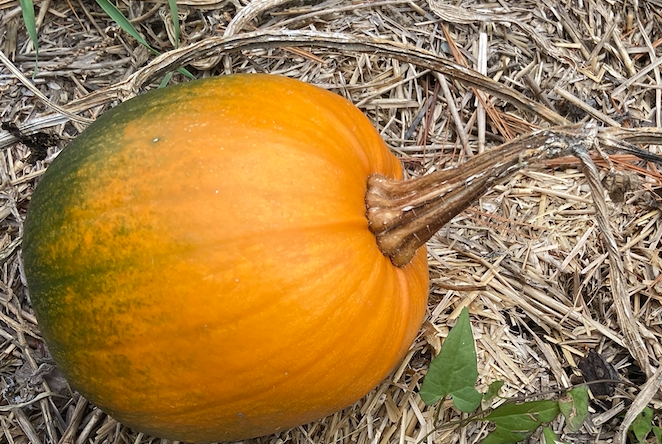
American pumpkin
Cucurbita pepo
Cucurbita pepo is a cultivated plant of the genus Cucurbita. It yields varieties of winter squash and pumpkin, but the most widespread varieties belong to the subspecies Cucurbita pepo subsp. pepo, called summer squash.
It has been domesticated in the Americas for thousands of years, from where it was spread by early colonisers to Europe and later across the rest of the Old World in the context of the Columbian Exchange. Some authors maintain that C. pepo is derived from C. texana, while others suggest that C. texana is merely feral C. pepo. They have a wide variety of uses, especially as a food source. C. pepo seems more closely related to C. fraterna, though disagreements exist about the exact nature of that connection, too.
From the article Cucurbita pepo on Wikipedia (CC BY-SA), quoted section by section
Description
Due to their varied genetic background, members of C. pepo vary widely in appearance, primarily in regards to their fruits. The plants are typically 30–76 centimetres (1–2+1⁄2 ft) high and 61–91 cm (2–3 ft) wide, with yellow flowers. Within C. pepo, the pumpkins, scallops, and possibly crooknecks are ancient and were domesticated separately. The domesticated species have larger fruits and larger yet fewer seeds. Parthenocarpy is known to occur in certain cultivars of C. pepo. The leaves have three to five lobes and are 20–35 centimetres (8–14 in) wide. All the subspecies, varieties, and cultivars are conspecific and interfertile.
At the table
Fresh squash is cut into spiral strips, folded into hanks and hung up to dry for winter use. The blossoms are fried in grease and used as a delicacy in combination with other foods. Fresh squash, either whole or in pieces, is roasted in ashes and used for food. In the Zuni culture, the gourds are made into cups, ladles, dippers, and storage receptacles. A poultice of seeds and blossoms was used to treat cactus scratches.
Wikipedia: “Uses”
In human culture
C. pepo is one of the oldest, if not the oldest domesticated species. The oldest known locations are in southern Mexico in Oaxaca 8,000–10,000 years ago and Ocampo, Tamaulipas, Mexico about 7,000 years ago. Before the arrival of Europeans, C. pepo, along with C. moschata, had been carried over all parts of North America where they could be grown. The ancient territory of C. pepo extended north into Texas and up the Greater Mississippi River Valley into Illinois and east to Florida, and possibly even to Maine. It is one of several plants cultivated in prehistoric North America as part of the Eastern Agricultural Complex. It is known to have appeared in Missouri at least 4,000 years ago. Some varieties grow in arid regions and some in moist regions. Many of these peoples, particularly in the west, still grow a diversity of hardy squashes and pumpkins not to be found in commercial markets. Still, neither C. pepo nor C. moschata had been carried into South America as had beans, which originated in the same general region. Debates about the origin of C. pepo have been going on since at least 1857. Recent biosystematic investigations indicate two distinct domestication events in two different areas: one in Mexico and one in the eastern United States, with C. pepo subsp. fraterna and C. pepo subsp. …
Wikipedia: “Origin and history”
Where it lives
Recorded sightings
—
geo-referenced records in GBIF, from museums, herbaria and field observers.
Drag the globe to turn it. Dots are where records exist, not a range map; darker means more records.
In the stacks
Searching the stacks…
Every page naming Cucurbita pepo in the Biodiversity Heritage Library →
This page is assembled live from iNaturalist, GBIF, Wikipedia, the Source Library and the Internet Archive. It is not yet part of the hand-edited codex. iNaturalist taxon 76541.