On eBird ↗
American Dipper
Live sightings near you, the range map, bar charts of when it is seen, and Macaulay Library photos and recordings.
American Dipper
Cinclus mexicanus
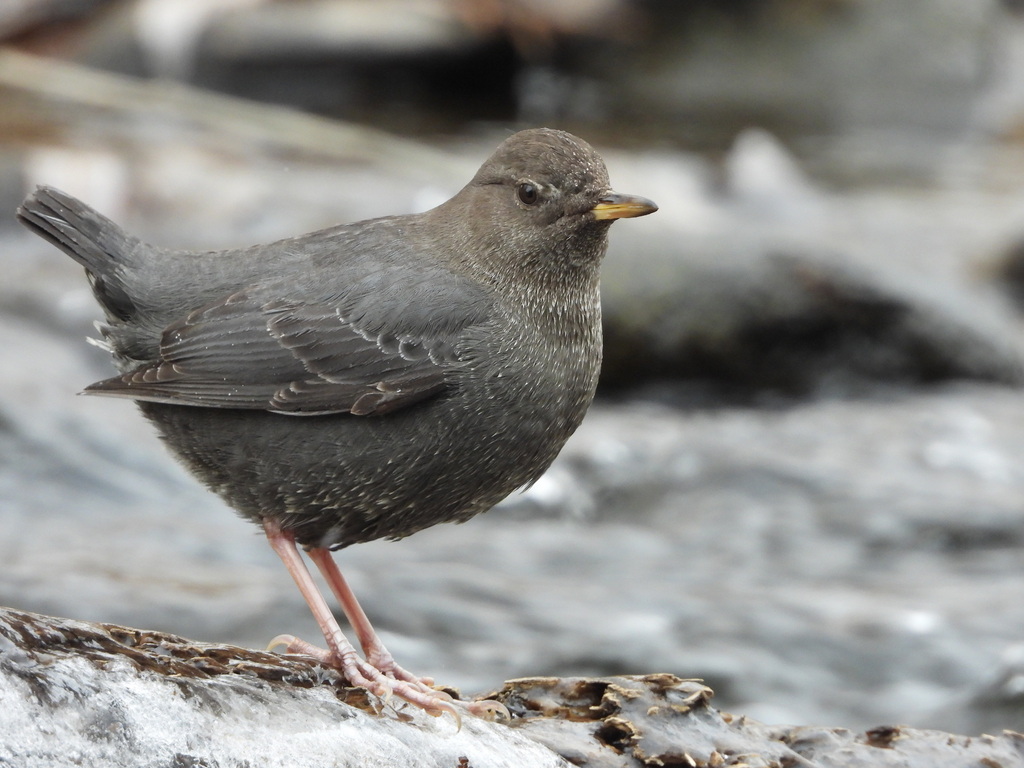
The American dipper (Cinclus mexicanus), also known as a water ouzel, is a stocky dark grey bird with a head sometimes tinged with brown, and white feathers on the eyelids that cause the eyes to flash white as the bird blinks. It is 16.5 cm long and weighs on average 46 g. It has long legs, and bobs its whole body up and down during pauses as it feeds on the bottom of fast-moving, rocky streams. It...
From the article American dipper on Wikipedia (CC BY-SA), quoted section by section
Description
The American dipper is a stocky, grey bird with a head sometimes tinged with brown, and white feathers on the eyelids that cause the eyes to flash white as the bird blinks. On average, it measures 16.5 cm (6.5 in) in length, has a wingspan of 23 cm (9.1 in), and weighs 46 g (1.6 oz).
Range & habitat
The American dipper inhabits the mountainous regions of western North America and Central America, from Alaska to Panama. It is usually a permanent resident, moving slightly south or to lower elevations if necessary to find food or unfrozen water. The presence of this indicator species shows good water quality; it has vanished from some locations due to pollution or increased silt load in streams.
Wikipedia: “Distribution and habitat”
What it does
The American dipper defends a linear territory along streams. In most of its habits, it closely resembles its European counterpart, the white-throated dipper (Cinclus cinclus), which is also sometimes known as a water ouzel. American Dippers are North America's only aquatic songbird, being able to walk under water. It is known for rhythimically bobbing its body up and down, the origin of its name.
Breeding. The American dipper's nest is a globe-shaped structure with a side entrance, close to water, on a rock ledge, river bank, behind a waterfall, or under a bridge. The normal clutch is two to four white eggs, incubated solely by the female, which hatch after about 15–17 days, with another 20–25 days to fledging. The male helps to feed the young. The maximum recorded age from ring-recovery data of an American dipper is 8 years and 1 month for a bird ringed and recovered in South Dakota.
Feeding. It feeds on aquatic insects and their larvae, including dragonfly nymphs, small crayfish, and caddisfly larvae. It may also take tiny fish or tadpoles.
Predators. Dippers may occasionally be preyed on by predatory fish such as by brook, bull or Dolly Varden trout.
Wikipedia: “Behaviour and ecology”
In human culture
The American dipper, previously known as the waternouzel, was the favorite bird of famous naturalist John Muir. He dedicated an entire chapter in his book The Mountains of California to the ouzel, stating, "He is the mountain streams' own darling, the hummingbird of blooming waters, loving rocky ripple-slopes, and sheets of foam as a bee loves flowers, as a lark loves sunshine and meadows. Among all the mountain birds, none has cheered me so much in my lonely wanderings, —none so unfailingly. For both in winter and summer he sings, sweetly, cheerily, independent alike of sunshine and of love, requiring no other inspiration than the stream on which he dwells. While water sings, so must he, in heat or cold, calm or storm, ever attuning his voice in sure accord; low in the drought of summer and the drought of winter, but never silent."
Wikipedia: “History”
Listen
Looking for field recordings…
Where it lives
Recorded sightings
—
geo-referenced records in GBIF, from museums, herbaria and field observers.
Drag the globe to turn it. Dots are where records exist, not a range map; darker means more records.
In the stacks
Searching the stacks…
Every page naming Cinclus mexicanus in the Biodiversity Heritage Library →
This page is assembled live from iNaturalist, GBIF, Wikipedia, the Source Library and the Internet Archive. It is not yet part of the hand-edited codex. iNaturalist taxon 7643.