- Plants
- ›Vascular Plants
- ›flowering plants
- ›Dicots
- ›Sunflowers, Bellflowers, Fanflowers, and Allies
- ›Sunflowers, Daisies, Asters, and Allies
- ›chicories, dandelions, and allies
- ›Lettuce, Chicory, Dandelion and Salsify Tribe
- ›Chondrillinae
- ›Chondrilla
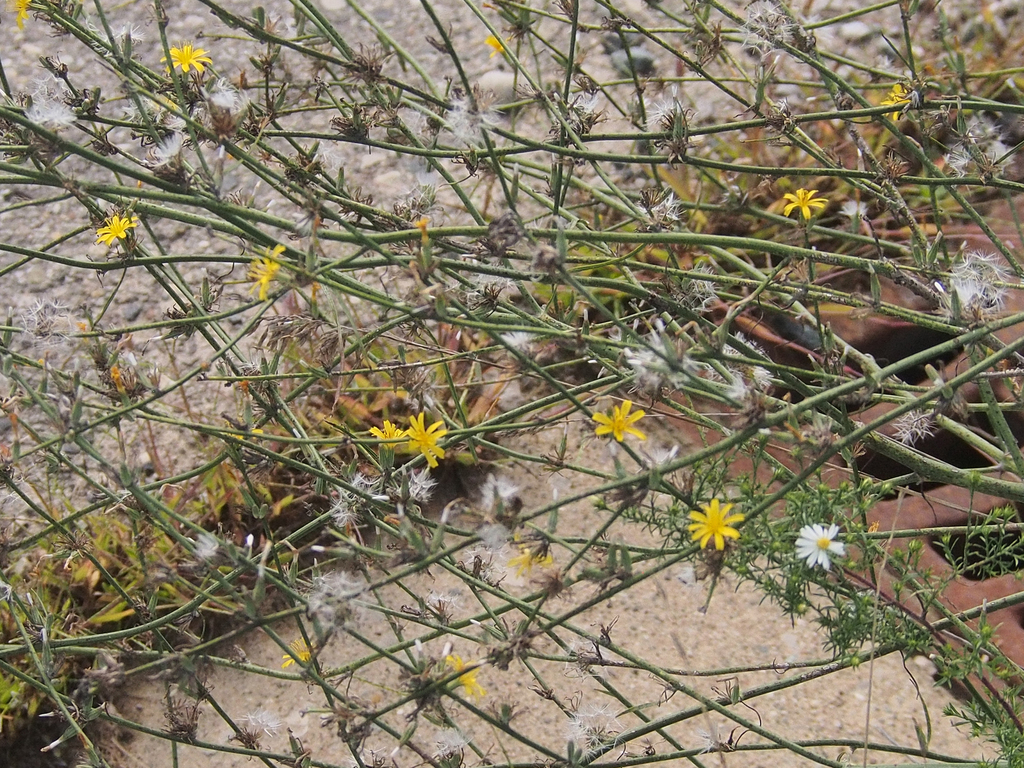
Rush Skeletonweed
Chondrilla juncea
Chondrilla juncea is a species of flowering plant in the family Asteraceae known by a number of common names, including rush skeletonweed, gum succory, devil's grass, and nakedweed. The plant is native to Europe, Asia, and North Africa, but it is known throughout most temperate regions of the world as an introduced species which is usually considered a noxious weed.
From the article Chondrilla juncea on Wikipedia (CC BY-SA), quoted section by section
Description
It is a thin, spindly plant which reaches a meter in height. It starts from a basal rosette of leaves and branches extensively, often forming a weedy thicket. It produces small dandelionlike flowers with rectangular yellow ray florets. The fruit is an achene about a centimeter long topped with a white pappus. It reproduces by seed but also by cloning itself at the root; tilling of soil and chopping up plants actually help this species disperse by sectioning and distributing root parts.
At the table
In the Greek island of Crete the leaves and the tender shoots of a local variety called ampelosyrida (αμπελοσυρίδα) or glykosyrida (γλυκοσυρίδα) are eaten raw or boiled in salads by the locals. The plant is also traditionally consumed by ethnic Albanians (Arbëreshë) in the Vulture area (southern Italy). Chondrilla juncea may have an anti-oxidant activity and some potential for medicinal use. XO-inhibiting activity shown by extracts of the aerial parts of the plant with potential benefits for hyperuricaemia and gout. In the eastern region of Turkey, chewing gum is obtained from the body of the plant.
Wikipedia: “Uses”
Where it lives
Recorded sightings
—
geo-referenced records in GBIF, from museums, herbaria and field observers.
Drag the globe to turn it. Dots are where records exist, not a range map; darker means more records.
In the stacks
Searching the stacks…
Every page naming Chondrilla juncea in the Biodiversity Heritage Library →
This page is assembled live from iNaturalist, GBIF, Wikipedia, the Source Library and the Internet Archive. It is not yet part of the hand-edited codex. iNaturalist taxon 76300.