On eBird ↗
Rufous Wren
Live sightings near you, the range map, bar charts of when it is seen, and Macaulay Library photos and recordings.
Rufous Wren
Cinnycerthia unirufa
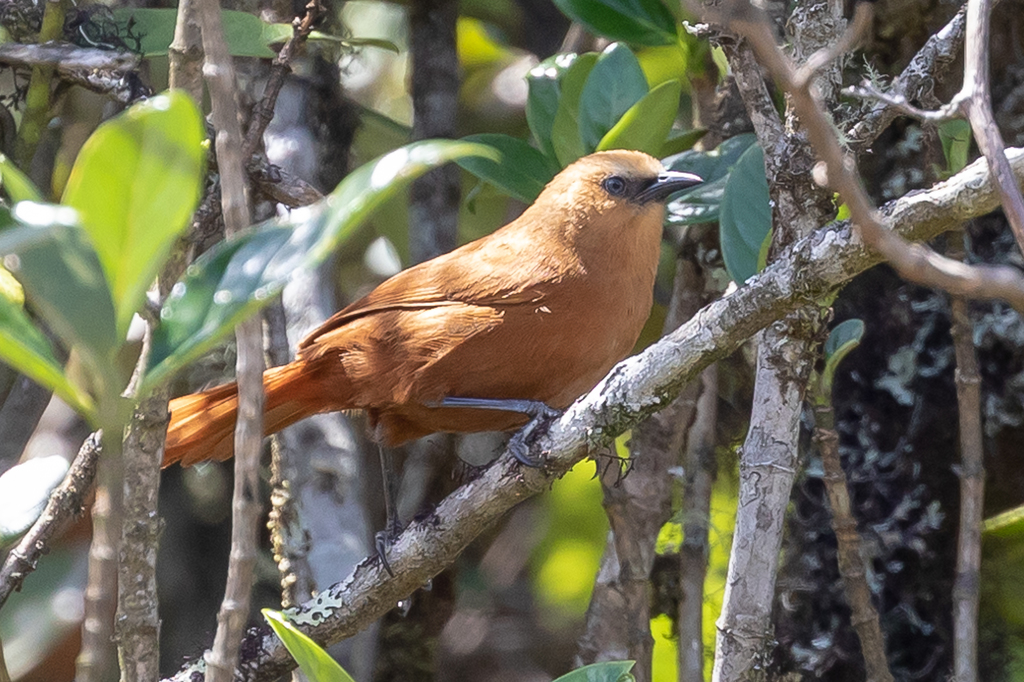
The rufous wren (Cinnycerthia unirufa) is a species of bird in the family Troglodytidae. It is found in Colombia, Ecuador, Peru, and Venezuela. Its natural habitat is subtropical or tropical moist montane forests.
There are three subspecies:
From the article Rufous wren on Wikipedia (CC BY-SA), quoted section by section
Description
The rufous wren has a length of about 16.5 cm (6.5 in). Birds in most of Colombia and in Ecuador are a uniform dark chestnut-brown colour with slight blackish barring on the wings and tail, though this is difficult to observe in the field. The lores are also blackish. Individuals in northeastern Colombia and in Venezuela are a slightly paler shade, especially on the crown. The rufous wren could be confused with the sepia-brown wren (Cinnycerthia olivascens), but that species is less rufous and has bolder barring on wings and tail. Another similar bird is the rufous spinetail (Synallaxis unirufa), but that species has a longer tail, has no barring on wings and tail and is altogether different in voice and habits.
Range & habitat
The rufous wren is found in montane areas of northern Peru, Ecuador, Colombia and southwestern Venezuela at altitudes usually between 2,200 and 3,400 metres (7,200 and 11,200 ft). It occurs in dense undergrowth in tropical moist forests.
Wikipedia: “Distribution and habitat”
What it does
The rufous wren is usually found in groups of a few individuals often joining other species of birds in small flocks. It flits about in the undergrowth and is often to be seen in and around clumps of Chusquea mountain bamboo. It has a complex and musical song consisting of repeated notes, trills and short phrases, and often sung in duets with other birds.
Wikipedia: “Behaviour”
Listen
Looking for field recordings…
Where it lives
Recorded sightings
—
geo-referenced records in GBIF, from museums, herbaria and field observers.
Drag the globe to turn it. Dots are where records exist, not a range map; darker means more records.
In the stacks
Searching the stacks…
Every page naming Cinnycerthia unirufa in the Biodiversity Heritage Library →
This page is assembled live from iNaturalist, GBIF, Wikipedia, the Source Library and the Internet Archive. It is not yet part of the hand-edited codex. iNaturalist taxon 7628.