- Plants
- ›Vascular Plants
- ›flowering plants
- ›Dicots
- ›nightshades, bindweeds, gooseweeds, and allies
- ›nightshade family
- ›cestrums and allies
- ›Cestreae
- ›Cestrum
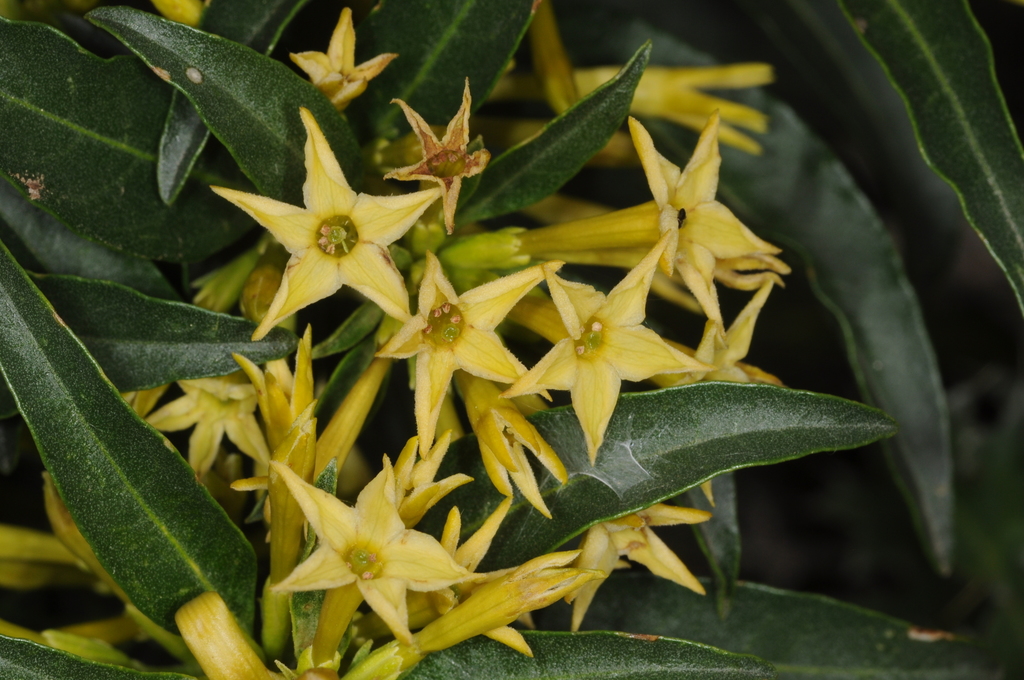
green cestrum
Cestrum parqui
Cestrum parqui, commonly known as palqui, green cestrum, Chilean cestrum, green poisonberry, or willow-leaved jessamine, is a species of flowering plant native to Chile.
In cultivation in the United Kingdom this plant has gained the Royal Horticultural Society's Award of Garden Merit (confirmed 2017). In Australia, the plant is regarded as an invasive species.
From the article Cestrum parqui on Wikipedia (CC BY-SA), quoted section by section
Description
C. parqui is a fast-growing, straggling, woody, semi-evergreen shrub that grows to over 3 metres in height (or more in warmer areas) with one or a few fragile green stems. Leaves are alternate, light green in colour, lance-shaped or marginally elliptic (that are wide at the middle), narrowly tapered at both ends, mainly 30–65 mm long and 8–23 mm wide. They have an unpleasant rubber-like smell when crushed. In areas with cool winters, the plant is partly deciduous.
Inflorescences. It produces terminal sprays of small, pungent-scented, tubular yellow-green flowers 2.5 cm long, followed by bunches of small, black, egg-shaped berries produced from summer to autumn. All parts of the plant are reported to be highly toxic. Whilst the flower colors are generally yellow-green, some varieties have mustard orange, creamy white, golden yellow and reddish-orange colors. The flowers have an unpleasant odor during the day, but are fragrant (sweet-scented) at night. …
In medicine
The plant contains toxic alkaloids. It has been used in folk medicine to treat tumours and haemorrhoids and possesses sudorific (perspiration-inducing), laxative and antispasmodic properties. Decoctions or infusions of the plant have also been administered in cases of intermittent fever and an infusion of the inner bark drunk to treat unspecified "stomach ailments".
A poultice prepared from the plant (part unspecified) in combination with Solanum nigrum (part unspecified) and the crushed stems of Vitis vinifera, the grape vine, is believed in folk medicine to have anti-inflammatory properties. A crude extract of its aerial parts in methanol water displayed inhibition of carrageenin-induced oedema.
Wikipedia: “Medicinal”
Where it lives
Recorded sightings
—
geo-referenced records in GBIF, from museums, herbaria and field observers.
Drag the globe to turn it. Dots are where records exist, not a range map; darker means more records.
In the stacks
Searching the stacks…
Every page naming Cestrum parqui in the Biodiversity Heritage Library →
This page is assembled live from iNaturalist, GBIF, Wikipedia, the Source Library and the Internet Archive. It is not yet part of the hand-edited codex. iNaturalist taxon 76226.