- Plants
- ›Vascular Plants
- ›flowering plants
- ›Dicots
- ›myrtles, evening primroses, and allies
- ›evening primrose family
- ›Camissonia
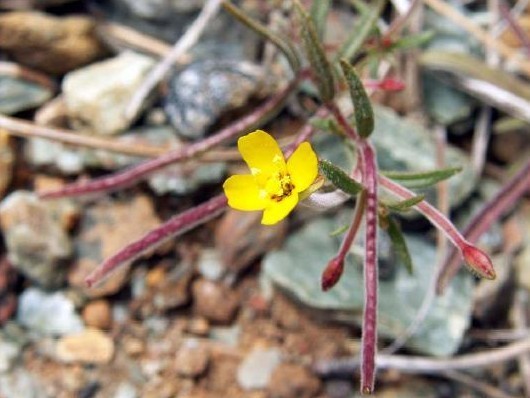
San Benito evening-primrose
Camissonia benitensis
Camissonia benitensis is a species of evening primrose known by the common names San Benito suncup and San Benito evening primrose. It is endemic to the Diablo Range of the South Coast Ranges of California, where its range includes far southern San Benito County, far western Fresno County, and far eastern Monterey County.
The species is categorized as a strict serpentine endemic, meaning that it is almost always found growing on serpentine soils; however, at least 10 populations of the species are known to occur on greywacke substrates. Most of the habitat of the species is associated with the New Idria Serpentine Mass, Laguna Mountain Serpentine Mass, Hepsedam Peak Serpentine Mass, Panther Peak Serpentine Mass, Mustang Ridge Serpentine Mass, and numerous smaller serpentine masses between. These masses are surrounded by non-serpentine rocks of the Franciscan Formation, including greywacke which some populations of Camissonia benitensis occur. Serpentine is an ultramafic rock. It weathers to produce soils with characteristically low levels of nutrients like nitrogen, phosphorus, potassium, and calcium, and high levels of magnesium and heavy metals including nickel and chromium. A major, consistent chemical feature of serpentine soil is a bioavailable calcium:magnesium ratio much less than 1. Most nonserpentine soils have a ratio far greater than 1 (more calcium and much less magnesium). The extreme chemical characteristics of serpentine soils give rise to uniquely adapted and rare serpentine endemic plant species such as C. benitensis.
From the article Camissonia benitensis on Wikipedia (CC BY-SA), quoted section by section
Description
Camissonia benitensis was discovered by Peter H. Raven on a serpentine stream terrace adjacent to Clear Creek (New Idria serpentine mass; Bureau of Land Management Clear Creek Management Area) in 1960 and scientifically described by him in 1969. The plant's specific epithet, "benitensis", commemorates its discovery in San Benito County. It is a diminutive annual herb that rarely grows larger than 10 centimeters in field conditions, but can become multi-branched and exceed 30 centimeters in diameter within a horticultural setting. Its reddish stems bear plentiful linear leaves less than 1 centimeter long and minutely toothed along the edges. Plants bear four-petaled yellow flowers approximately 6 millimeters in diameter. Camissonia benitensis seeds at and near the soil surface germinate with the first rains in fall or winter (November 1 - January 31). The plants grow through late fall, winter, and early spring (germination with first rainfall to April) and flowering in April and May. The species is fully self-pollinating. The fruit is a long, cylindrical capsule approximately 2 to 3 centimeters in length that matures May through July, becoming dry at full maturity with plant senescence. The fruits typically either do not open or only open part way near the tip and do not disperse most of the seed at maturity. …
Range & habitat
Based upon the original discovery of C. benitensis on a serpentine alluvial stream terrace adjacent to Clear Creek, it was long believed that its only habitat type consisted of serpentine alluvial terraces adjacent to perennial streams and rivers, a very rare type of habitat. Until 2010 few populations of the species had been found in any other habitat. In 2010 numerous additional populations were discovered on other land forms including ancient serpentine alluvium deposits (upland hills), serpentine landslides originating from tectonic masses (upland), and serpentine soils on the periphery of large tectonic serpentine (ultramafic) masses (upland)(USFWS 2020). These recently discovered habitat types are collectively called the "geologic transition zone." This habitat type is now known to constitute the majority of the habitat area and contains most of the known populations of the species (USFWS 2020). Populations found near Priest Valley in 2010 extended the previously known range 15 kilometers to the southeast (USFWS 2020). Common features of the stream terrace are friable serpentine soils that are stable due to very low gradient or no slope and high percentage of coarser substrate particles including sand, gravel, and cobbles. The plant communities in the area include chaparral and woodland with gaps in between where there are microclimates. C. …
Wikipedia: “Range and habitat”
Where it lives
Recorded sightings
—
geo-referenced records in GBIF, from museums, herbaria and field observers.
Drag the globe to turn it. Dots are where records exist, not a range map; darker means more records.
In the stacks
Searching the stacks…
Every page naming Camissonia benitensis in the Biodiversity Heritage Library →
This page is assembled live from iNaturalist, GBIF, Wikipedia, the Source Library and the Internet Archive. It is not yet part of the hand-edited codex. iNaturalist taxon 75971.