- Plants
- ›Vascular Plants
- ›flowering plants
- ›monocots
- ›grasses, sedges, cattails, and allies
- ›grasses
- ›Pooideae
- ›Poeae
- ›Beardgrasses, Bentgrasses, Reedgrasses, and Allies
- ›Calamagrostis
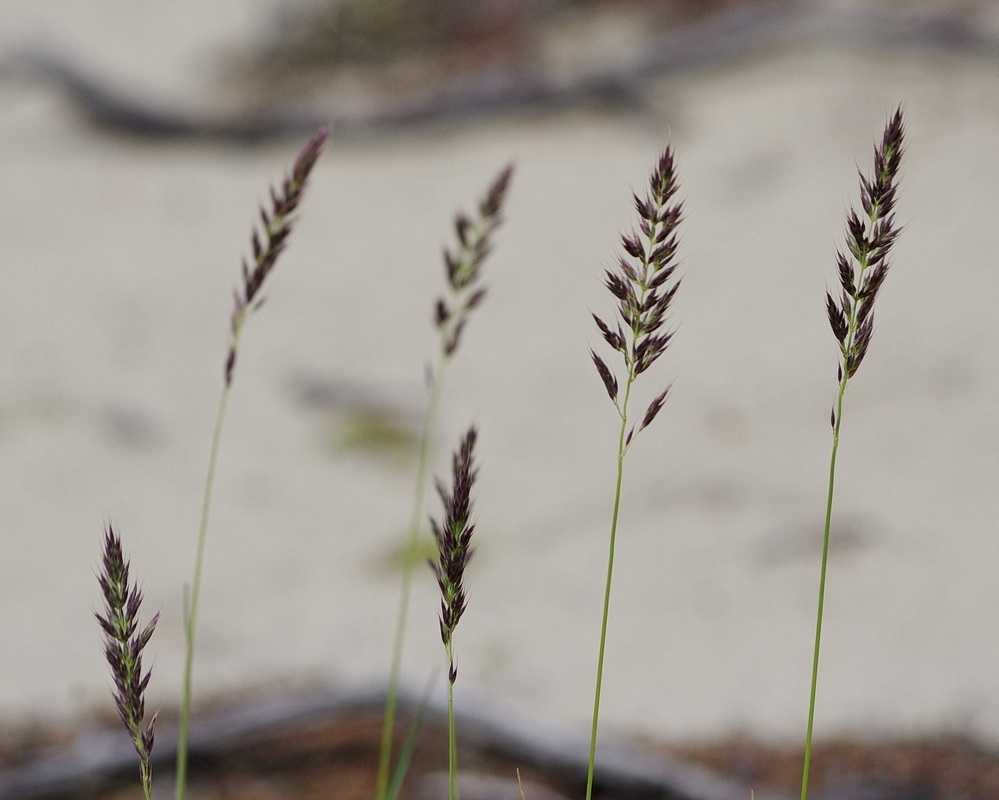
Purple Reedgrass
Calamagrostis purpurascens
Calamagrostis purpurascens, variously known by the common names purple reedgrass, purple pinegrass, or alpine reedgrass is a perennial grass, growing 30 to 70 centimetres (28 in) tall.
From the article Calamagrostis purpurascens on Wikipedia (CC BY-SA), quoted section by section
Description
Calamagrostis purpurascens is a large, clump forming, perennial grass; growing 30–80 cm (12–31 in) tall. It grows from short rhizomes and has dense, often purpled tinted flower heads that are 4 to 13 cm (1.6 to 5.1 in) long. It has one flowered spikelets, two subequal glumes, and lemma with a dorsal awn. The awn is longer than the glum and sharply bent, and longer than the tip of the spikelet. Flowering stems have typically one or two leaves.
Range & habitat
Calamagrostis purpurascens is native from arctic Greenland, to much of Canada (Alberta, British Columbia, Manitoba, Newfoundland, Northwest Territories, Nunavut, Ontario, Quebec, Saskatchewan, and Yukon Territory) and the western and northern U.S. (Alaska, California, Colorado, Idaho, Minnesota, Montana, Nevada, New Mexico, Oregon, South Dakota, Utah, Washington, and Wyoming). It is rare and scattered in the southern U.S. states, such as Louisiana, where it is a post-glacial relict. Further south, C. purpurascens is also known in Chile, where it was recorded by Rodolfo Amando Philippi in 1860. Philippi gave it the name Deyeuxia robusta, now relegated to synonymy. It is also found in Asia (in eastern Siberia).
Wikipedia: “Distribution”
What it does
Carterocephalus palaemon (arctic skipper) butterflies eat the nectar from C. purpurascens flowers, and their caterpillars feed on the shoots. Ovis canadensis (bighorn sheep) are known to graze this grass.
== References ==
Wikipedia: “Ecology”
Where it lives
Recorded sightings
—
geo-referenced records in GBIF, from museums, herbaria and field observers.
Drag the globe to turn it. Dots are where records exist, not a range map; darker means more records.
In the stacks
Searching the stacks…
Every page naming Calamagrostis purpurascens in the Biodiversity Heritage Library →
This page is assembled live from iNaturalist, GBIF, Wikipedia, the Source Library and the Internet Archive. It is not yet part of the hand-edited codex. iNaturalist taxon 75929.