- Plants
- ›Vascular Plants
- ›flowering plants
- ›monocots
- ›grasses, sedges, cattails, and allies
- ›grasses
- ›Pooideae
- ›Bromeae
- ›Bromus
- ›Bromopsis
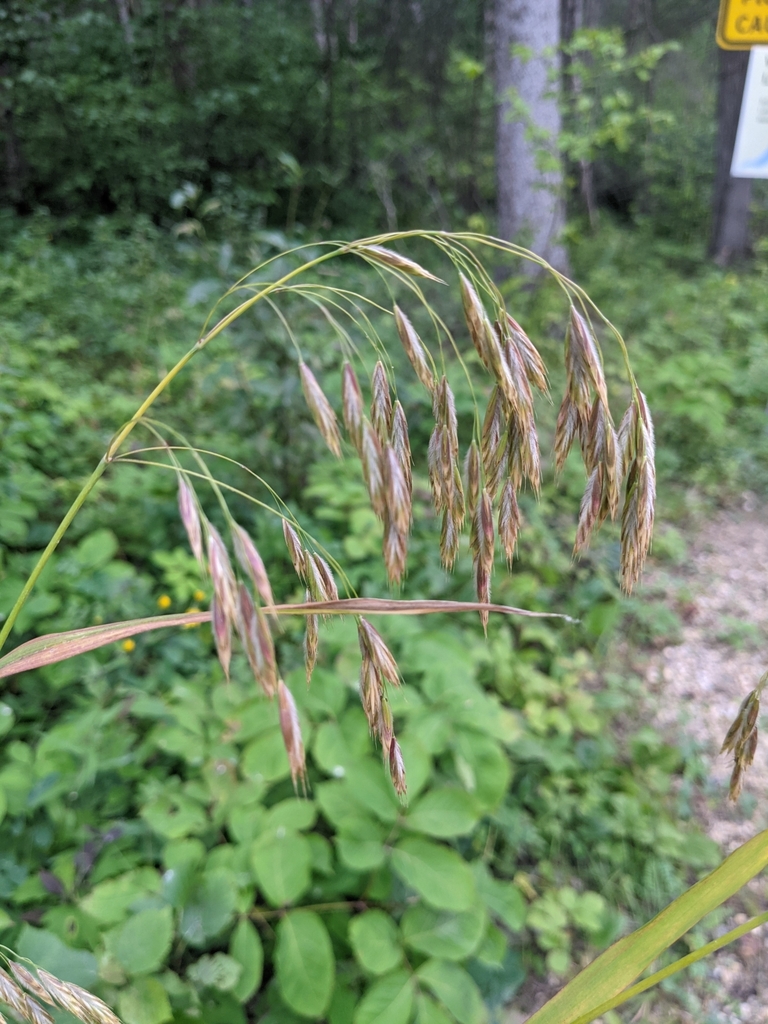
Fringed Brome
Bromus ciliatus
Bromus ciliatus is a species of brome grass known by the common name fringed brome. It is native to most of North America, including most of Canada, most of the United States except for some portions of the South, and northern Mexico. It is a plant of many habitats, including temperate coniferous forest. The specific epithet ciliatus is Latin for "ciliate", referring to the delicate hairs of the leaf blades.
From the article Bromus ciliatus on Wikipedia (CC BY-SA), quoted section by section
Description
Bromus ciliatus is a perennial grass that grows in tufts up to 1.2 m (3 ft 11 in) tall, and occasionally taller in the Great Plains. The grass lacks rhizomes but has a well developed root system. The sheaths are glabrous or bear minute hairs and have a narrow "V" shaped orifice. The sheaths are typically shorter than the internodes. The scabrous leaves often have sparse long hairs and measure 3–16 mm (0.12–0.63 in) wide. The open inflorescence bears many spikelets on stalks, the upper ones ascending and the lower nodding or drooping. This panicle is 10–30 cm (3.9–11.8 in) long. The flattened spikelets are 1.5–3 cm (0.59–1.18 in) long and 4–10 mm (0.16–0.39 in) wide. The spikelets are greenish and occasionally tinged with bronze or purple. The spikelets bear three to nine flowers and display their rachilla at maturity. The glumes are conduplicate, with the upper glume tapering at its base. The firm lemmas are also conduplicate, measuring 2.5–3.5 mm (0.098–0.138 in) broad with delicate nerves. The linear palea is typically enclosed by the folded lemma. The anthers are 1–2.5 mm (0.039–0.098 in) long. The caryopsis is lanceolate in shape. The grass flowers from July into early October.
Range & habitat
Bromus ciliatus is common in subalpine areas. It is a very palatable forage grass that is heavily grazed and shade tolerant. The grass occurs in many moist conditions, in wet woodlands, moist meadows or thickets, stream banks, pond and lake margins, bogs, and marshes.
Wikipedia: “Habitat”
Where it lives
Recorded sightings
—
geo-referenced records in GBIF, from museums, herbaria and field observers.
Drag the globe to turn it. Dots are where records exist, not a range map; darker means more records.
In the stacks
Searching the stacks…
Every page naming Bromus ciliatus in the Biodiversity Heritage Library →
This page is assembled live from iNaturalist, GBIF, Wikipedia, the Source Library and the Internet Archive. It is not yet part of the hand-edited codex. iNaturalist taxon 75899.