- Plants
- ›Vascular Plants
- ›flowering plants
- ›Dicots
- ›pinks, cactuses, and allies
- ›four o'clock family
- ›Boerhavia
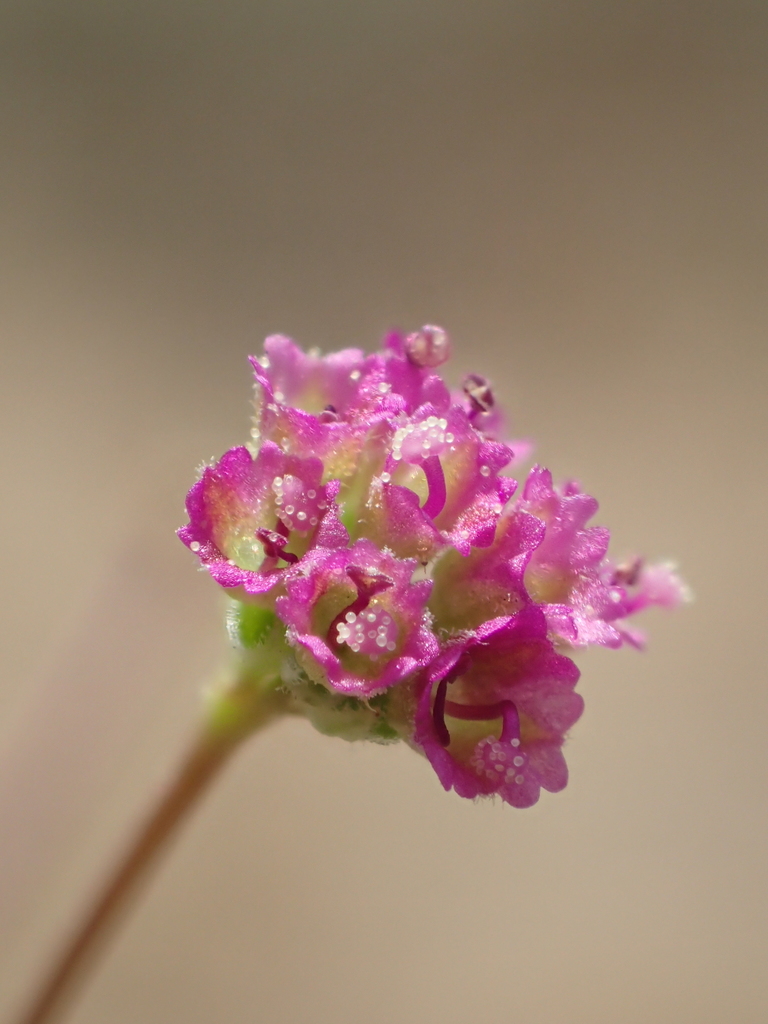
Wineflower
Boerhavia diffusa
Boerhavia diffusa is a species of flowering plant in the four o'clock family which is commonly known as punarnava (meaning that which rejuvenates or renews the body in Ayurveda), red spiderling, spreading hogweed, or tarvine. It is taken in herbal medicine for pain relief and other uses. The leaves of B. diffusa are often used as a green vegetable in many parts of India.
From the article Boerhavia diffusa on Wikipedia (CC BY-SA), quoted section by section
Description
Boerhavia diffusa is widely dispersed, occurring throughout India (where it is known as punarnava and used in Ayurveda,), the Pacific, and southern United States. Flowers are small, around 5 mm in diameter. Pollens are round, roughly 65 microns in diameter. This wide range is explained by its small fruit, which are very sticky and grow a few inches off the ground, ideally placed to latch on to small migratory birds as they walk by. Habit A creeping, perennial, much-branched herb with stout fusi form roots. Stem Branches divaricate, stem purplish, thickened at nodes. Leaves Opposite, oblique, ovate or sub orbicular, rounded, entire, margins slightly pinkish, wavy, lower surface with small, white scales, base rounded. Inflorescence Small umbels forming Corymbose, axillary and terminal panicle. Flowers
Bracteoles, acute. Perianth -tube constricted above the ovary, limb funnel-shaped, dark-pink, with 5 vertical bands outside. Stamens 2 or 3, slightly exserted, unequal. Ovary superior, oblique, ovule 1, erect, stigma. Fruit Achene rounded, 6-ribbed. Seed Minute, albuminous with endosperm. Embryo curved.
Range & habitat
A true and accurate accounting of the native range of Boerhavia diffusa has not been determined. However, it is very widespread, and has become naturalized in many places. It is believed to be a native plant to the following places in:
Africa — Botswana, Egypt, Eswatini, Ghana, Kenya, Liberia, Malawi, Mozambique, Namibia, Nigeria, Rwanda, Senegal, Sierra Leone, Somalia, South Africa (Eastern Cape, Gauteng, KwaZulu-Natal, Limpopo, Mpumalanga, Northern Cape provinces), Tanzania, Togo, Uganda, Zambia, and Zimbabwe.
Asia — Bangladesh, Sri Lanka, Burma, Cambodia, China (Fujian, Guangdong, Guangxi, Guizhou, Hainan, Sichuan, and Yunnan), India, Indonesia, Japan (Ryukyu Islands), Laos, Malaysia, Nepal, Pakistan (Punjab, Sind, Balochistan, Gilgit Baltistan), the Philippines, southern Taiwan, Thailand, and Vietnam. Also, on the Arabian Peninsula in Oman, Saudi Arabia, and the United Arab Emirates, and Yemen (Socotra).
North America — Mexico, and the U.S. (in the states of Florida, Georgia, and South Carolina).
Caribbean — Anguilla, the Bahamas, the Cayman Islands, Cuba, Dominica, Grenada, Hispaniola (Dominican Republic and Haiti), Jamaica, Montserrat, the Netherlands Antilles (Saba), Puerto Rico, Saint Lucia, Saint Vincent and the Grenadines, and both the British and the U.S. …
Wikipedia: “Distribution”
Where it lives
Recorded sightings
—
geo-referenced records in GBIF, from museums, herbaria and field observers.
Drag the globe to turn it. Dots are where records exist, not a range map; darker means more records.
In the stacks
Searching the stacks…
Every page naming Boerhavia diffusa in the Biodiversity Heritage Library →
This page is assembled live from iNaturalist, GBIF, Wikipedia, the Source Library and the Internet Archive. It is not yet part of the hand-edited codex. iNaturalist taxon 75835.