- Plants
- ›Vascular Plants
- ›flowering plants
- ›Dicots
- ›Buttercups, Poppies, and Allies
- ›barberry family
- ›Berberidoideae
- ›Berberideae
- ›Berberis
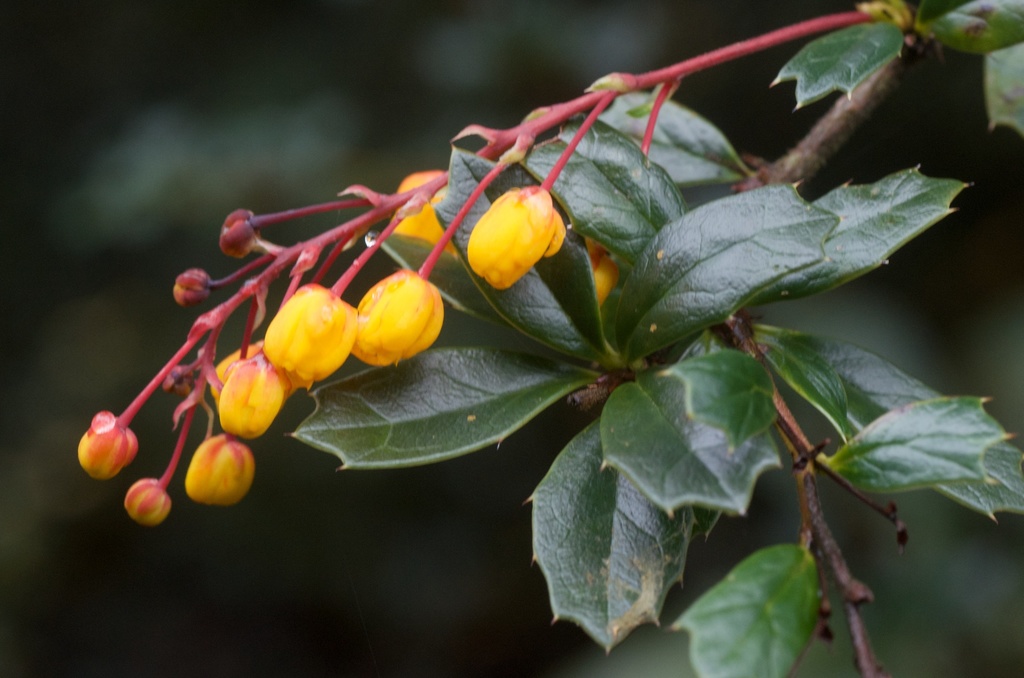
Darwin's Barberry
Berberis darwinii
Berberis darwinii, Darwin's barberry, is a species of flowering plant in the family Berberidaceae. It is native to southern Chile and Argentina and naturalized elsewhere. Regional vernacular names include michay, calafate, and quelung. Growing to 3–4 m (9.8–13.1 ft) tall, it is an evergreen thorny shrub.
From the article Berberis darwinii on Wikipedia (CC BY-SA), quoted section by section
Description
Berberis darwinii has dense branches from ground level. The leaves are small oval, 12–25 mm (0.47–0.98 in) long and 5–12 mm (0.20–0.47 in) broad, with a spiny margin; they are borne in clusters of 2–5 together, subtended by a three-branched spine 2–4 mm long. The flowers are orange, 4–5 mm long, produced in dense racemes 2–7 cm long in spring. The fruit is a small purple-black berry 4–7 mm diameter, ripening in summer. Berberis darwinii was first described in 1835 by Charles Darwin during the voyage of the Beagle. It was one of many named in honour of Darwin. The berries of this species are known to have been consumed by prehistoric native peoples in the Patagonian region over millennia. It is a popular garden and hedging shrub in the British Isles. The Royal Horticultural Society has given the species its Award of Garden Merit. The edible fruit is very acidic.
Where it lives
Recorded sightings
—
geo-referenced records in GBIF, from museums, herbaria and field observers.
Drag the globe to turn it. Dots are where records exist, not a range map; darker means more records.
In the stacks
Searching the stacks…
Every page naming Berberis darwinii in the Biodiversity Heritage Library →
This page is assembled live from iNaturalist, GBIF, Wikipedia, the Source Library and the Internet Archive. It is not yet part of the hand-edited codex. iNaturalist taxon 75751.