- Plants
- ›Vascular Plants
- ›flowering plants
- ›Dicots
- ›Legumes, Milkworts, and Allies
- ›Legumes
- ›Faboideae
- ›milkvetches, locoweeds, and allies
- ›Astragalus
- ›Hypoglottidei
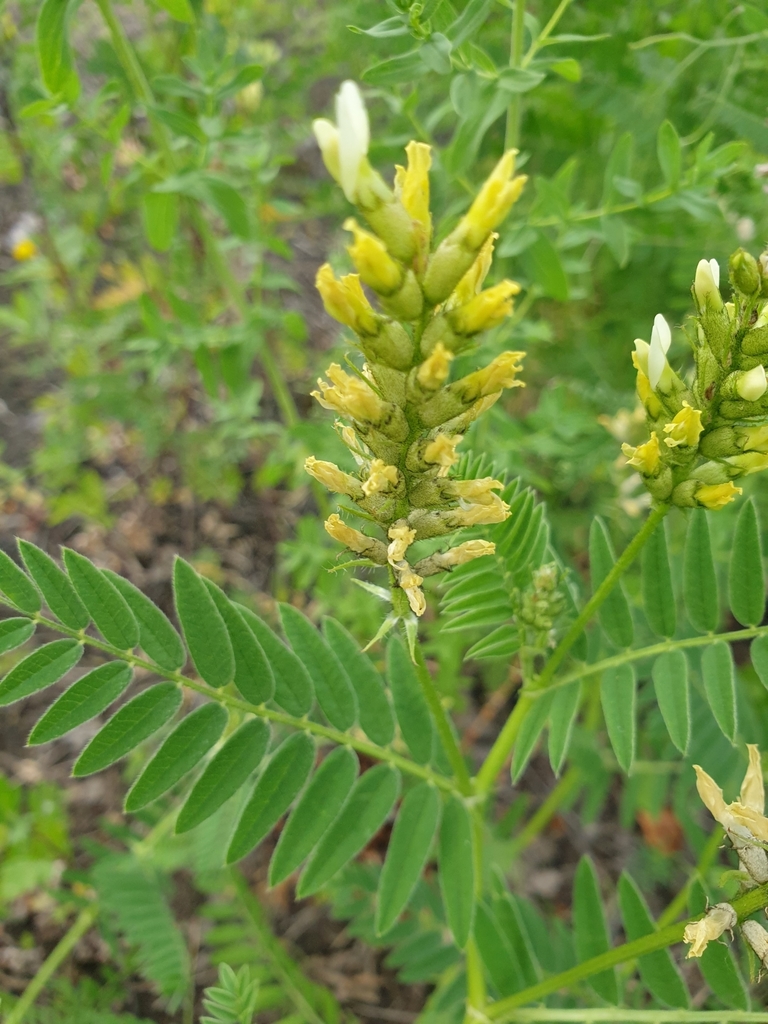
Chickpea Milkvetch
Astragalus cicer
Astragalus cicer, the chickpea milkvetch, chick-pea milk-vetch or cicer milkvetch, is a perennial flowering plant native to Eastern Europe, popularized and subsequently transported to areas in Southern Europe, North America, and South America. Cicer milkvetch exhibits legume-like qualities; the plant produces pods which harbor its seeds. Its flowers are usually of pale yellow tint (sometimes white), and as such, attract bumble or European honey bees for pollination. Growth often exceeds 0.6 meters, up to a height...
From the article Astragalus cicer on Wikipedia (CC BY-SA), quoted section by section
Description
Cicer milkvetch exhibits rhizomes (sometimes referred to as creeping roots), or an extended horizontal stem propagated underground, which continuously grow as the plant ages. Thus, the plant becomes increasingly vigorous with time. In regards to proliferation, cicer milkvetch spreads by its utilization of rhizomatous growth, in addition to reproduction via seeds. Seeds (produced by pods) have a very thick integument (or seed coat) which requires scarification to proceed towards germination. The hardy aspect of the seed coat acts as a preventative barrier against microbial invasion. In addition, the thickness of the seed coat reduces the capacity for water absorption, which in turn allows for the seed to remain dormant for a longer period of time. Stipules are readily observed and green in color. Leaves are compound and alternate.
Wikipedia: “Morphology”
Range & habitat
Astragalus cicer is suited best to grow in the Rocky Mountain area in the United States; however, it has been shown that cicer milkvetch also flourishes in coastal areas – and more specifically has been found to perform well in the coasts of Alaska. Because cicer milkvetch displays high tolerance to drought, it has been shown to survive in dryland areas of Idaho, Montana, and Wyoming that often receive less than 14 in (360 mm) of yearly rain.
Wikipedia: “Distribution”
What it does
In general, cicer milkvetch can be seen to grow in the fringes of forests, meadows, and alongside streams; however, it has also been reported that the plant proliferates along roadsides. Cicer milkvetch has the capacity to grow in a vast amount soil types and textures, such as clay and sand. As such, it has been shown to proliferate in coarsely-textured soil. Excessive salt proves to be harmful to the plant. Soils deviating from the 6.0 to 8.1 pH range are also indicative of a less-than-desirable condition for growth. Despite these few restrictions, cicer milkvetch persists excellently in less nutrient-rich or disturbed soils. Although the plant grows exceptionally well in higher temperatures, it has been shown to exhibit slow-growth at temperatures as low as 7 to 18 °C. Drought tolerance is another important aspect in regards to the inherent durability of the plant. In regards to obtaining adequate amounts of nitrogen, cicer milkvetch employs a mutualistic relationship with rhizobia bacteria.
Wikipedia: “Habitat and ecology”
Where it lives
Recorded sightings
—
geo-referenced records in GBIF, from museums, herbaria and field observers.
Drag the globe to turn it. Dots are where records exist, not a range map; darker means more records.
In the stacks
Searching the stacks…
Every page naming Astragalus cicer in the Biodiversity Heritage Library →
This page is assembled live from iNaturalist, GBIF, Wikipedia, the Source Library and the Internet Archive. It is not yet part of the hand-edited codex. iNaturalist taxon 75633.