- Plants
- ›Vascular Plants
- ›flowering plants
- ›Dicots
- ›Gentians, Dogbanes, Madders, and Allies
- ›Dogbane Family
- ›milkweeds
- ›Asclepiadeae
- ›Oxypetalinae
- ›Araujia
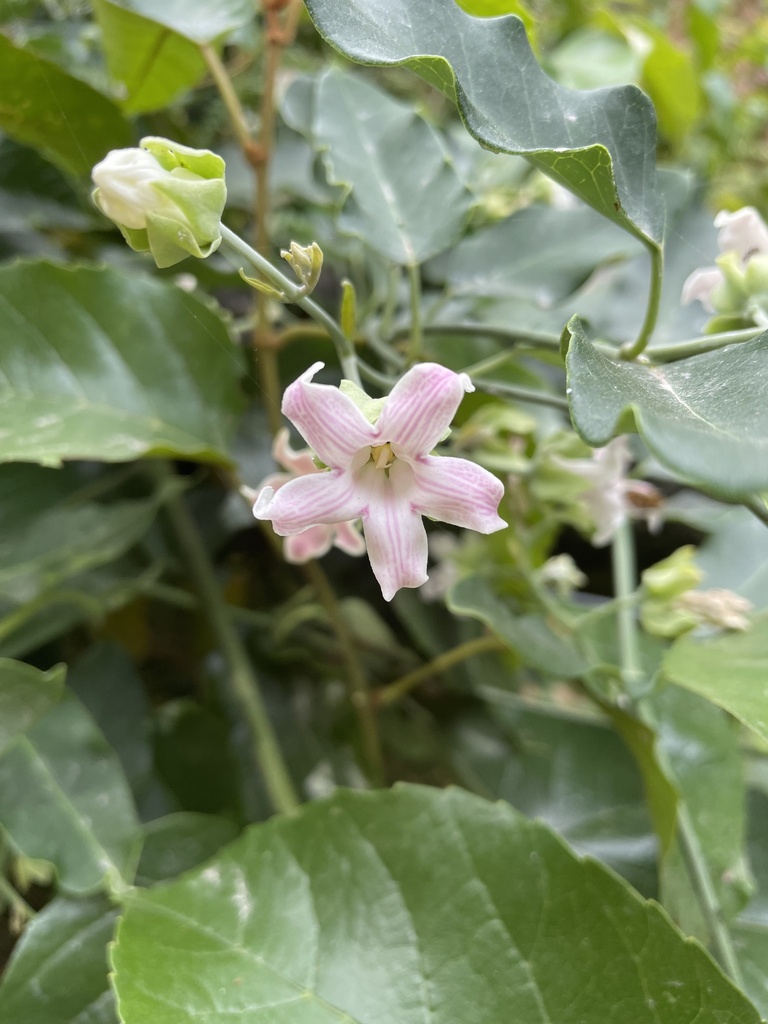
Moth Vine
Araujia sericifera
Araujia sericifera is a perennial vining plant in the genus Araujia, of the family Apocynaceae, that is native to South America. The species was described in 1817 by the Portuguese botanist Félix de Avelar Brotero. The synonym Araujia hortorum is in more frequent use in New Zealand. Its common names include bladderflower, white bladderflower, bladder vine, cruel vine, cruel plant, moth plant, moth vine, common moth vine, and false choko.
It was introduced to Europe and other areas as an ornamental plant, but it is now considered a noxious weed. In some countries, such as France, the attractive and abundant fragrant flowering make it a specimen considered worth cultivating. However its strong robustness combined with high seed production can make it invasive in most environments, but not in France due to its sensitivity to frost.
From the article Araujia sericifera on Wikipedia (CC BY-SA), quoted section by section
Description
Araujia sericifera is a creeping vine that can climb up to 5–10 metres (16–33 ft) high. When broken it releases a milky, smelly exudate. Leaves are opposite, dark green, glossy and quite fleshy, almost triangular, with entire margins, about 10–12 centimetres (3.9–4.7 in) long and 1–6 centimetres (0.39–2.36 in) wide with an intact leaf margin. The upper side is dark green, bare and shiny, the underside is grey-green with felt-like hairs. When a stem, leaf or unripe fruit is broken, a white milky juice is produced at the breaking point. It is slightly toxic and can cause an allergic skin reaction when touched. The stems are thin and right-winding. They branch strongly and can lignify at the base. The plant usually wraps itself around other plants or around a post or the bars of a fence. The root system consists of a short taproot with superficial lateral roots. The plant's stems and leaves may senesce in late summer or early autumn, but new shoots will grow on the old stems as climbing support.
Inflorescences. The twining stems feature scented, cup-shaped bisexual flowers, around 2 centimetres (0.79 in) in width, with five white, cream-coloured, violet or pale pink petals. The flowers are generally pollinated by moths (hence the name "moth plant"), butterflies and bees (entomophily), but they can self-pollinate. The flowering period extends from late spring to summer. …
Range & habitat
The plant is native to South America: Peru mainly, but also Argentina, Brazil, and Uruguay. It was introduced to Europe and other areas as an ornamental plant, but it is now considered a noxious weed. The plant is now widely distributed in France by horticultural networks as a climbing and scent plant. It thrives in rich soil in sunny locations (possibly also in partial shade) and becomes perennial when protected from frost. The plant's geographical distribution included southern Europe, South Africa, North America (California, Georgia, North Carolina), South America (Argentina, Brazil, Paraguay, Uruguay), Australia, and New Zealand in 2024.
Wikipedia: “Distribution”
Toxicity
Moth plant is toxic for some people. Skin contact with its sap can cause rashes. Contact with the eyes, in particular, can cause severe discomfort.
In human culture
The genus name (Araujia) derives from António de Araújo e Azevedo, 1st Count of Barca (1754–1817), a Portuguese amateur botanist who conducted scientific studies and experiments in his own botanical garden. The species' Latin name sericifera means "silk-bearing" and refers to the silky hairs surrounding the seeds inside the fruits. Araujia sericofera is an incorrect taxonomic synonym for Araujia sericifera.
Wikipedia: “Etymology”
Where it lives
Recorded sightings
—
geo-referenced records in GBIF, from museums, herbaria and field observers.
Drag the globe to turn it. Dots are where records exist, not a range map; darker means more records.
In the stacks
Searching the stacks…
Every page naming Araujia sericifera in the Biodiversity Heritage Library →
This page is assembled live from iNaturalist, GBIF, Wikipedia, the Source Library and the Internet Archive. It is not yet part of the hand-edited codex. iNaturalist taxon 75499.