On eBird ↗
Noisy Scrub-bird
Live sightings near you, the range map, bar charts of when it is seen, and Macaulay Library photos and recordings.
Noisy Scrubbird
Atrichornis clamosus
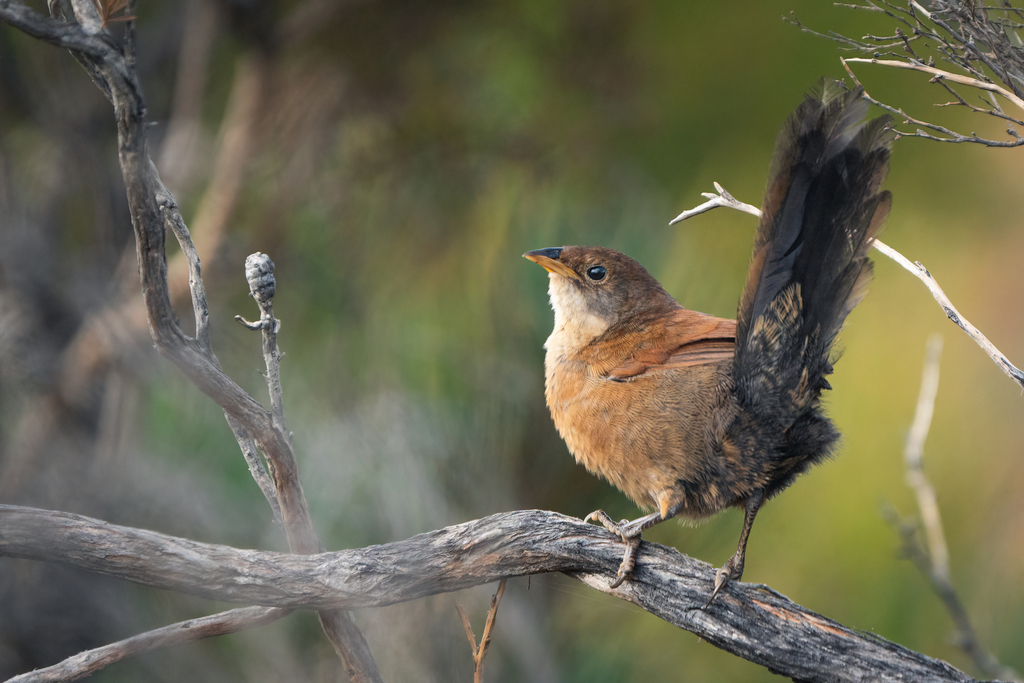
The noisy scrubbird (Atrichornis clamosus) is a species of bird in the Atrichornithidae family. It is endemic to the coastal heaths of south-western Australia (east of Albany). The Noisy Scrubbird features a dark brown colored back, rust-like colored wings and a speckled chestnut colored breast region with a grey-brown or pink bill and brown or silver legs and feet. They vary from 19–23 cm. in length and 25-58 grams. The males are distinguished from the females by...
From the article Noisy scrubbird on Wikipedia (CC BY-SA), quoted section by section
Description
The noisy scrubbird features a dark brown coloured back, rust-like coloured wings and a speckled chestnut colored breast region with a grey-brown or pink bill and brown or silver legs and feet. They vary from 19–23 cm. in length and 25-58 grams. The males are distinguished from the females by exhibiting a black triangle on their throat . They are closely related to the lyrebird, having only evolutionarily separated from them approximately 30-35 million years ago. They prefer feeding upon small invertebrates, such as ants and beetles, in the extremely dense understory and vegetative cover that only occurs after environmental damages.
Range & habitat
The noisy scrubbird is one of Australia's rarest birds. It was presumed extinct until a population was discovered at Two Peoples Bay, east of Albany in Western Australia in the 1960s. Since then a recovery plan has been put into action. Populations of the bird have been translocated to nearby Bald Island, in Waychinicup National Park, as well as the Porongorup Ranges, where a bushfire had destroyed much of the population. In 2025, the total population of birds was estimated at 1,500 individuals. In September 2025 three birds were reintroduced to West Cape Howe National Park where it has not been found since the 1890s.
Wikipedia: “Distribution”
What it does
Noisy scrubbirds are sexually mature at approximately 5 years of age for males and the first breeding season for females. Unlike many other birds they lay one egg at a time and have a clutch size of only 2 eggs. The nest is a circular-shaped structure typically built in low-lying shrubbery, rushes or sedges and is made from common sticks, leaves and decaying plant matter. Males play no part in the nest-building, but it is believed they may defend the territory the female has laid her eggs in. The eggs are incubated for approximately 36 days prior to hatching, and then the chicks leave the nest 4–6 weeks after hatching. In a 2005 study there is considered to be approximately 695 individual scrubbirds remaining, and included in that approximation are 278 territorial males. It was presumed that for each territorial male there were 2.5 females
Wikipedia: “Reproduction”
Listen
Looking for field recordings…
Where it lives
Recorded sightings
—
geo-referenced records in GBIF, from museums, herbaria and field observers.
Drag the globe to turn it. Dots are where records exist, not a range map; darker means more records.
In the stacks
Searching the stacks…
Every page naming Atrichornis clamosus in the Biodiversity Heritage Library →
This page is assembled live from iNaturalist, GBIF, Wikipedia, the Source Library and the Internet Archive. It is not yet part of the hand-edited codex. iNaturalist taxon 7422.