- Plants
- ›Vascular Plants
- ›flowering plants
- ›Dicots
- ›Nances, Willows, and Allies
- ›Violet Family
- ›Viola
- ›Neoandinium
- ›Inconspicuiflos
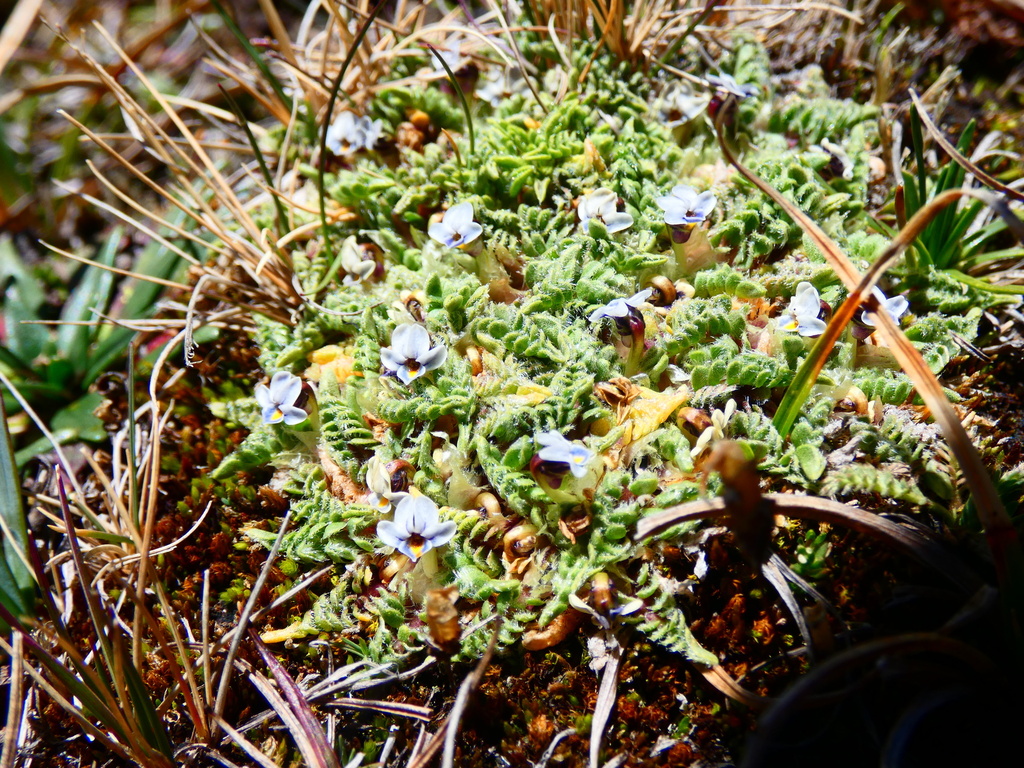
Viola lilliputana
Viola lilliputana, the Lilliputian violet, is a species of violet described in 2012, and is among the smallest violets, and in fact one of the tiniest terrestrial dicot plants in the world. It was discovered from the arid puna in the Peruvian Andes in 1960s and formally described only after half a century later. The name is derived from the fictional little people in Gulliver's Travels.
The violet species was selected by the International Institute for Species Exploration at Arizona State University to be among the Top 10 New Species discovered in 2012 out of more than 140 nominated species. Its distinctiveness is the small size. The selection was publicised on 22 May 2013.
From the article Viola lilliputana on Wikipedia (CC BY-SA), quoted section by section
Description
The entire above ground portion of the plant is barely 1 cm (0.39 in) tall. It is basically similar to other pinnatifid violets found endemic to central and southern Peru. It has large and strong stipules, elongate leaf lobes and dilated unappendaged style. But unlike other violets, it has conduplicated leaf blades, strong and oblong lanceolate to broadly elliptical lobes with blunt tips, and large basally-fused pedicel bractlets.
Where it lives
Recorded sightings
—
geo-referenced records in GBIF, from museums, herbaria and field observers.
Drag the globe to turn it. Dots are where records exist, not a range map; darker means more records.
In the stacks
Searching the stacks…
Every page naming Viola lilliputana in the Biodiversity Heritage Library →
This page is assembled live from iNaturalist, GBIF, Wikipedia, the Source Library and the Internet Archive. It is not yet part of the hand-edited codex. iNaturalist taxon 742076.