On eBird ↗
Dupont's Lark
Live sightings near you, the range map, bar charts of when it is seen, and Macaulay Library photos and recordings.
Dupont's Lark
Chersophilus duponti
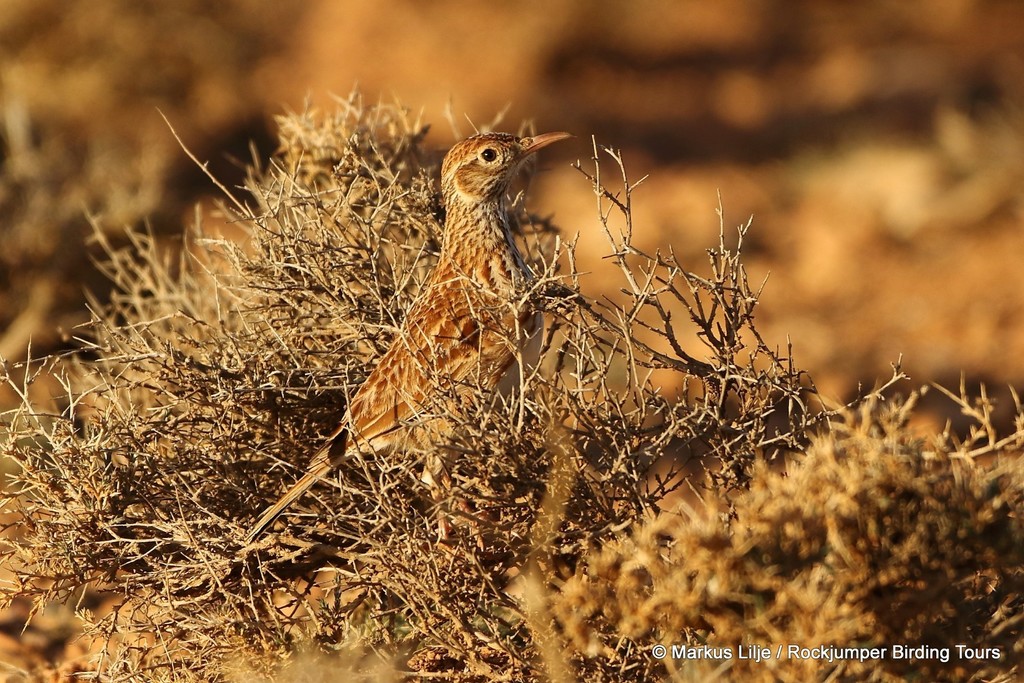
Dupont's lark (Chersophilus duponti) is a species of lark in the family Alaudidae of the monotypic genus Chersophilus. It is found in northern Africa and Spain.
From the article Dupont's lark on Wikipedia (CC BY-SA), quoted section by section
Description
Like most other larks, Dupont's lark is an undistinguished looking species on the ground. It is 17–18 cm long, slim, with a long neck, long legs and a fine slightly curved bill. It has a thin pale crown stripe and a dark-streaked breast. The north-western Dupont's lark of Europe and north-west Africa is mainly brown-grey above and pale below. The south-eastern Dupont's lark, which occupies most of the rest of the African range, has rufous upperparts.
Vocalisations. Its song is a repeated thin, melancholic whistling phrase, very ventriloquial (difficult to locate) and a nasal whistle given mainly at dawn and dusk or at night.
Range & habitat
It breeds across much of northern Africa, from Algeria to Egypt, and in Spain. It is a non-migratory resident. It is a species that commonly inhabits chaparral areas. However, it experienced a 3.9% annual population decrease in Spain with a 32.8% decrease from 2008 to 2018, shifting its conservation status to vulnerable on the national level and endangered in the regions of Andalusia and Castile-León.
Wikipedia: “Distribution and habitat”
What it does
This is a very shy species, which runs for cover when disturbed. It is difficult to see while running among vegetation but it sometimes sings, standing upright on the edge of a low bush.
Breeding. This is a bird of open sandy semi-desert or steppe with some grass. Its nest is on the ground, with three or four eggs being laid. Its food is seeds and insects.
Wikipedia: “Behaviour and ecology”
Listen
Looking for field recordings…
Where it lives
Recorded sightings
—
geo-referenced records in GBIF, from museums, herbaria and field observers.
Drag the globe to turn it. Dots are where records exist, not a range map; darker means more records.
In the stacks
Searching the stacks…
Every page naming Chersophilus duponti in the Biodiversity Heritage Library →
This page is assembled live from iNaturalist, GBIF, Wikipedia, the Source Library and the Internet Archive. It is not yet part of the hand-edited codex. iNaturalist taxon 7416.