- Animals
- ›Chordates
- ›Vertebrates
- ›Mammals
- ›Therians
- ›Placental Mammals
- ›Primates, Rodents, and Allies
- ›Primates
- ›Monkeys, Apes, and Tarsiers
- ›Monkeys and Apes
- ›New World Monkeys
- ›Cebid Monkeys
- ›Capuchins
- ›Cebus
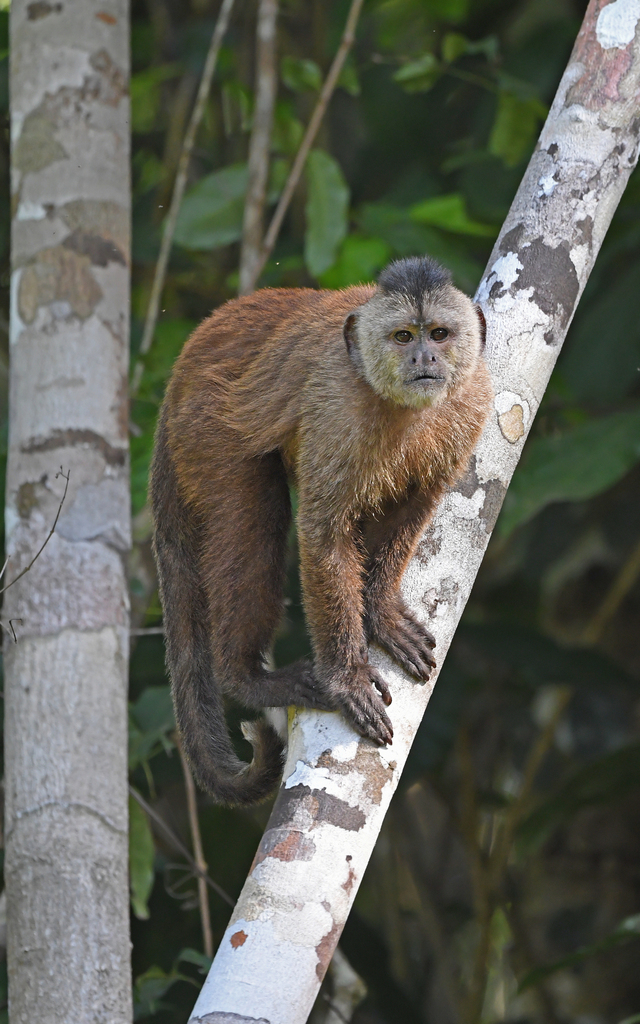
Ka’apor Capuchin
Cebus kaapori
The Kaapori capuchin (Cebus kaapori) is a capuchin monkey endemic to Brazil. This species is located the Brazilian states of Pará and Maranhão along the Atlantic coast to the north of the country, and usually found in dense forest regions, where their food is more abundant, but can also be found in secondary growth areas during the dry season. Like most Capuchins, the Kaapori capuchin is diurnal, arboreal and omnivorous, their diet consisting of small animals...
From the article Kaapori capuchin on Wikipedia (CC BY-SA), quoted section by section
Range & habitat
The Ka'apor capuchin has been described as having one of the smallest geographical ranges of any other Cebus species in the Amazon. They can be found in the eastern border of the Brazilian Amazon along the Atlantic coast; more specifically in the states of Pará and Maranhão. The region is known as for having the highest population density in all of the Amazon. Due to the large human population living in the same area, the species tend to live in isolated patches of tall, lowland terra firme forest. Included in their range, are two protected stretches of land: the Gurupi Biological Reserve and the Lago de Turucuí Environmental Protection Area. Studies of the Ka'apor capuchin populations in these areas have had very varying results but the consensus seems to be that the species is quite rare, even within their known range. In one study, researchers following a group of C. kaapori observed that their average daily travel was of approximately 2,175 m and utilized most quadrants of their home range every month.
Wikipedia: “Habitat and distribution”
What it does
Like most capuchins, the Kaapori capuchin is diurnal, arboreal and omnivorous. While they are omnivores, C. kaapori seem to rely heavily on fruit for nutrition. One study of the species in the wild concluded that almost 75% of their diet was composed of fruit matter such as fruit pulp or the aril of immature fruit. Other sources of nutrition which came up often in the study were arthropods (12.6%) and seeds (10.2%). From their research, the scientists concluded that the Ka'apor capuchins' diet resembles most closely that of the Sapajus genera than their fellow Cebus species. When foraging for insects, the capuchins can be observed practicing various techniques such as extracting their prey from leaves by breaking them manually, breaking branches with their teeth and hands in order to reach the ants inside and smashing snails against trees in order to crack their shells open.
Wikipedia: “Diet”
Listen
Looking for field recordings…
Where it lives
Recorded sightings
—
geo-referenced records in GBIF, from museums, herbaria and field observers.
Drag the globe to turn it. Dots are where records exist, not a range map; darker means more records.
In the stacks
Searching the stacks…
Every page naming Cebus kaapori in the Biodiversity Heritage Library →
This page is assembled live from iNaturalist, GBIF, Wikipedia, the Source Library and the Internet Archive. It is not yet part of the hand-edited codex. iNaturalist taxon 74155.