- Animals
- ›Chordates
- ›Vertebrates
- ›Mammals
- ›Therians
- ›Placental Mammals
- ›Primates, Rodents, and Allies
- ›Primates
- ›Monkeys, Apes, and Tarsiers
- ›Monkeys and Apes
- ›New World Monkeys
- ›Sakis, Titis, and Uakaris
- ›Titis
- ›Cheracebus
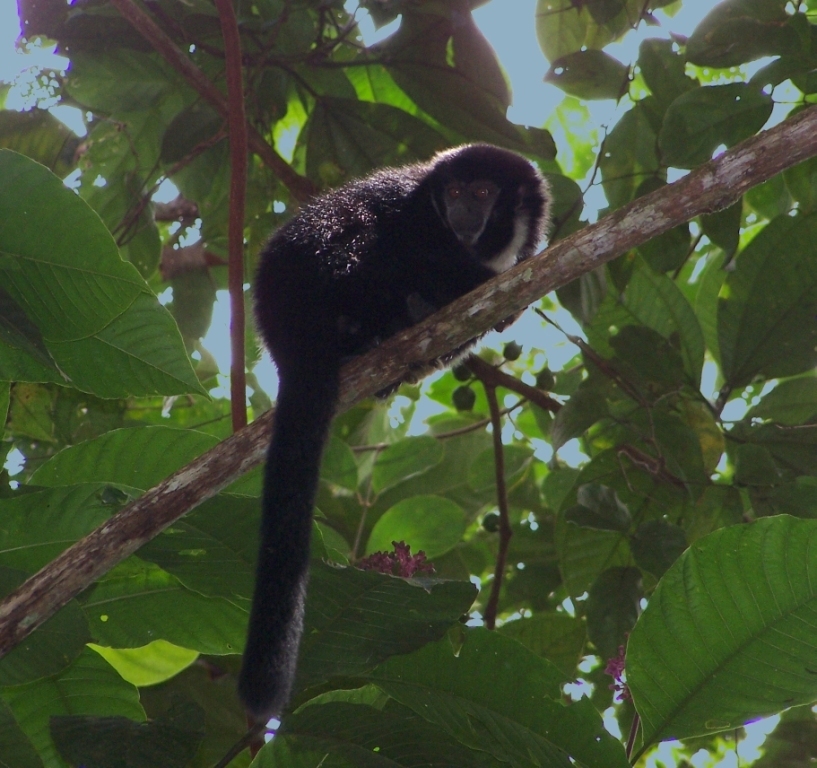
Black Titi
Cheracebus lugens
The black titi monkey (Cheracebus lugens), is a species of titi, a type of New World monkey, from South America. It is found in Brazil, Colombia, and Venezuela. It was described in 1811 as Callicebus lugens. It is sometimes called the widow monkey.
From the article Black titi monkey on Wikipedia (CC BY-SA), quoted section by section
Description
The pelage is generally blackish mixed with dark brownish and some reddish brown hairs on the back and the flanks. Hands are white or yellowish.
Range & habitat
This species has the largest range of the Cheracebus species, ranging from the Branco River and Rio Negro north to the Orinoco and Caqueta river basins. The species has been observed on the left bank of the Guayabero River,, where it was collected in 1959 by Jorge Hernández Camacho, both in La Macarena National Park, and recently it was observed by the Colombian biologist Rocío Palanco north of the Guayabero above La Cordillera de los Picachos National Park. The species is found in the Vichada selva between the Vichada and Guaviare Rivers and the northernmost Colombian population extends north of the Vichada River, reaching the middle Tomo River, where it probably extends to the upper Tomo, although this needs to be confirmed. The black titi is not found on the lower Tomo or lower Tuparro River nor on the north bank of the lower Vichada River, contrary to the distribution map of Hershkovitz. This error is due to the collection of a specimen by the English ornithologist Cherrie in about 1904 from Maipures, which may have been a captive animal obtained in the village, since extensive and concerted efforts have failed to identify it for the entire area mentioned above; nor is it known by locals for this area. The nearest titi monkeys from Maipures in Colombia are found on the middle Tuparro River and south of the lower Vichada River.
Wikipedia: “Distribution”
What it does
Although fruits are the major portion of this primate's diet, invertebrates and leaves are also consumed to a smaller degree. Lepidopteran larva, spiders and orthopterans are especially eaten with relish and probably occasional small lizards, judging by the hunting preferences of a tame, free-ranging adult female, which lived at the Caparú Biological Research Station on the lower Apaporis River. Kinzey found the following range of dietary preference during his 135 hours study in Peru: 14% Clarisia racemosa (Moraceae); 13% unidentified (Guttifereae); 7% Pithecellobium sp. (Convolvulaceae); Jessenia bataua (Arecaceae); Psychotrian axillaris (Rubiaceae); Guatteria elata (Annonaceae); Virola sp. (Myristicaceae). Easley identified frequency of item choice in the diet of the same groups as above: 74.1% fruits, 15.8% insects, 8.8% leaves, 0.6% buds and flowers and 0.1% other. Of the 57 fruit species identified, the palm tree, Jessenia polycarpa, was the most commonly eaten in 22.7% of the feeding observations. The following lists the range of preference observed in this study: 22.7% Jessenis polycarpa (Arecaceae), 7.9% Ocotea no. 1 (Lauraceae); 6.6% Tachigalia sp. (Caesalpiniaceae); 5.9% Beilschmiedia sp. (Lauraceae); 5.8% Ocotea no. 2 (Lauraceae); 4.8% unidentified; 3.5% unidentified; 3.5% Guatteria sp. (Annonaceae); 3.4% Annona sp. …
Wikipedia: “Diet”
In human culture
Social groups are made up of a monogamous pair and one or two of its young. A count of ten groups in Vichada yielded an average of 3.5 per group. Occasionally groups of five are seen and unpaired individuals ("floaters") can also be detected from time to time. Second year youngsters usually leave the group, although they may make it into the third year before leaving. These young animals sometimes appear, moving peripherally to the group and then disappear again to move alone. Measured home ranges have varied from about 15–25 ha. Appropriate habitat contains 4–5 groups/km2 (14 + "floaters"), which may add another 8–10 individuals to the total ecological density/km2. The average day range calculated by Kinzey (1977) and Kinzey et al. (1977) was 819.4 m (n=22 days) for a research project in Peru and at the Estación Biológica Caparú the average was 807.2 m (range 513.7 – 1070 m, n=26). Easley calculated a time budget based on 400 hours of observation as 62.7% rest, 16.5% moving, 16.1% feeding, 2.7% grooming, 1.6% playing and 0.3% vocalizing. Palacios & Rodríguez calculated 54.3% rest, 22.9% moving, 17.6% feeding, 4.07% grooming, 0.41% playing, and 0.42% vocalizing based on 240 hours of observation. Easley analyzed the locomotive and positional behavior of the species showing that it is a generalized quadruped using quadrupedal walking and running about 66.8% of the time. …
Wikipedia: “Natural history”
Listen
Looking for field recordings…
Where it lives
Recorded sightings
—
geo-referenced records in GBIF, from museums, herbaria and field observers.
Drag the globe to turn it. Dots are where records exist, not a range map; darker means more records.
In the stacks
Searching the stacks…
Every page naming Cheracebus lugens in the Biodiversity Heritage Library →
This page is assembled live from iNaturalist, GBIF, Wikipedia, the Source Library and the Internet Archive. It is not yet part of the hand-edited codex. iNaturalist taxon 738196.