- Animals
- ›Chordates
- ›Vertebrates
- ›Mammals
- ›Therians
- ›Placental Mammals
- ›Primates, Rodents, and Allies
- ›Primates
- ›Monkeys, Apes, and Tarsiers
- ›Monkeys and Apes
- ›New World Monkeys
- ›Sakis, Titis, and Uakaris
- ›Titis
- ›Plecturocebus
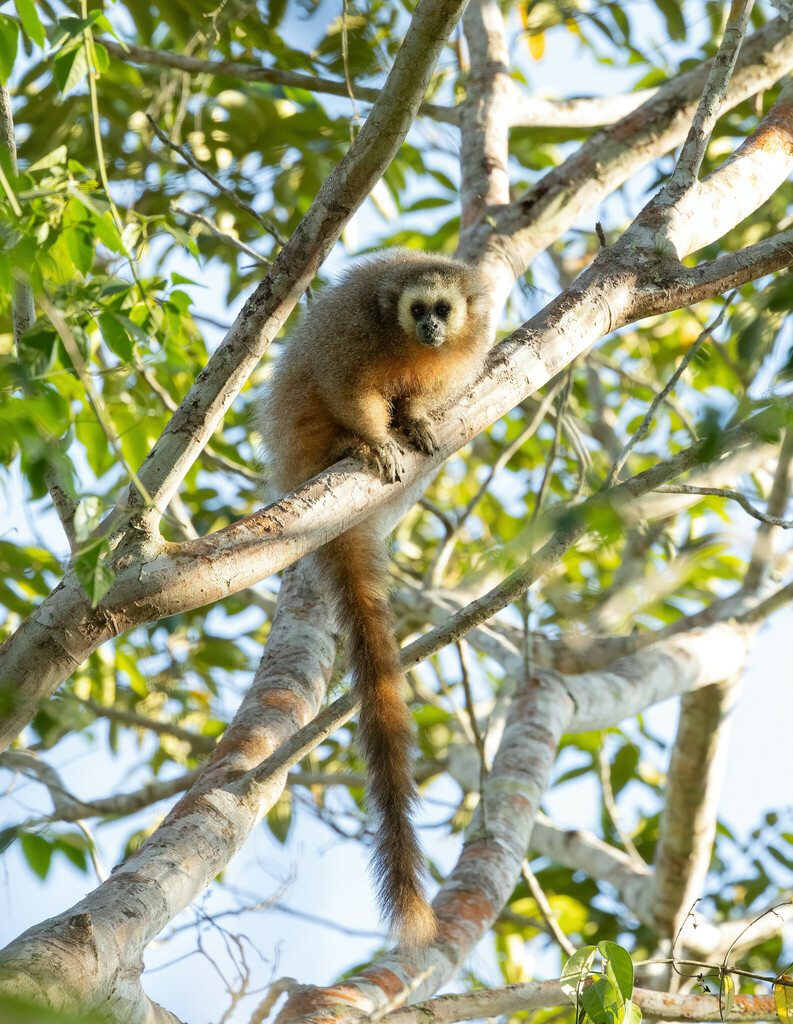
Rio Mayo Titi
Plecturocebus oenanthe
The Rio Mayo titi monkey (Plecturocebus oenanthe) is a species of titi monkey, a type of New World monkey, endemic to Peru. The Rio Mayo titi, was thought previously to have a small range of origin in the Alto Mayo valley, but research has proven that the range extends southward and reaches the Bajo Mayo and Huallaga Central. It had been classified as vulnerable but due to major habitat loss and restricted living space, it is now classified as Critically Endangered. In October 2012, it was included in The World's 25 Most Endangered Primates list. An increase in deforestation is leading to the decrease in available living space for this titi monkey, forcing it to live in sympatry with another species of Callicebus. Yet in some areas, such drastic deforestation has resulted in extremely high population density. The Rio Mayo titi is better adapted to moderately populated areas, thus overpopulation negatively impacts the species. The forests the Rio Mayo titi lives in are being destroyed for agricultural purposes, leaving little forest for the monkeys. They were only seen a few times and featured in museums until 2003 when more research was done on them. In order for this species to survive, their forests need to be protected to avoid overpopulation. Different conservation groups are working to help P. oenanthe survive. Neotropical Primate Conservation, Proyecto Mono Tocón and Amazónicos para la Amazonia are working in the more southern areas to protect the monkey.
The Rio Mayo titi is a fairly inconspicuous creature, making observation and research difficult to obtain.
From the article Rio Mayo titi monkey on Wikipedia (CC BY-SA), quoted section by section
Range & habitat
Rio Mayo titis usually live in dry woodland areas with a lot of vines and plants. They are found in Peru in the northern part of the Department of San Martin, at altitudes of 750–950 meters and also in the foothills of the Andes. One P. oenanthe family was studied by scientist DeLuycker from October 2004 to September 2005. The studied family consisted of a mother and father, two offspring, and a baby born within the study period. The family was observed to live in bamboo stands and low forests with trees with a mean height of 6.8 meters. The family used only five sleeping sites during the year-long study time, two of them only rarely. Sleeping and resting was the most common activity, followed by traveling, and then eating and foraging. The P. oenanthe also socialized with others of their own kind. However, forest degradation and disturbed habitats had a negative effect on P. oenanthe sociability.
Wikipedia: “Location, habitat and activity”
What it does
The diet of the Rio Mayo titi consists of mostly leaves, seeds, fruits, and arthropods. In one study, it was found that 54% of their diet was fruit, and 22% insects (consisting of at least 10 different types of insects), with the remainder consisting of leaves, tendrils, meristems, flowers and seeds. The 22% of the P. oenanthe diet that consists of insects is gathered in a variety of ways. There are three main types of foraging technique that the species uses to catch insects: lunging and grabbing exposed prey, biting and inspecting hidden prey, and stealth foraging or scanning for prey. Out of the three techniques, the most frequently used technique for hunting insects was found to be lunging and grabbing exposed prey. They have a high success rate of catching insects, reaching up to 83%. This species' ability to hunt insects so easily is especially important for survival in times of scarce food availability.
Wikipedia: “Diet”
Listen
Looking for field recordings…
Where it lives
Recorded sightings
—
geo-referenced records in GBIF, from museums, herbaria and field observers.
Drag the globe to turn it. Dots are where records exist, not a range map; darker means more records.
In the stacks
Searching the stacks…
Every page naming Plecturocebus oenanthe in the Biodiversity Heritage Library →
This page is assembled live from iNaturalist, GBIF, Wikipedia, the Source Library and the Internet Archive. It is not yet part of the hand-edited codex. iNaturalist taxon 738178.