On eBird ↗
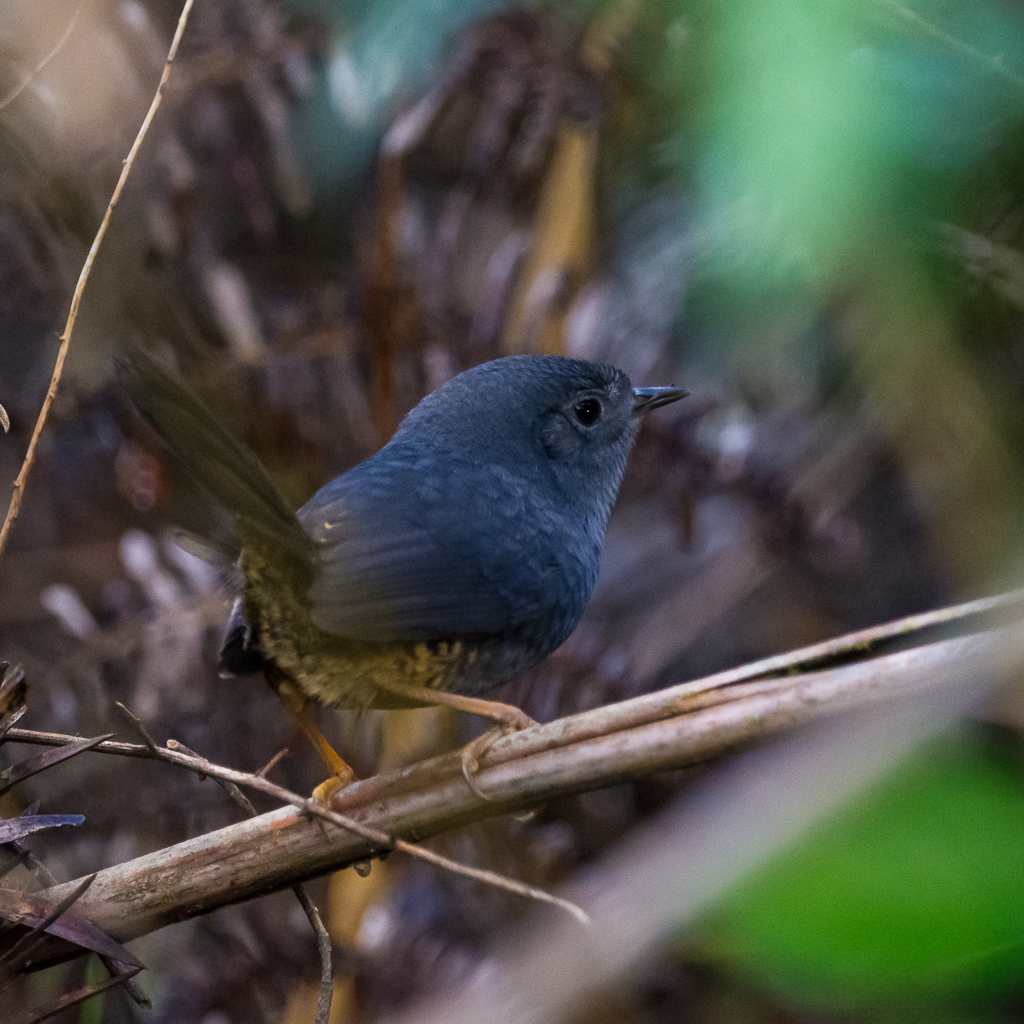
Planalto Tapaculo
Live sightings near you, the range map, bar charts of when it is seen, and Macaulay Library photos and recordings.
Planalto Tapaculo
Scytalopus pachecoi
The Planalto tapaculo (Scytalopus pachecoi) is a small passerine bird belonging to the genus Scytalopus, a genus of tapaculos. It was previously included in the mouse-coloured tapaculo (S. speluncae) but was described as a new species in 2005 based on differences in plumage and vocalizations.
From the article Planalto tapaculo on Wikipedia (CC BY-SA), quoted section by section
Description
The Planalto tapaculo is about 12 cm (4.7 in) long and weighs about 15 g (0.53 oz). The male's upperparts are mainly dark gray and the underparts paler gray. The flanks are buff with dark bars, which differentiate it from the similar but unbarred mouse-colored tapaculo. The female is browner and the juvenile has not been described.
Range & habitat
The Planalto tapaculo is known from southern Brazil (several parts of Rio Grande do Sul and southeastern Santa Catarina) and extreme northeast Misiones Province of Argentina. It inhabits forest and forest edge where it is often found near streams and in undergrowth such as bamboo thickets. It has been found at higher densities in secondary forest than in undisturbed forest. It ranges up to 1,500 m (4,900 ft) elevation.
Wikipedia: “Distribution and habitat”
What it does
The Planalto tapaculo forages for arthropods in the forest understory, primarily in thickets of terrestrial bromeliads and bamboo.
Wikipedia: “Feeding”
Listen
Looking for field recordings…
Where it lives
Recorded sightings
—
geo-referenced records in GBIF, from museums, herbaria and field observers.
Drag the globe to turn it. Dots are where records exist, not a range map; darker means more records.
In the stacks
Searching the stacks…
Every page naming Scytalopus pachecoi in the Biodiversity Heritage Library →
This page is assembled live from iNaturalist, GBIF, Wikipedia, the Source Library and the Internet Archive. It is not yet part of the hand-edited codex. iNaturalist taxon 73379.