On eBird ↗
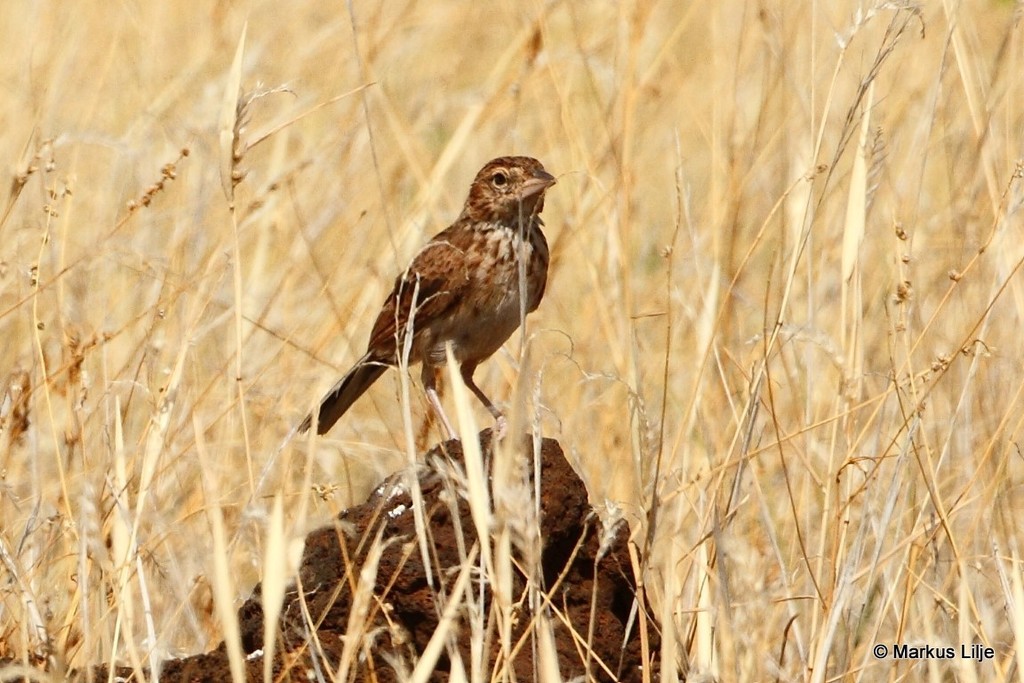
Williams's Lark
Live sightings near you, the range map, bar charts of when it is seen, and Macaulay Library photos and recordings.
Williams's Lark
Mirafra williamsi
Williams's lark (Mirafra williamsi) is a species of lark in the family Alaudidae. Discovered in 1955, much of its life and ecology is still a mystery to ornithology.
From the article Williams's lark on Wikipedia (CC BY-SA), quoted section by section
Range & habitat
In general, the natural habitat of M. williamsi is subtropical or tropical dry shrubland. Its range is restricted to northern Kenya where it is found in two disjunct populations: One population is located north of Marsabit, in the Didi Galgalla desert, a region marked by plains of rocky, red lava soils and patches of short-grass and bushes. The other inhabits a particular area (elevated between 600 m and 1,350 m) lying between Isiolo and Garba Tula. It has even, unbroken communities of Barleria shrubs.
Wikipedia: “Distribution and habitat”
What it does
The males of the species perform long, drawn-out, conspicuous song-flights above their territories after the rains at dawn, making them easy to find at this time.
Food and feeding. Williams's larks consume various seeds and insects.
== References ==
Wikipedia: “Behaviour and ecology”
Listen
Looking for field recordings…
Where it lives
Recorded sightings
—
geo-referenced records in GBIF, from museums, herbaria and field observers.
Drag the globe to turn it. Dots are where records exist, not a range map; darker means more records.
In the stacks
Searching the stacks…
Every page naming Mirafra williamsi in the Biodiversity Heritage Library →
This page is assembled live from iNaturalist, GBIF, Wikipedia, the Source Library and the Internet Archive. It is not yet part of the hand-edited codex. iNaturalist taxon 7333.