- Animals
- ›Chordates
- ›Vertebrates
- ›Birds
- ›Perching Birds
- ›Ovenbirds and Woodcreepers
- ›Typical Ovenbirds
- ›Pseudasthenes
On eBird ↗
Patagonian Canastero
Live sightings near you, the range map, bar charts of when it is seen, and Macaulay Library photos and recordings.
Patagonian Canastero
Pseudasthenes patagonica
The Patagonian canastero (Pseudasthenes patagonica) is a species of bird in the family Furnariidae. It is endemic to Argentina. Its natural habitat is subtropical or tropical dry shrubland.
From the article Patagonian canastero on Wikipedia (CC BY-SA), quoted section by section
Description
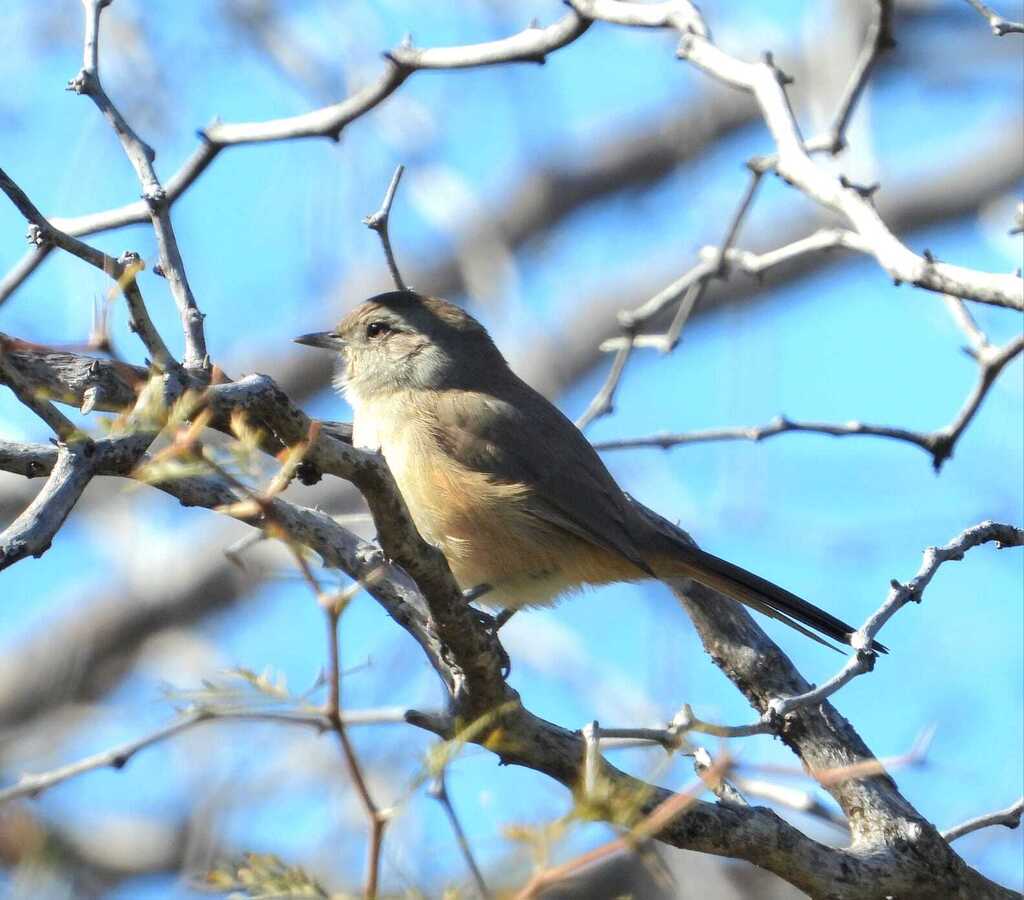
The Patagonian canastero is 14 to 15 cm (5.5 to 5.9 in) long and weighs 14 to 19 g (0.49 to 0.67 oz). The sexes have the same plumage. Adults have a light grayish brown face with hints of a paler supercilium and darker line behind the eye. Their crown and upperparts are light gray-brown. Their wings are somewhat browner and the feathers have somewhat rufescent edges. Their tail is dark gray-brown with chestnut on the outer feathers. Their chin and throat are grayish white with black flecks and streaks on the latter. Their breast is pale grayish, their upper belly pale buff-gray, their lower belly and flanks tawny, and their undertail coverts tawny-rufous.
Range & habitat
The Patagonian canastero is found in southern Argentina from the provinces of Mendoza, La Pampa, and Buenos Aires south into northern Santa Cruz Province. It inhabits semi-arid to arid steppe scrublands from near sea level to 700 m (2,300 ft).
Wikipedia: “Distribution and habitat”
What it does
The Patagonian canastero feeds mostly on arthropods with some seeds also part of its diet. As best is known, it forages by itself, gleaning prey from the ground and low vegetation.
Wikipedia: “Feeding”
Listen
Looking for field recordings…
Where it lives
Recorded sightings
—
geo-referenced records in GBIF, from museums, herbaria and field observers.
Drag the globe to turn it. Dots are where records exist, not a range map; darker means more records.
In the stacks
Searching the stacks…
Every page naming Pseudasthenes patagonica in the Biodiversity Heritage Library →
This page is assembled live from iNaturalist, GBIF, Wikipedia, the Source Library and the Internet Archive. It is not yet part of the hand-edited codex. iNaturalist taxon 73289.