On eBird ↗
Black Oropendola
Live sightings near you, the range map, bar charts of when it is seen, and Macaulay Library photos and recordings.
Black Oropendola
Psarocolius guatimozinus
The black oropendola (Psarocolius guatimozinus) is a species of bird in the family Icteridae (New World blackbirds). It is found in Colombia and Panama. Its natural habitat is subtropical or tropical moist lowland forests.
From the article Black oropendola on Wikipedia (CC BY-SA), quoted section by section
Description
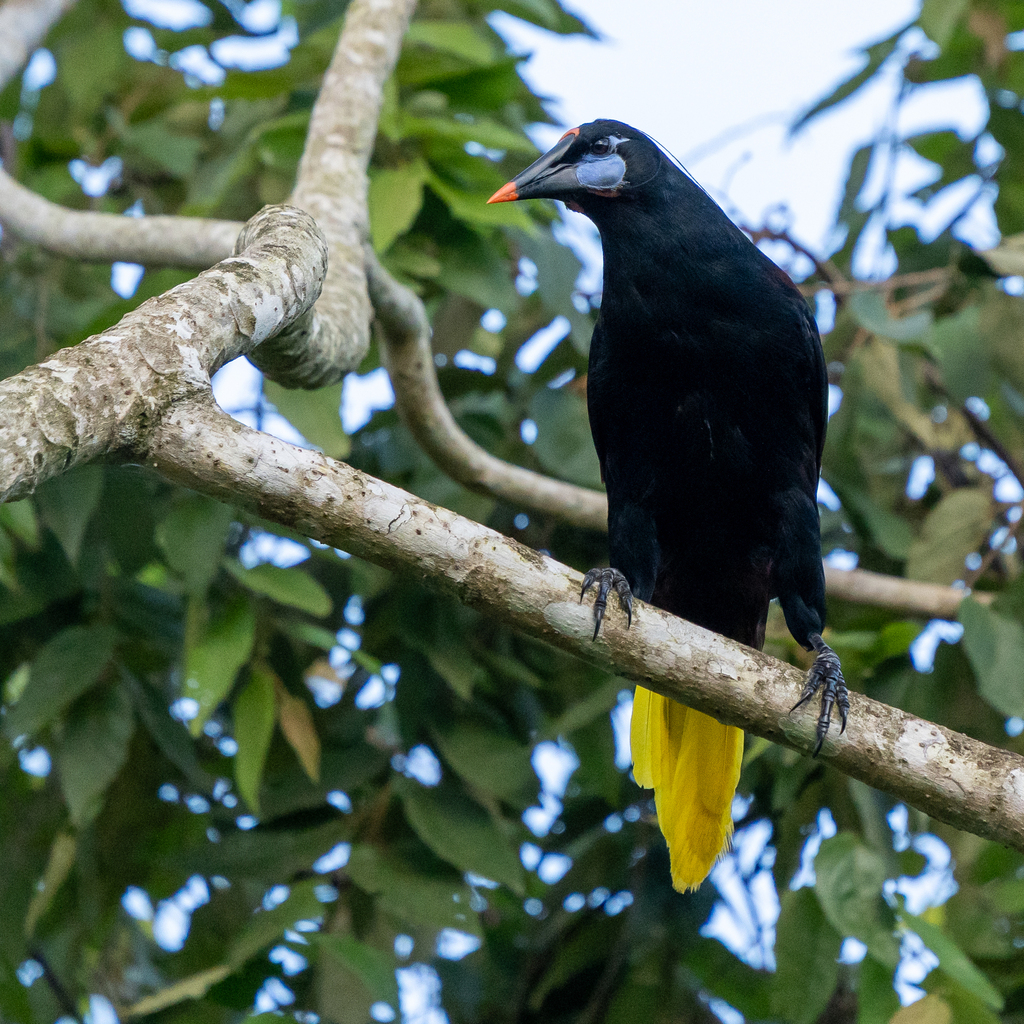
Male black oropendolas are about 47 cm (19 in) long and females about 39 cm (15 in). Adult males have long black feathers on their nape that form a crest. Females have a shorter crest but are otherwise like males except for their smaller size. Adults are mostly black. They have a patch of bare pale blue skin on their face and a pink wattle at the base of the bill. Their scapulars, upperwing coverts, lower back, rump, most uppertail coverts, and undertail coverts are dark chestnut. (The rearmost uppertail coverts are black.) Their tail's central pair of feathers are black and the rest yellow; because the black ones are shorter than the others the tail often looks completely yellow from below. They have a large bill with a swollen casque; it is mostly black with an orange tip. They have a brown iris and blackish legs and feet.
Range & habitat
The black oropendola is found from eastern Panama's Panamá and Darién provinces into northwestern Colombia's Chocó, Antioquia, and Caldas departments. In Colombia its eastern boundary is the Magdalena River valley. It inhabits the canopy and edges of humid forest and also nearby plantations. In reaches an elevation of 800 m (2,600 ft).
Wikipedia: “Distribution and habitat”
What it does
The black oropendola's diet has not been studied but is assumed to include insects, other arthropods, small vertebrates, fruit, and nectar. It usually forages singly or in small groups, and mostly in the forest's higher levels. It has been observed prying apart flowers by opening its bill inside them.
Wikipedia: “Feeding”
Listen
Looking for field recordings…
Where it lives
Recorded sightings
—
geo-referenced records in GBIF, from museums, herbaria and field observers.
Drag the globe to turn it. Dots are where records exist, not a range map; darker means more records.
In the stacks
Searching the stacks…
Every page naming Psarocolius guatimozinus in the Biodiversity Heritage Library →
This page is assembled live from iNaturalist, GBIF, Wikipedia, the Source Library and the Internet Archive. It is not yet part of the hand-edited codex. iNaturalist taxon 73286.