On eBird ↗
Singing Bushlark
Live sightings near you, the range map, bar charts of when it is seen, and Macaulay Library photos and recordings.
Singing Bushlark
Mirafra javanica
The singing bush lark or Horsfield's bush lark (Mirafra javanica) is a species of lark which inhabits grassland throughout most of Australia and much of Southeast Asia. It was described by the American naturalist Thomas Horsfield.
From the article Singing bush lark on Wikipedia (CC BY-SA), quoted section by section
Description
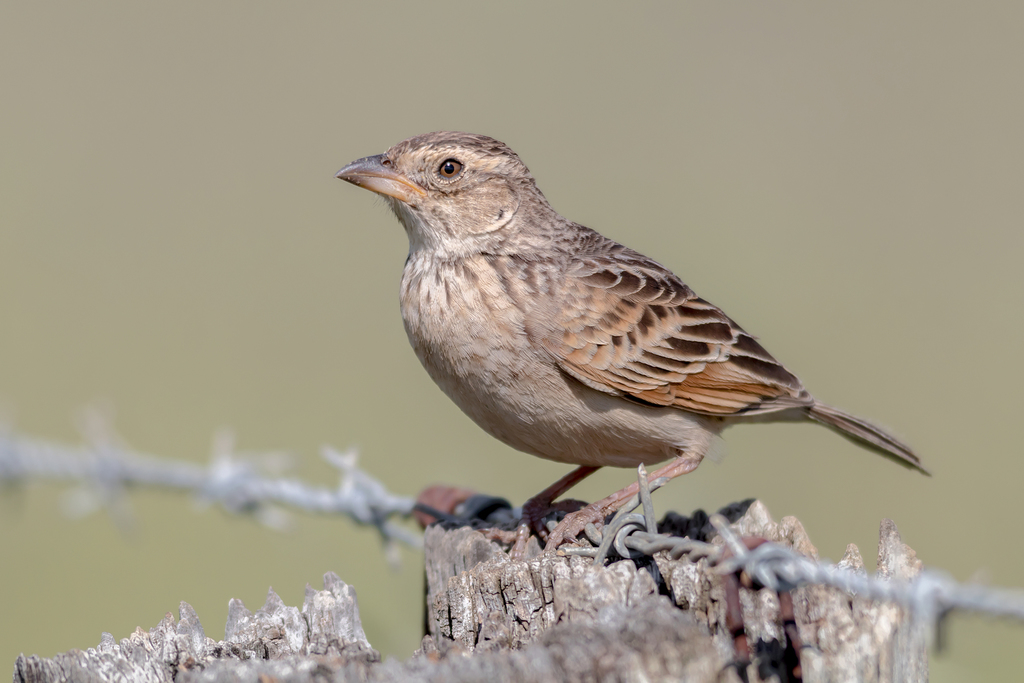
The singing bush lark is a small, thickset bird with a large head, a short, sparrow-like bill and a small crest which is only visible when raised. Its dorsal plumage colour is brown, reddish or sandy with darker central streaks to the feathers. The breast is mottled or streaked and it has a buff eyebrow. The underparts are pale, with a brown tail. The adult upper parts and crown are near black with coarse buff to russet streaking. Juveniles are similar but the crown and upper parts are neatly scaled by narrow white fringes to the feathers. Nestlings have dense natal down and contrasting dark spots on their tongue and mouth. The average lengths for the wing are 61–81 mm, tail 40–56 mm, bill 12–16 mm and weight 18–25 grams. The wings are short and rounded with a distinctive rufous panel. The innermost secondary feather is vestigial and of the ten primary feathers, p10 is very short but not vestigial. The primaries moult outward starting at p1 while the tail and body moult during the early stages of, or just before the start of the moult of the primaries.
Similar species. In appearance and size the bushlark is very similar to the Australian pipit and can also be mistaken for a half-grown Eurasian skylark. The bush lark's wings lack the white trailing edge of the skylark while in flight, its tail is white-sided like the skylark and pipits, but is only half as long. …
Range & habitat
The range of the singing bush lark is very broad, with an estimated global extent of occurrence of 10,000,000 km2. In Australia, the bush lark occurs from the Eyre Peninsula, South Australia, through Victoria, New South Wales, Queensland, Northern Territory and Western Australia to Shark Bay. This species is a summer migrant to south-eastern continental Australia and vagrant to the island of Tasmania. In Australia they inhabit chenopod shrublands, native and exotic grasslands in temperate and tropical areas, coastal heathlands, dunes, mudflats and also modified open habitats such as crop and pastureland. They are found less commonly on playing fields, golf courses, road verges, salt marshes and other shrublands or heathland and rarely in treed habitats.
Wikipedia: “Distribution and habitat”
What it does
Bush larks are terrestrial and omnivorous foragers with a short, stout bill suited for crushing seeds. They eat mainly grass seeds and invertebrates, particularly insects during the breeding season. By gleaning and probing most food is taken from the ground surface or, just below. Mostly they forage alone, but sometimes are found in small parties.
Wikipedia: “Feeding”
Listen
Looking for field recordings…
Where it lives
Recorded sightings
—
geo-referenced records in GBIF, from museums, herbaria and field observers.
Drag the globe to turn it. Dots are where records exist, not a range map; darker means more records.
In the stacks
Searching the stacks…
Every page naming Mirafra javanica in the Biodiversity Heritage Library →
This page is assembled live from iNaturalist, GBIF, Wikipedia, the Source Library and the Internet Archive. It is not yet part of the hand-edited codex. iNaturalist taxon 7318.