On eBird ↗
Blue Grosbeak
Live sightings near you, the range map, bar charts of when it is seen, and Macaulay Library photos and recordings.
Blue Grosbeak
Passerina caerulea
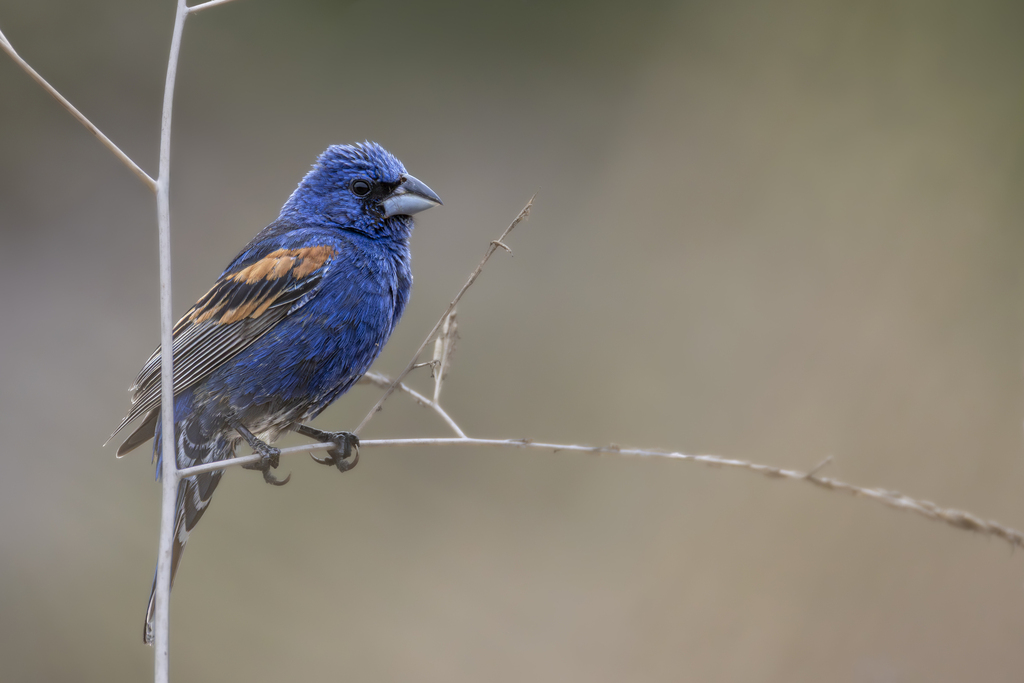
The blue grosbeak (Passerina caerulea) is a medium-sized North American passerine bird in the cardinal family Cardinalidae. It is mainly migratory, wintering in Central America and breeding in northern Mexico and the southern United States. The male is blue with two brown wing bars. The female is mainly brown with scattered blue feathers on the upperparts and two brown wing bars.
From the article Blue grosbeak on Wikipedia (CC BY-SA), quoted section by section
Description
The male blue grosbeak is deep blue, with both black and brown on its wings. The female is mostly brown. Both sexes are distinguished by their large, deep bill and double wing bars. These features, as well as the grosbeak's relatively larger size, distinguish this species from the indigo bunting. Length can range from 14 to 19 cm (5.5 to 7.5 in) and wingspan is from 26 to 29 cm (10 to 11 in). Body mass is typically from 26 to 31.5 g (0.92 to 1.11 oz).
Range & habitat
This is a migratory bird, with nesting grounds across most of the southern half of the United States and much of northern Mexico. The range of this species has expanded northward over the past century or two, likely aided by the clearing of forests by humans. Blue grosbeaks are now regularly observed nesting across much of the Midwest and Northeastern United States. They are uncommon within their range, migrating south to Central America and in very small numbers to northern South America; the southernmost record comes from eastern Ecuador. Vagrant birds have appeared as far north as New England and Eastern Canada. This species is found in partly open habitat with scattered trees, riparian woodland, scrub, thickets, cultivated lands, woodland edges, overgrown fields, or hedgerows.
Wikipedia: “Distribution and habitat”
What it does
It eats mostly insects, but it will also eat snails, spiders, seeds, grains, and wild fruits. The blue grosbeak forages mainly on the ground.
Wikipedia: “Feeding”
Listen
Looking for field recordings…
Where it lives
Recorded sightings
—
geo-referenced records in GBIF, from museums, herbaria and field observers.
Drag the globe to turn it. Dots are where records exist, not a range map; darker means more records.
In the old herbals & bestiaries

In the stacks
Searching the stacks…
Every page naming Passerina caerulea in the Biodiversity Heritage Library →
This page is assembled live from iNaturalist, GBIF, Wikipedia, the Source Library and the Internet Archive. It is not yet part of the hand-edited codex. iNaturalist taxon 73155.