On eBird ↗
Giant White-eye
Live sightings near you, the range map, bar charts of when it is seen, and Macaulay Library photos and recordings.
Giant White-eye
Megazosterops palauensis
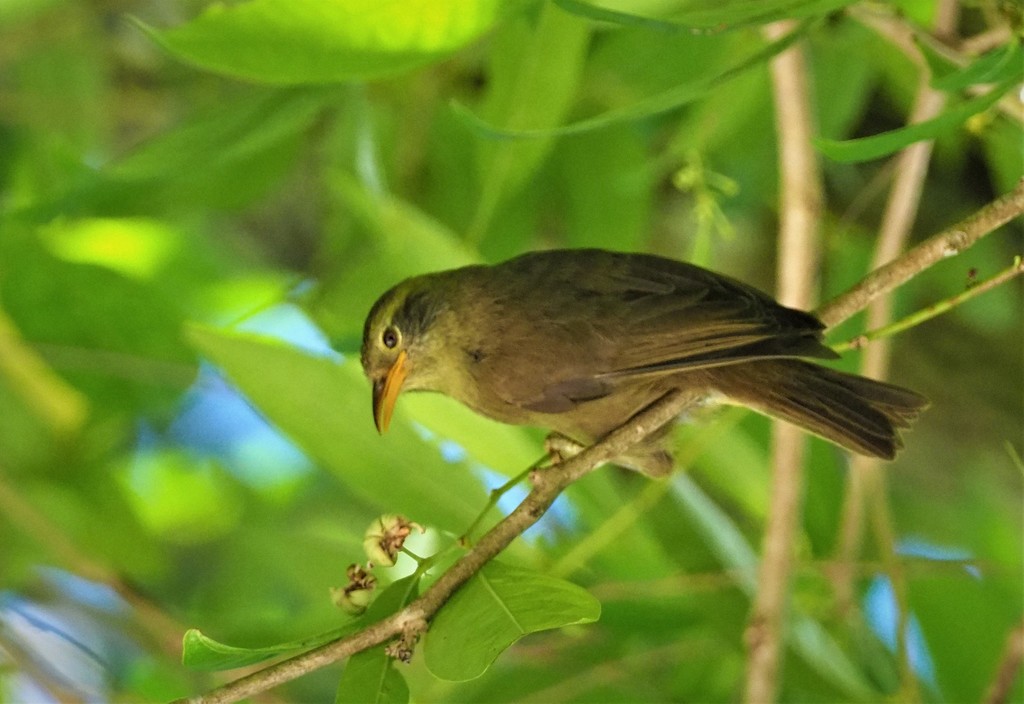
The giant white-eye, or Palau greater white-eye (Megazosterops palauensis) is a species of bird in the family Zosteropidae. It is monotypic within the genus Megazosterops. It is endemic to Palau, where its natural habitat is tropical moist lowland forest. The species is currently classified as Near Threatened by the IUCN due to likely habitat loss and the possibility of the establishment of the invasive Brown tree snake on the island.The Giant White-eye is 13-14cm large. It has a pale yellowish supercilium from the eye, widening backwards. Iris, greyish to dark brown. Narrow pale-yellow eye ring. Dark loral area leading to dark greying ear-coverts with pale yellow mottling. Dark fulvous olive over, crown feathers, greyish towards bases. Slightly buffy flanks. Legs tawny or olive-green with yellowish soles. It has a mottled appearance.
From the article Giant white-eye on Wikipedia (CC BY-SA), quoted section by section
Range & habitat
The species is currently listed as endangered because of its restricted distribution and small population size. The island's isolation and small habitat size may contribute to a restriction to the species distribution.The species is on a decline due to habitat loss. There is continuous deforestation which has resulted in a major loss in habitat area. This leaves the species with limited forest through its habitat range. This specific species has been on a slow decline at a rate of 20% over the past three generations.
Wikipedia: “Geographic Range”
What it does
The Giant white-eye sounds like two Canaries (Serinus) singing at the same time. Short sibilant whistle during inflight or feeding. Downward strained whistles followed by a long trill. Rhythmic rattling surging while simultaneously up slurred whistles. Descending siren-like uttered polyphonically. They do not travel in flocks but do form flocks in December.
Wikipedia: “Sound and Behavior”
Listen
Looking for field recordings…
Where it lives
Recorded sightings
—
geo-referenced records in GBIF, from museums, herbaria and field observers.
Drag the globe to turn it. Dots are where records exist, not a range map; darker means more records.
In the stacks
Searching the stacks…
Every page naming Megazosterops palauensis in the Biodiversity Heritage Library →
This page is assembled live from iNaturalist, GBIF, Wikipedia, the Source Library and the Internet Archive. It is not yet part of the hand-edited codex. iNaturalist taxon 73017.