On eBird ↗
White-backed Swallow
Live sightings near you, the range map, bar charts of when it is seen, and Macaulay Library photos and recordings.
White-backed Swallow
Cheramoeca leucosterna
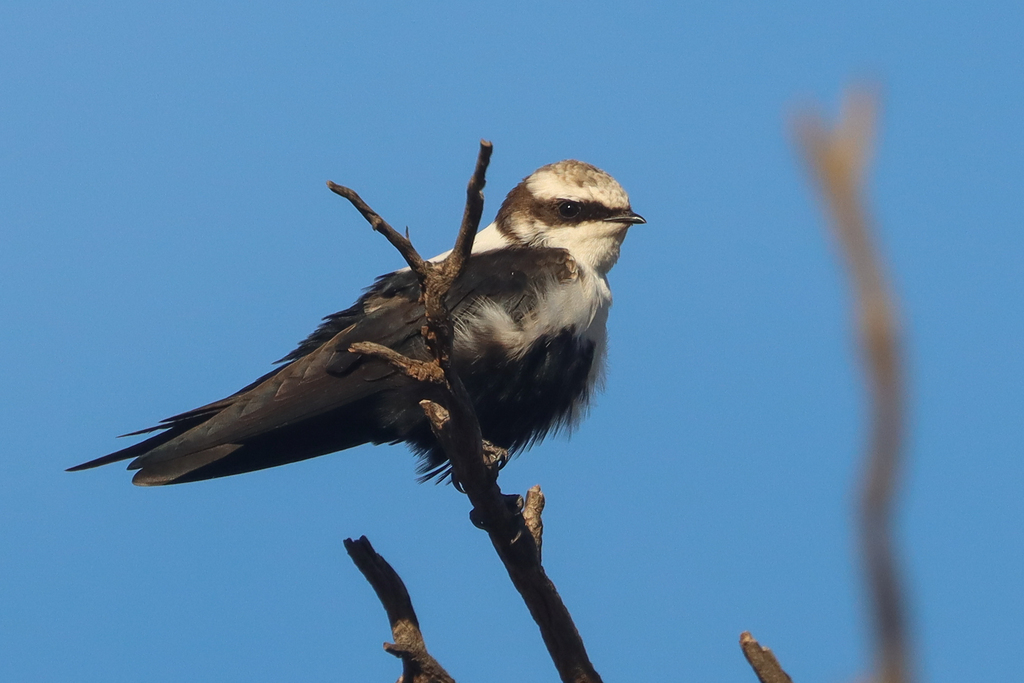
The white-backed swallow (Cheramoeca leucosterna) is a member of the swallow family Hirundinidae and is endemic to Australia. It is the only species placed in the genus Cheramoeca. As with all swallows, it is characterised by adaptation to aerial feeding. It can be identified by its white back, surrounded by black wings and tail. It has a wide distribution, from the southern part of the Australian continent, up to the Tropic of Capricorn. The white-backed swallow prefers grasslands and will create a burrow nest.
From the article White-backed swallow on Wikipedia (CC BY-SA), quoted section by section
Description
An adult white-backed swallow averages 15 cm long, similar in size to other swallows found in Australia. The adult has a mottled grey cap above white eyebrows and a grey eye. It has a dark stripe running from the lores and across the nape of the neck. The back and most of the breast is white. The belly, wings and tail are black. The white-backed swallow has a deeply forked tail, with curved and pointed wings. The short bill is black; the legs and feet are grey. It has a slender, streamlined body. The eyes consist of a prominent, dark iris. The sexes have similar colouring but during adolescence the white-backed swallow has duller colours.
Range & habitat
White-backed swallows are endemic to Australia and have a wide population distribution on the continent. They can be found from the southern latitudes of Australia and their range extends to the Tropic of Capricorn. Occasionally, after inland rainfall, white-backed swallows can extend their range to encompass the entire southern portion of Australia including the desert regions. White-backed swallows prefer open country, above open grassland and low shrubs. During the breeding season, they have a strong preference for habitats around creek beds. There is no population count, but the species is reported to be common. Due to range expansion from land clearance and mining, the population is estimated to be increasing. Due to the large range and increasing population, the white-backed swallow is categorised as least concern by the IUCN.
Wikipedia: “Distribution and habitat”
What it does
White-backed swallows are insectivorous and feed in-flight on insects, like all known swallows. The composition of their diet varies by geographic region and with the time of year. They typically nest by digging a horizontal tunnel into a vertical dirt cliff. Predation of swallows nests is known to occur, typically from foxes and cats.
== References ==
Wikipedia: “Behaviour”
Listen
Looking for field recordings…
Where it lives
Recorded sightings
—
geo-referenced records in GBIF, from museums, herbaria and field observers.
Drag the globe to turn it. Dots are where records exist, not a range map; darker means more records.
In the stacks
Searching the stacks…
Every page naming Cheramoeca leucosterna in the Biodiversity Heritage Library →
This page is assembled live from iNaturalist, GBIF, Wikipedia, the Source Library and the Internet Archive. It is not yet part of the hand-edited codex. iNaturalist taxon 72658.