- Animals
- ›Chordates
- ›Vertebrates
- ›Birds
- ›Perching Birds
- ›Ovenbirds and Woodcreepers
- ›Typical Ovenbirds
- ›Asthenes
On eBird ↗
White-chinned Thistletail
Live sightings near you, the range map, bar charts of when it is seen, and Macaulay Library photos and recordings.
White-chinned Thistletail
Asthenes fuliginosa
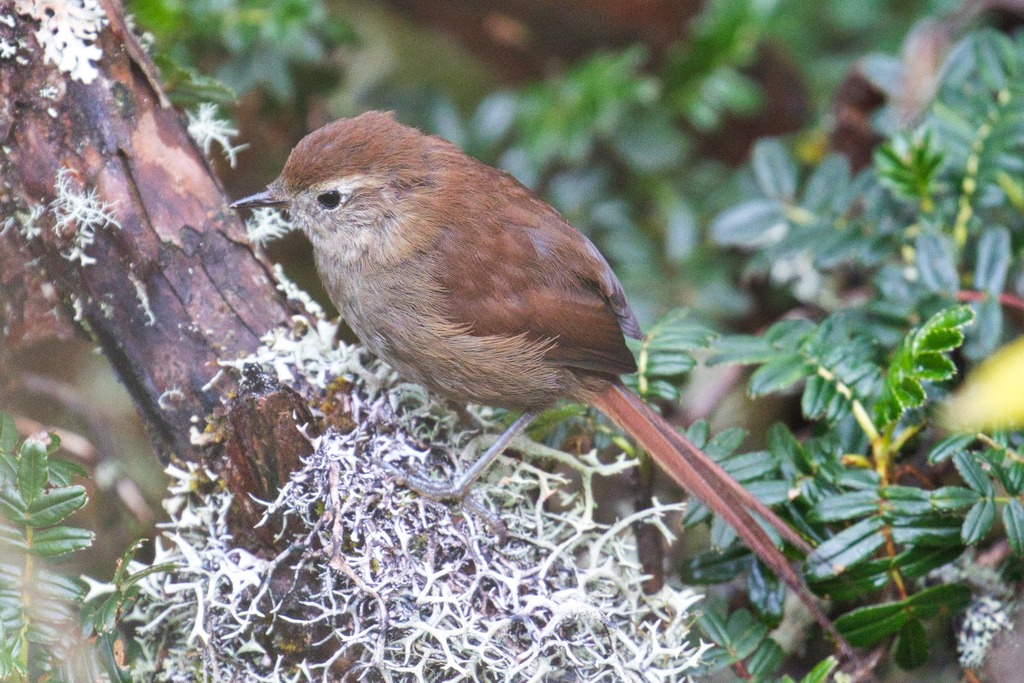
The white-chinned thistletail or "Colicardo Barbiblanco" (Asthenes fuliginosa) is a species of bird in the family Furnariidae. It is found in Colombia, Ecuador, Peru, and Venezuela. Its natural habitats are subtropical or tropical moist montane forests and subtropical or tropical high-altitude grassland.
From the article White-chinned thistletail on Wikipedia (CC BY-SA), quoted section by section
Description
The white-chinned thistletail is 18 to 20 cm (7.1 to 7.9 in) long and weighs 14 to 20 g (0.49 to 0.71 oz). It is the largest thistletail. The sexes have the same plumage. Adults of the nominate subspecies A. f. fuliginosa have a faint grayish-tawny supercilium and a whitish eyering on an otherwise blackish to dark brown face. Their crown, back, rump, and tail are dark reddish brown. Their wings are a brighter reddish brown. Their tail is long and deeply forked with few barbs at the feather ends that give a ragged appearance. Their chin is whitish. Their throat and the rest of their underparts are grayish with a brownish tinge on the flanks. Their iris color is highly variable, their maxilla black to dark gray, their mandible dark with a pinkish to whitish base, and their legs and feet blue-gray to gray. The other subspecies of the white-chinned thistletail differ mostly in the color of their upperparts. Subspecies A. f. fumigata has a darker back than the nominate and browner underparts. A. f. peruviana has duller upperparts than the nominate, with a darker chin, little or no eyering, and a gray or blue-gray mandible. A. f. plengei has redder upperparts and tail than the nominate, with a longer and whiter supercilium and a dark gray lower throat with whitish streaks.
Range & habitat
The subspecies of the white-chinned thistletail are found thus:
A. f. fuliginosa: Venezuela's Táchira state, Colombia's Eastern Andes, and the Andes of Ecuador as far south as Pichincha Province on the western slope and Morona-Santiago Province on the eastern slope A. f. fumigata: Colombia's Central Andes between the departments of Caldas and Nariño A. f. peruviana: Andes of northern Peru's Amazonas Department A. f. plengei: Andes of central Peru between the departments of San Martín and Pasco The white-chinned thistletail inhabits páramo grasslands and elfin forest, the upper edge of cloudforest, and dense undergrowth at tree line. Locally it also occurs in Polylepis woodland. In elevation it generally ranges between 2,800 and 4,000 m (9,200 and 13,100 ft). In Ecuador it occurs below 3,500 m (11,500 ft); in Colombia it occurs as low as 2,400 m (7,900 ft).
Wikipedia: “Distribution and habitat”
What it does
The white-chinned thistletail feeds mostly on arthropods but also includes small seeds in its diet. It usually forages singly on in pairs and only rarely joins mixed-species feeding flocks. It feeds in the understory, gleaning prey from foliage and small branches, and sometimes makes acrobatic moves.
Wikipedia: “Feeding”
Listen
Looking for field recordings…
Where it lives
Recorded sightings
—
geo-referenced records in GBIF, from museums, herbaria and field observers.
Drag the globe to turn it. Dots are where records exist, not a range map; darker means more records.
In the stacks
Searching the stacks…
Every page naming Asthenes fuliginosa in the Biodiversity Heritage Library →
This page is assembled live from iNaturalist, GBIF, Wikipedia, the Source Library and the Internet Archive. It is not yet part of the hand-edited codex. iNaturalist taxon 72538.