On eBird ↗
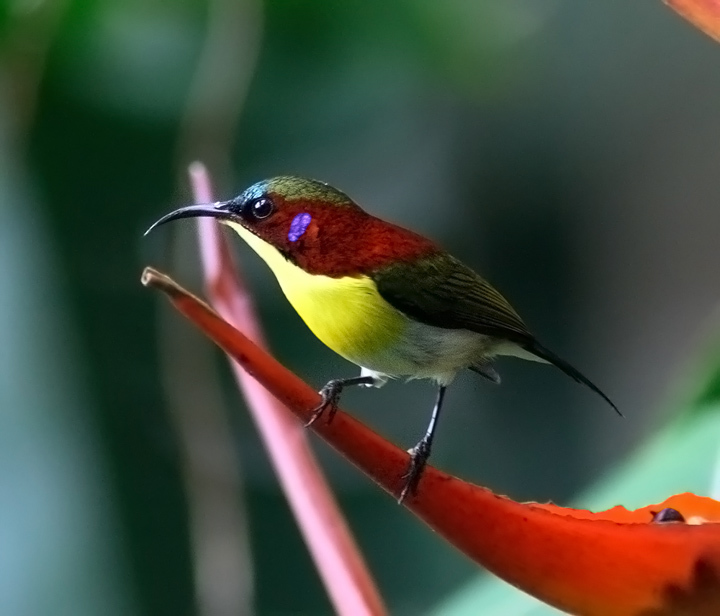
Handsome Sunbird
Live sightings near you, the range map, bar charts of when it is seen, and Macaulay Library photos and recordings.
Handsome Sunbird
Aethopyga bella
The handsome sunbird (Aethopyga bella) is a species of bird in the family Nectariniidae. It is endemic to the Philippines.
Its natural habitats are tropical moist lowland forests and tropical moist montane forests.It has a high pitched voice and it sounds like "chik".
From the article Handsome sunbird on Wikipedia (CC BY-SA), quoted section by section
Description
It was formerly conspecific with the Lovely sunbird but is differentiated by its plain yellow breast versus the Lovely sunbirds red streaking.
Subspecies. Six subspecies are recognised:
A. b. flavipectus Ogilvie-Grant, WR, 1894 – northern Philippines (northern Luzon) A. b. minuta Bourns, FS & Worcester, DC, 1894 – northern Philippines (central Luzon, Mindoro, Polillo, and Marinduque) A. b. rubrinota McGregor, RC, 1905 – northern Philippines (Lubang) A. b. bella Tweeddale, A, 1877 – east-central and southern Philippines (Samar, Leyte, Dinagat Islands, Siargao, and Mindanao) A. b. bonita Bourns, FS & Worcester, DC, 1894 – west-central Philippines (Ticao, Masbate, Panay, Negros and Cebu) A. b. arolasi Bourns, FS & Worcester, DC, 1894 – southern Philippines (Sulu Archipelago)
Wikipedia: “Description and taxonomy”
Range & habitat
Its natural habitats are tropical moist lowland forest, montane forest, second growth and plantations up to 2,000 meters above sea level. The IUCN has classified the species as Least Concern as it has a large range and it is common throughout with the population believed to be stable. However, deforestation in the Philippines continues throughout the country due to slash and burn farming, mining, illegal logging and habitat conversion. It is found in multiple protected areas such as Bataan National Park, Mount Banahaw, Mount Kitanglad. Mount Apo, Pasonanca Natural Park and Northern Sierra Madre Natural Park but like all areas in the Philippines, protection is lax and deforestation continues despite this protection on paper.
== References ==
Wikipedia: “Habitat and conservation status”
What it does
Not much is known about its diet but it is presumed to have the typical flowerpecker diet of small fruits, insects, nectar especially from mistletoes. Typically seen singly, pairs, small groups and joins mixed species flocks. Breeding has been recorded on January, June, July and September. Nests were found with 3 eggs but otherwise breeding is unstudied.
Wikipedia: “Ecology and behavior”
Listen
Looking for field recordings…
Where it lives
Recorded sightings
—
geo-referenced records in GBIF, from museums, herbaria and field observers.
Drag the globe to turn it. Dots are where records exist, not a range map; darker means more records.
In the stacks
Searching the stacks…
Every page naming Aethopyga bella in the Biodiversity Heritage Library →
This page is assembled live from iNaturalist, GBIF, Wikipedia, the Source Library and the Internet Archive. It is not yet part of the hand-edited codex. iNaturalist taxon 72467.