On eBird ↗
Orange Minivet
Live sightings near you, the range map, bar charts of when it is seen, and Macaulay Library photos and recordings.
Orange Minivet
Pericrocotus flammeus
The orange minivet (Pericrocotus flammeus) is a species of bird in the cuckooshrike family, Campephagidae. It is found in Bangladesh, Bhutan, Brunei, Cambodia, China, India, Indonesia, Laos, Malaysia, Myanmar, Nepal, Philippines, Singapore, Sri Lanka, Thailand and Vietnam. Its natural habitats are temperate forests, subtropical or tropical moist lowland forest, and subtropical or tropical moist montane forest. It was formerly considered a subspecies of the scarlet minivet.
From the article Orange minivet on Wikipedia (CC BY-SA), quoted section by section
Description
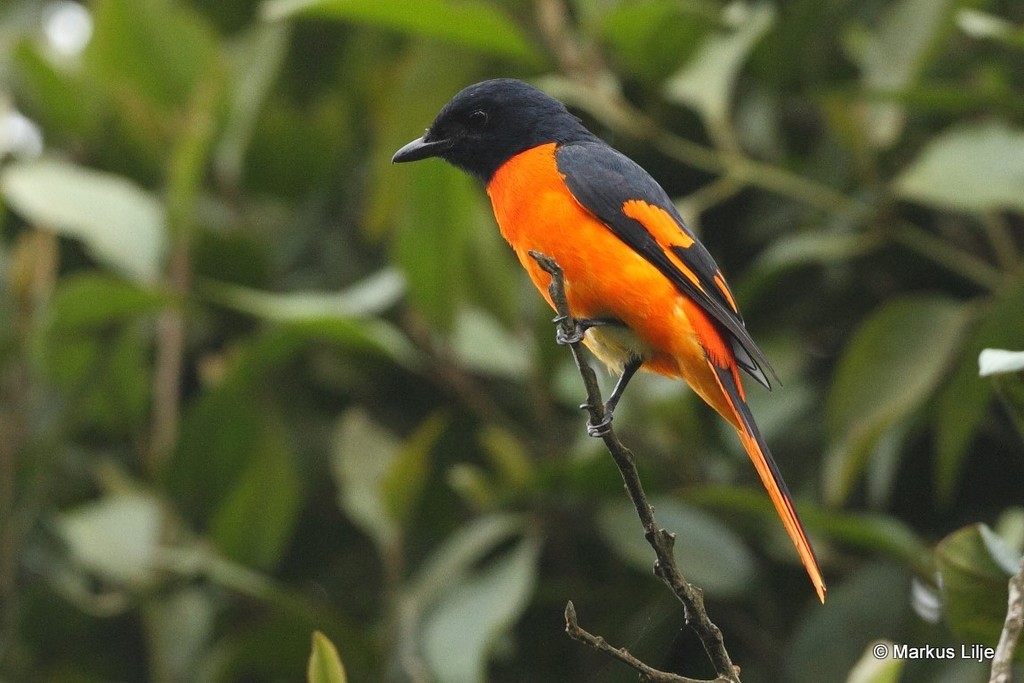
The orange minivet measures about 17 – 22 cm and weighs 19 – 24.5 g. Males are bright orange and black while females are largely yellow with a grey upperside. Males have a glossy black head, chin, throat and mantle and upper back. Lower back, rump and uppertail-coverts are orange-red. Underparts are largely bright orange-red, that makes it stand out in the surroundings. It can be distinguished from other Pericrocotus species by isolated red markings near tips of tertials and inner secondaries. Females have a yellow forehead and ashy-grey, lower back. Red areas of male are replaced by yellow and in addition they have a yellow chin and are almost completely bright yellow on the underside. Juveniles resemble the female in this species with some variation.
What it does
The species is gregarious, typically seen foraging in small groups (more than 2 individuals) along tree tops in forests. Minivets are often seen to make bouncing flights over the canopy of the forest. They are primarily insectivorous, known to perch and scan surroundings. They catch prey by making a flight and hovering at plant surfaces to pick insects. This behaviour is often known as sally-gleaning. They regularly forage in mixed-hunting parties along with other canopy species of birds. The call of this species is sweeping whistles composed of multiple "weep-sweep" notes. They are often seen to call when in flight or when stationary.
== References ==
Wikipedia: “Behaviour and ecology”
Listen
Looking for field recordings…
Where it lives
Recorded sightings
—
geo-referenced records in GBIF, from museums, herbaria and field observers.
Drag the globe to turn it. Dots are where records exist, not a range map; darker means more records.
In the stacks
Searching the stacks…
Every page naming Pericrocotus flammeus in the Biodiversity Heritage Library →
This page is assembled live from iNaturalist, GBIF, Wikipedia, the Source Library and the Internet Archive. It is not yet part of the hand-edited codex. iNaturalist taxon 717333.