dewstick family
Roridulaceae
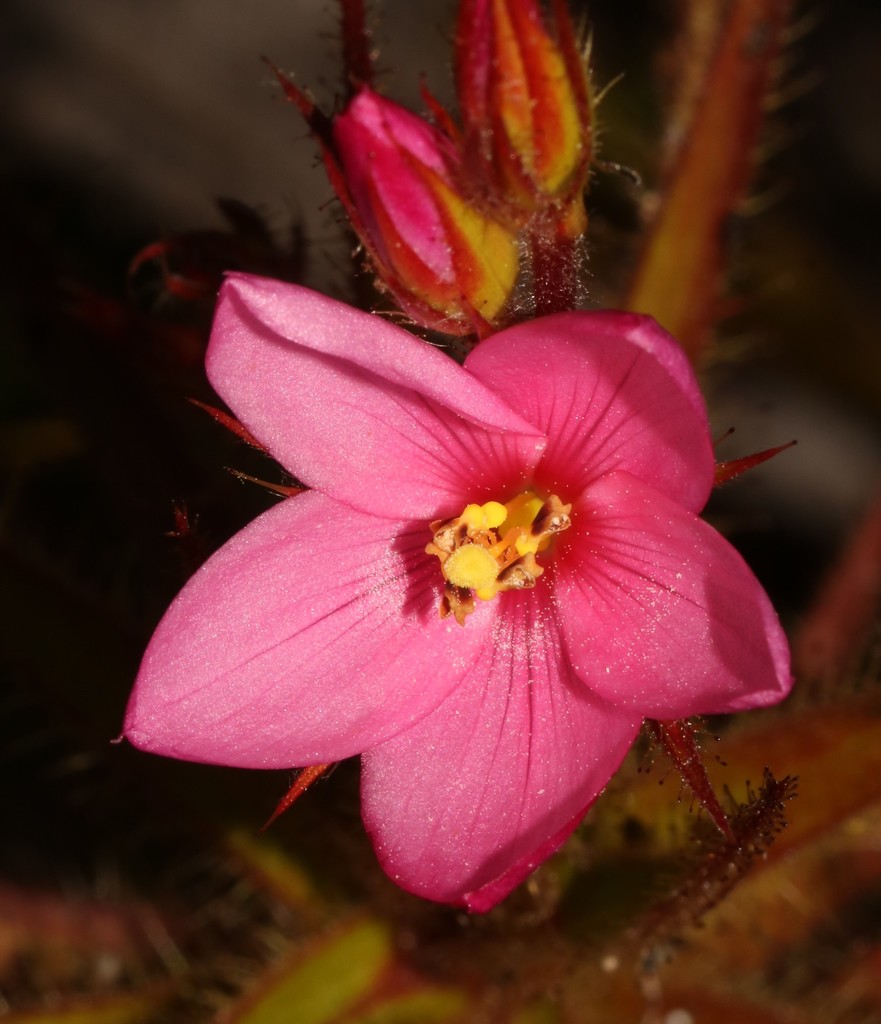
Roridula (; from Latin roridus "dewy") is a genus of evergreen, insect-trapping shrubs, with two species, of about 1.3–2 m (4.3–6.6 ft). It is the only genus in the family Roridulaceae. It has thin, woody, shyly branching, upright, initially brown, later grey stems, with lance- to awl-shaped leaves crowded at their tips. The star-symmetrical flowers consist from the outside in of five, green or reddish, free sepals, alternating with five white, pink or purple, free petals. Further to the middle and opposite the sepals are five stamens with the anthers initially kinked down. These suddenly flip up if the nectar-containing swelling at its base is being touched. The center of the flower is occupied by a superior ovary. The leaves and sepals carry many sticky tentacles of different sizes, that trap insects. Roridula does not break down the insect proteins, but bugs of the genus Pameridea prey on the trapped insects. These later deposit their feces on the leaves, which take up nutrients from the droppings. The species can be found in the Western Cape province of South Africa. They are commonly known as dewstick or fly bush in English and vlieëbos or vlieëbossie in Afrikaans.
1 branches of this family, most-observed first
See this branch on the Wheel of Life →
Where it lives
Recorded sightings
—
geo-referenced records in GBIF, from museums, herbaria and field observers.
Drag the globe to turn it. Dots are where records exist, not a range map; darker means more records.
In the stacks
Searching the stacks…
Every page naming Roridulaceae in the Biodiversity Heritage Library →
This page is assembled live from iNaturalist, GBIF, Wikipedia, the Source Library and the Internet Archive. It is not yet part of the hand-edited codex. iNaturalist taxon 71613.