- Animals
- ›Arthropods
- ›Hexapods
- ›Insects
- ›Winged and Once-winged Insects
- ›Grasshoppers, Crickets, and Katydids
- ›Katydids, Crickets, and Allies
- ›Crickets
- ›True Crickets and Allies
- ›True Crickets
- ›Field Crickets
- ›Gryllini
- ›Gryllina
- ›Gryllus
- ›Gryllus
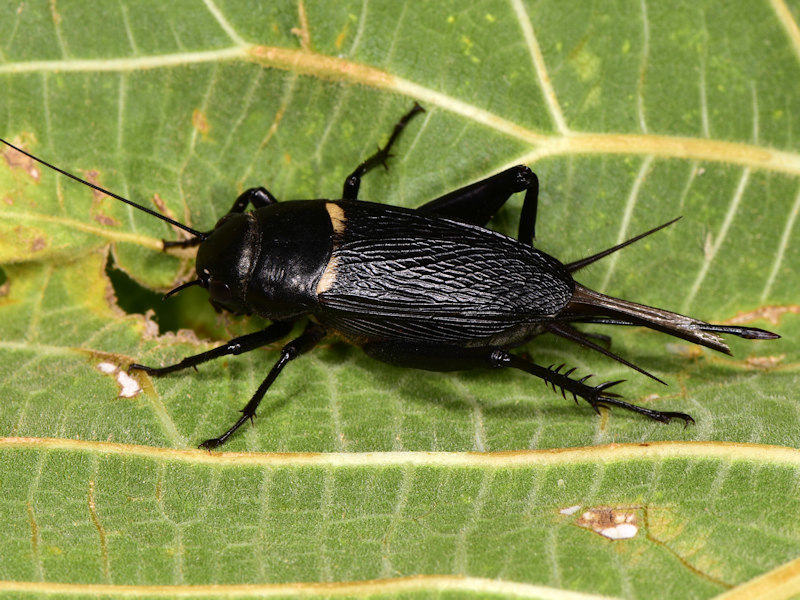
Southern Field Cricket
Gryllus bimaculatus
Gryllus bimaculatus is a species of cricket in the subfamily Gryllinae. Most commonly known as the two-spotted cricket, it has also been called the "African" or "Mediterranean field cricket", although its recorded distribution also includes much of Asia, including China and Indochina through to Borneo. It can be discriminated from other Gryllus species by the two dot-like marks on the base of its wings.
The species is popular for use as a food source for insectivorous animals like spiders and reptiles kept as pets or in zoos. They are easy to raise and do not require prolonged exposure to cold in order to complete their life cycle.
From the article Gryllus bimaculatus on Wikipedia (CC BY-SA), quoted section by section
What it does
Females have a tubular organ at the rear, known as an ovipositor, which is used to lay eggs into the ground. They lay their eggs into humid soil or sand and hatchlings emerge from the eggs in about two weeks.
Mating. Gryllus bimaculatus exhibit polygamy. Polyandry is the most common form of polygamy practiced in G. bimaculatus. This means that female crickets will mate with more than one male. Male crickets do not exhibit polygyny. The more sperm that is deposited results in greater fertilization success because more eggs are able to hatch. The order in which various males mate with one female before fertilization also affects fertilization success. The last male that mates with a female tends to have the highest fertilization success. Traits that increase the ability of a male's sperm to successfully fertilize a female's egg compared to that of another male are most advantageous. This is because these traits have been selected for over traits that have lower fertilization success.
Polyandry. Females prefer to mate with certain males more than others, with preference for mating with new males. Female G. bimaculatus mate with at least two males before zygote production occurs. These males have to invest even more resources into each reproductive opportunity when a mate competitor is in their environment. …
Wikipedia: “Life cycle”
Listen
Looking for field recordings…
Where it lives
Recorded sightings
—
geo-referenced records in GBIF, from museums, herbaria and field observers.
Drag the globe to turn it. Dots are where records exist, not a range map; darker means more records.
In the stacks
Searching the stacks…
Every page naming Gryllus bimaculatus in the Biodiversity Heritage Library →
This page is assembled live from iNaturalist, GBIF, Wikipedia, the Source Library and the Internet Archive. It is not yet part of the hand-edited codex. iNaturalist taxon 71247.