- Plants
- ›Vascular Plants
- ›flowering plants
- ›Dicots
- ›Sunflowers, Bellflowers, Fanflowers, and Allies
- ›Sunflowers, Daisies, Asters, and Allies
- ›chicories, dandelions, and allies
- ›Lettuce, Chicory, Dandelion and Salsify Tribe
- ›hawkweeds
- ›Pilosella
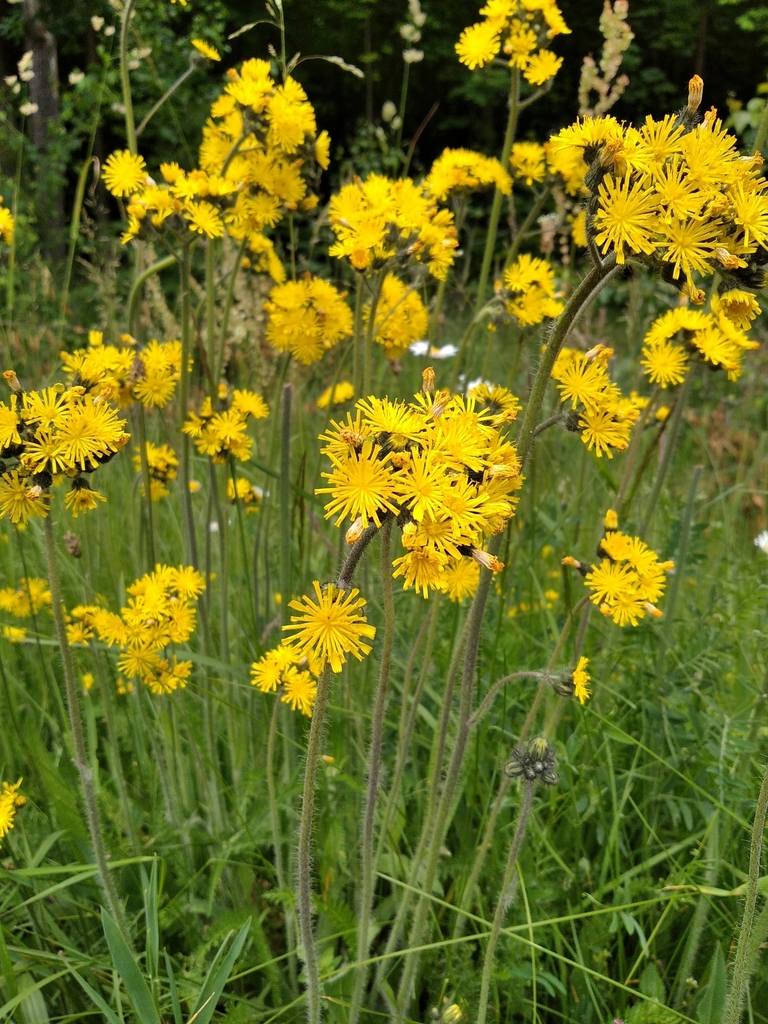
meadow hawkweed
Pilosella caespitosa
Hieracium caespitosum (commonly known as meadow hawkweed, yellow hawkweed, field hawkweed, king devil, yellow paintbrush, devil's paintbrush, yellow devil, yellow fox-and-cubs, and yellow king-devil) is like several other Hieracium species and has a similar appearance to many of the other Hawkweeds.
From the article Pilosella caespitosa on Wikipedia (CC BY-SA), quoted section by section
Description
Pilosella caespitosa is a creeping perennial, with shallow, fibrous roots and long rhizomes. The leaves, hairy on both sides (unlike Pilosella floribunda, which looks similar but has hair only on the underside), are up to 6 inches (15 centimeters) long, spathulate, and almost exclusively basal with the exception of 1 or 2 very small cauline leaves. The leaves lie flat to the ground, overlap, and will smother non-vigorous turf. The stems are bristly and usually leafless, although occasionally a small leaf appears near the midpoint. Stems, leaves, and bracts have dense, blackish hairs and exude milky juice when broken. The 1/2 inch (1 centimeter) flower heads appear in tight clusters at the top of the 1 to 3 foot (1/3 to 1 meter) stems with 5 to 40 flowers per cluster. Corollas are all ligulate and bright yellow. Each single flower head is an inflorescence and each petal forms its own seed, making them each a separate flower or floret. The seeds are shiny, black, and plumed. After maturing they are dispersed by wind, clothing, hair, feathers, and some vehicles that disturb fields or soils. P. …
Range & habitat
Tolerant of drought and trampling, this species finds its habitat where the soil has been neglected. Places like roadsides, neglected residential and commercial landscapes, minimally maintained public parks and open spaces, vacant lots, rubble dump sites, and abandoned grasslands (meadows). Pilosella caespitosa is an introduced species in North America and can be found in Canada (British Columbia, Manitoba, New Brunswick, Newfoundland, Labrador, Nova Scotia, Ontario, Prince Edward Island, and Quebec) and the United States (Connecticut, Washington, D.C., Georgia, Idaho, Illinois, Indiana, Massachusetts, Maine, Michigan, Minnesota, Montana, North Carolina, New Hampshire, New Jersey, New York, Ohio, Oregon, Pennsylvania, Rhode Island, Tennessee, Virginia, Vermont, Washington, Wisconsin, West Virginia, and Wyoming). It is considered a noxious weed in Idaho, Montana, Oregon and Washington. Pilosella caespitosa's native range includes a large portion of Europe, including Austria, Belarus, Bulgaria, Czechoslovakia, Estonia, France, Finland, Germany, Greece, Hungary, Latvia, Lithuania, Norway, Poland, Romania, Sweden, Switzerland, Ukraine, and Former Yugoslavia.
Wikipedia: “Habitat and distribution”
Where it lives
Recorded sightings
—
geo-referenced records in GBIF, from museums, herbaria and field observers.
Drag the globe to turn it. Dots are where records exist, not a range map; darker means more records.
In the stacks
Searching the stacks…
Every page naming Pilosella caespitosa in the Biodiversity Heritage Library →
This page is assembled live from iNaturalist, GBIF, Wikipedia, the Source Library and the Internet Archive. It is not yet part of the hand-edited codex. iNaturalist taxon 711086.