- Plants
- ›Vascular Plants
- ›flowering plants
- ›Dicots
- ›honeysuckles, moschatels, and allies
- ›elder family
- ›Viburnum
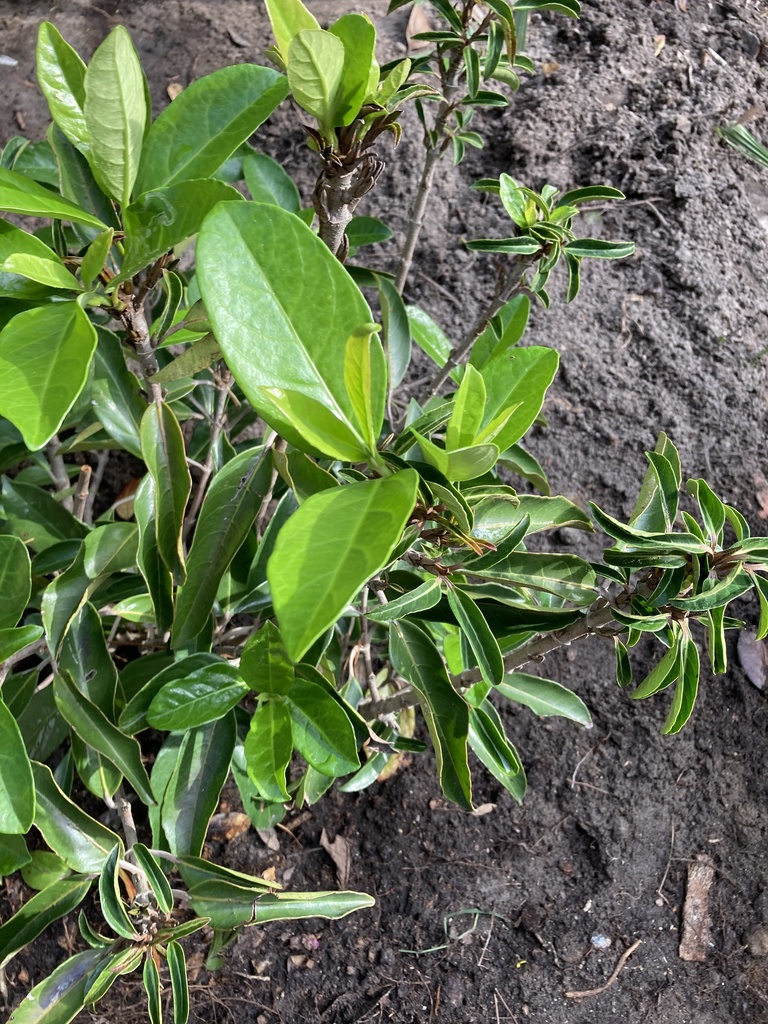
Viburnum awabuki
Viburnum awabuki, the Awabuki sweet viburnum, is a species of flowering plant in the family Viburnaceae. Many authorities consider it to be a variety of Viburnum odoratissimum, Viburnum odoratissimum var. awabuki. It is native to eastern Asia; Korea, Japan, the Ryukyus, and Taiwan, and is a common ornamental in China. An evergreen shrub or tree usually 5 m (16 ft) tall, with some individuals reaching 8 m (26 ft), it is typically found in coastal forests at elevations from sea level to 1,500 m (4,900 ft). Hardy in USDA Zones 7 through 9, the unimproved ("wild type") species and a number of cultivars are available from commercial suppliers.
From the article Viburnum awabuki on Wikipedia (CC BY-SA), quoted section by section
At the table
It is extensively used as an ornamental in China and Japan, in a variety of landscaping applications; park tree, street tree, hedging, and in green roofs, firebreaks, windbreaks, and storm-surge resistance plantings. In the past it was used as a fish poison by artisanal fishers. The phytochemicals produced by the plant, including vibsanins, salicin, emulsin, diterpenoids, triterpenes, and sesquiterpenes, have been extensively isolated and cataloged, with an eye towards their potential anticarcinogenic and anti-tumor properties.
== References ==
Wikipedia: “Uses”
In human culture
Viburnum awabuki goes by two names in Japanese: sangoju (サンゴジュ), meaning "coral tree" and referring to the color of the fruit, and awabuki (アワブキ) meaning "bubble blowing". During a fire, Viburnum awabuki plants resist burning by "blowing bubbles"—exuding foam—from their thick leaves and from their woody parts. For this reason Viburnum awabuki is planted as hedges to protect buildings from fires. Viburnum awabuki was described by Karl Koch in 1867.
Wikipedia: “Etymology”
Where it lives
Recorded sightings
—
geo-referenced records in GBIF, from museums, herbaria and field observers.
Drag the globe to turn it. Dots are where records exist, not a range map; darker means more records.
In the stacks
Searching the stacks…
Every page naming Viburnum awabuki in the Biodiversity Heritage Library →
This page is assembled live from iNaturalist, GBIF, Wikipedia, the Source Library and the Internet Archive. It is not yet part of the hand-edited codex. iNaturalist taxon 708906.