- Animals
- ›Arthropods
- ›Hexapods
- ›Insects
- ›Winged and Once-winged Insects
- ›Ants, Bees, Wasps, and Sawflies
- ›Narrow-waisted Wasps, Ants, and Bees
- ›Ants, Bees, and Stinging Wasps
- ›Bees and Apoid Wasps
- ›Bees
- ›Sweat Bees
- ›Sweat and Furrow bees
- ›Halictini
- ›Halictina
- ›Halictus
- ›Hexataenites
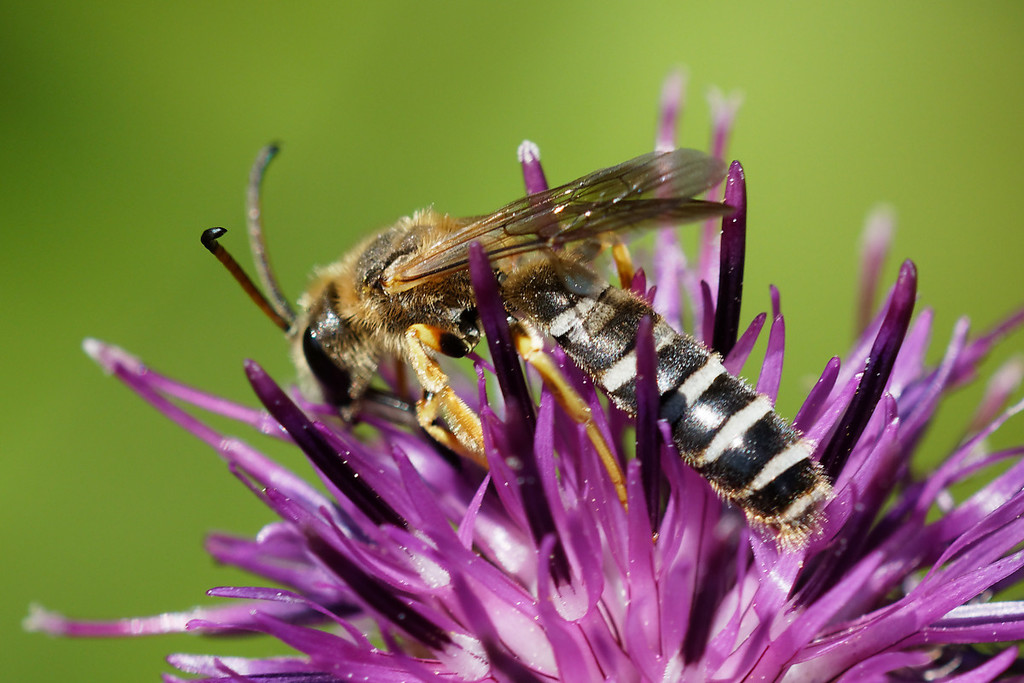
Six-banded Sweat Bee
Halictus sexcinctus
Halictus sexcinctus, commonly referred to as the six-banded furrow bee, is a species of sweat bee found throughout Europe and as far east as Asian Turkey and Iraq. The H. sexcinctus can be easily confused with the closely related species, Halictus scabiosae, due to very similar morphological features. H. sexcinctus show a social polymorphism in which different colonies can exhibit solitary, communal, or eusocial structure. Due to this large variance in social organization, it was suspected that it was not one species at all, but rather multiple, cryptic species. However, genetic analysis was able to confirm these varying populations as one species. H. sexcinctus will forage from multiple flower species, but prefers plant species with wide-open flowers. Their nests can be found dug into the ground in loamy or sandy soil.
From the article Halictus sexcinctus on Wikipedia (CC BY-SA), quoted section by section
Description
Halictus sexcinctus is a species of ground-nesting bees, previously thought to only exhibit solitary behavior. They are relatively large compared to other sweat bees. They are 14–16 mm in length, and have white felt bands on their abdomens. Workers are typically smaller than foundresses, while foundresses will usually be the largest and most worn individuals in the nest. Sterile and reproductive workers do not differ in size.
Sexual dimorphism. As is typical among sweat bees, females are larger than males. Males also have slimmer bodies than females and their antennae are longer with a slightly different coloration. H. sexcinctus looks very similar to Halictus scabiosae, so the two are easily confused. Both have ring-like bands on their tergites, with females having anterior and posterior buff-colored bands on tergites 2-4, while males have whitish posterior bands on tergites 2-6. H. sexcinctus differs from H. scabiosae in that males have longer, reddish antennae, and females lack the basal hair bands on tergites 2-4.
Social description. In eusocial nests, queens show aggressive behavior, and a fight to the death can occur if another female tries to usurp the foundress. However, in communal nests, aggression between females is little to non-existent, and foundresses will continuously join the colony during the founding period from late May to early June. …
Wikipedia: “Description and identification”
Range & habitat
Halictus sexcinctus are commonly found across Europe, and can be found as far north as southern Sweden and as far east as Turkey and Iraq. They are solitary in the northern part of the range and social in their southern range. They live in very large aggregations in central Europe, despite being solitary in this part of their range. H. sexcinctus prefers to nest in sandy or loamy soil. They use their mandibles to dig nests in the ground or even on vertical substrates if it is made of earth. Their nests consist of a main tunnel dug diagonally into the ground, with several short side chambers off of it leading to brood cells, and a small tumulus around the nest entrance. One egg is laid per cell on top of a nectar-pollen mixture. Females tend to forage in plant species with wide-open flowers, therefore they primarily collect pollen from plants of the family Asteraceae such as asters, daisies, and sunflowers.
Wikipedia: “Distribution and habitat”
Toxicity
With the rise of antibiotic resistant bacteria, the need to find antimicrobial substances that function differently than current antibiotics is incredibly important. Antimicrobial peptides (AMPs) are commonly found in the venom of arthropods, and these proteins function by breaking up bacterial cell membranes. However, these AMPs will often also damage eukaryotic cells, typically red blood cells. A substance that damages human red blood cells will be less valuable as an antibiotic for obvious reasons. AMPs that damaged red blood cells at low rates were found in the venom of several species of bees, leading to a study of the venom of H. sexcinctus. Two newly isolated peptides from the venom were found to be significantly different in structure to any other AMPs in the antimicrobial peptide database. These new proteins showed effective antimicrobial activity against four strains of bacteria (B. subtilis, S. aureus, E. coli, and P. aeruginosa) and a yeast pathogen (C. albicans). While these proteins isolated from H. sexcinctus venom show good antimicrobial properties, they also show found to damage red blood cells (hemolysis), reducing their therapeutic potential. However, when their structures were modified a few analogs with slightly lower hemolytic activity were discovered, meriting further study.
Wikipedia: “Antimicrobial properties of proteins in the venom”
Listen
Looking for field recordings…
Where it lives
Recorded sightings
—
geo-referenced records in GBIF, from museums, herbaria and field observers.
Drag the globe to turn it. Dots are where records exist, not a range map; darker means more records.
In the stacks
Searching the stacks…
Every page naming Halictus sexcinctus in the Biodiversity Heritage Library →
This page is assembled live from iNaturalist, GBIF, Wikipedia, the Source Library and the Internet Archive. It is not yet part of the hand-edited codex. iNaturalist taxon 704040.