- Animals
- ›Arthropods
- ›Hexapods
- ›Insects
- ›Winged and Once-winged Insects
- ›Grasshoppers, Crickets, and Katydids
- ›Grasshoppers, Locusts, and Allies
- ›Grasshoppers
- ›Short-horned Grasshoppers and Locusts
- ›Short-horned Grasshoppers
- ›Slant-faced Grasshoppers
- ›Amblytropidiini
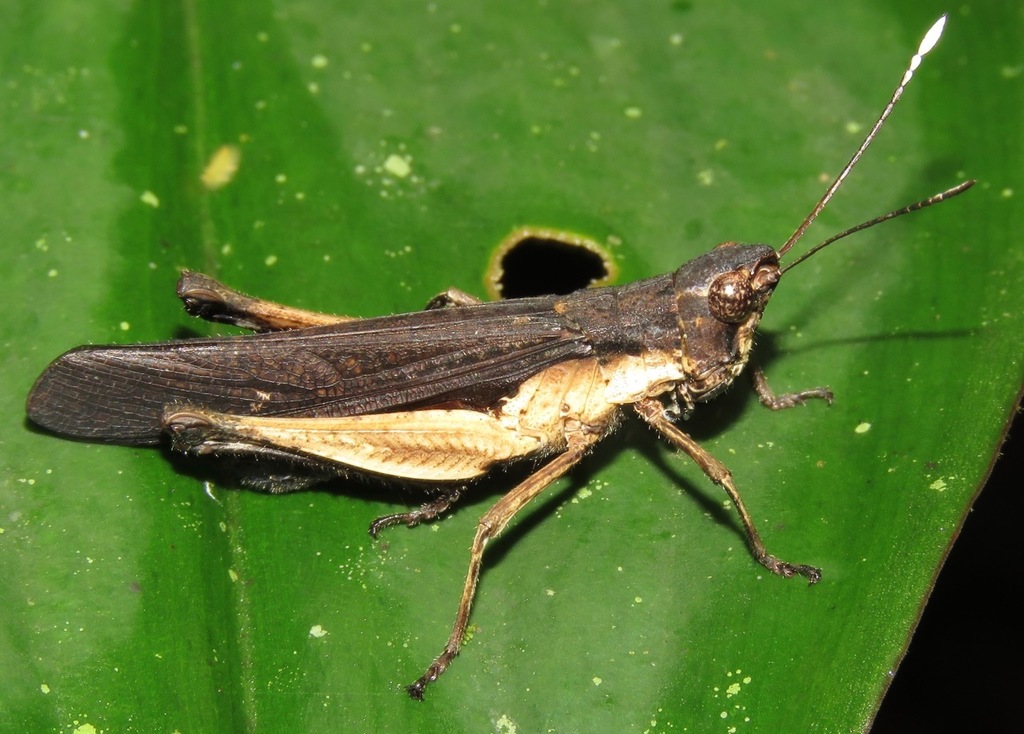
Peruvia
Peru, officially the Republic of Peru, is a country in western South America. It is bordered to the north by Ecuador and Colombia, to the east by Brazil, to the southeast by Bolivia, to the south by Chile, and to the south and west by the Pacific Ocean. Peru is a megadiverse country, with habitats ranging from the arid plains of the Pacific coastal region in the west, to the peaks of the Andes mountains extending from the north to the southeast of the country, to the tropical Amazon basin rainforest in the east with the Amazon River. Peru has a population of over 32 million, and its capital and largest city is Lima. At 1,285,216 km2 (496,225 sq mi), Peru is the 19th largest country in the world, and the third largest in South America.
Peruvian territory was home to several cultures during the ancient and medieval periods, and has one of the longest histories of civilization of any country, tracing its heritage back to the 10th millennium BCE Caral–Supe civilization, the earliest civilization in the Americas and considered one of the cradles of civilization. Notable succeeding cultures and civilizations include the Nazca culture, the Moche, Wari and Tiwanaku empires, the Kingdom of Cusco, and the Inca Empire, the largest known state in the pre-Columbian Americas. The Spanish Empire conquered the region in the 16th century and Charles V established a viceroyalty with the official name of the Kingdom of Peru that encompassed most of its South American territories, with its capital in Lima.
2 branches of this genus, most-observed first
See this branch on the Wheel of Life →
Where it lives
Recorded sightings
—
geo-referenced records in GBIF, from museums, herbaria and field observers.
Drag the globe to turn it. Dots are where records exist, not a range map; darker means more records.
In the old herbals & bestiaries

History of Rare Plants
Carolus Clusius · 1601 · p.194

Treasury of Medical Matters of New Spain
Francisco Hernández · 1651 · p.95

History of Plants in Four Books
Valerius Cordus · 1561 · p.200

Florum et coronariarum historia
Rembert Dodoens · 1568 · p.299

Six Groups of the History of Plants
Rembert Dodoens · 1583 · p.470

Six Groups of the History of Plants
Rembert Dodoens · 1583 · p.470

The Flowering Garden: Autumn
Crispijn van de Passe · 1616 · p.28

The Flowering Garden: Autumn
Crispijn van de Passe · 1616 · p.44

Thesaurus of Medical Things of New Spain, or History of Mexican Plants, Animals, and Minerals
Francisco Hernández; Nardo Antonio Recchi (ed.) · 1651 · p.189

History of Rare Plants
Carolus Clusius · 1601 · p.20

Herbarium Portatile, Oder Behendes Kräuter- und Gewächs-Buch: Darinn nicht allein 1363. so wol Einheimische als Außländndische Kräuter mit Lateinisch und Deutscher Benennung abgebildet, sondern auch die meisten, so in der Medicin gebräuchlich, kürtzlich erkläret werden
Panckow, Thomas · 1656 · p.160

Herbarium Portatile, Oder Behendes Kräuter- und Gewächs-Buch: Darinn nicht allein 1363. so wol Einheimische als Außländndische Kräuter mit Lateinisch und Deutscher Benennung abgebildet, sondern auch die meisten, so in der Medicin gebräuchlich, kürtzlich erkläret werden
Panckow, Thomas · 1656 · p.373
In the stacks
Searching the stacks…
Every page naming Peruvia in the Biodiversity Heritage Library →
This page is assembled live from iNaturalist, GBIF, Wikipedia, the Source Library and the Internet Archive. It is not yet part of the hand-edited codex. iNaturalist taxon 702429.