- Plants
- ›Vascular Plants
- ›flowering plants
- ›Dicots
- ›borages
- ›borage family
- ›Cynoglossoideae
- ›Myosotideae
- ›Myosotis
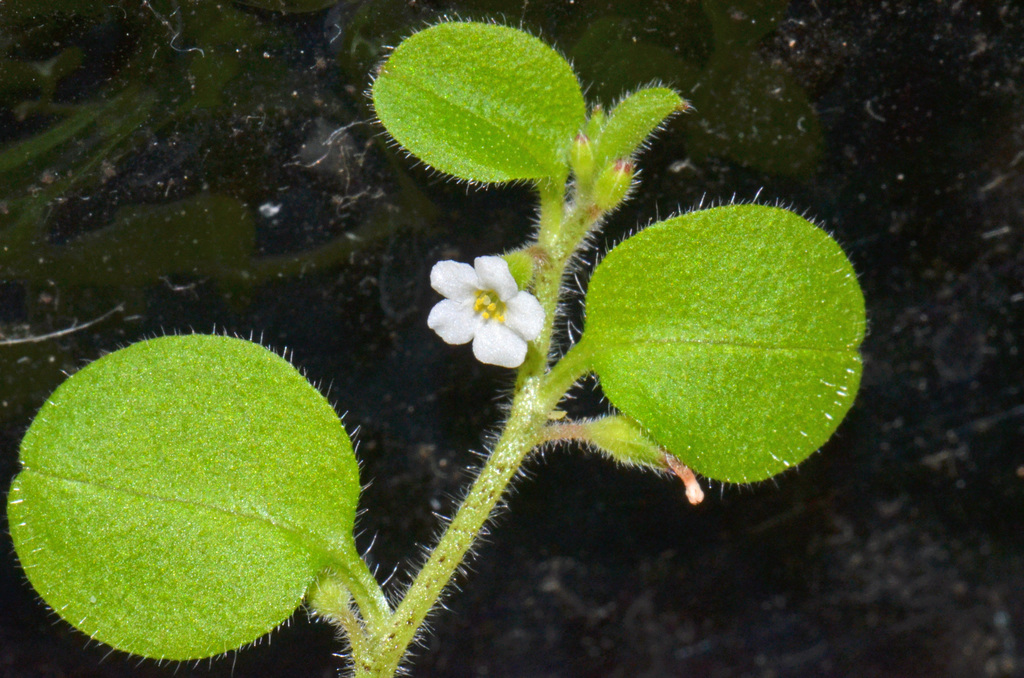
Myosotis spatulata
Myosotis spatulata is a species of flowering plant in the family Boraginaceae, endemic to New Zealand. Georg Forster described the species in 1786. Plants of this species of forget-me-not are perennial rosettes with bracteate inflorescences and white corollas.
M. spatulata is distributed across many plant communities in both the North and South Islands. It is listed as Naturally Uncommon by the New Zealand Threat Classification System.
From the article Myosotis spatulata on Wikipedia (CC BY-SA), quoted section by section
Description
M. spatulata plants are rosettes. The rosette leaves have petioles 4–30 mm long. The rosette leaf blades are 4–28 mm long by 3–18 mm wide (length: width ratio 0.9–1.7: 1), usually narrowly to broadly obovate, widest at or above the middle, with an obtuse apex. Both surfaces of the leaf are sparsely to densely covered in straight (some flexuous), patent, antrorse (forward-facing) hairs that are oriented at an angle (upper surface) or parallel (lower surface) relative to the mid vein. The leaf margin hairs are the same but usually appressed. Each rosette has 2–12 sprawling, creeping, prostrate, unbranched or once-branched bracteate inflorescences that are 62–310 mm long. The cauline leaves (or bracts) are very similar to the rosette leaves, but become smaller and sessile toward the tip of the inflorescence. The flowers are 1–47 per inflorescence and each is borne on a short pedicel and associated with a bract. The calyx is 1–4 mm long at flowering and 2–4 mm long at fruiting, deeply lobed to half or all of its length, and densely covered in short, straight to flexuous (sometimes hooked near the calyx base), appressed, patent, or erect, antrorse hairs. The corolla is white and 1–5 mm in diameter, with a cylindrical tube, petals that are broadly obovate, rotund or ovate, and flat, and small, faint yellow scales alternating with the petals. The anthers are fully exserted. …
Range & habitat
Myosotis spatulata is endemic to New Zealand, and has a large geographical distribution throughout the North and South Islands from 0–1500 m elevation. On the North Island, it is found in: Northland, Auckland, Volcanic Plateau, Gisborne and Southern North Island; on the South Island it is known from Sounds-Nelson, Canterbury, Otago and Fiordland. It is also present on several offshore islands, including Manawatāwhi / Three Kings; Aotea / Great Barrier; Taranga / Hen and Chickens; Moutohora / Whale; and Chatham Islands. M. spatulata is found on rocky, base-rich substrates, in dry or wet, shaded, sheltered areas in grassland, shrubland or forests.
Wikipedia: “Distribution and habitat”
Where it lives
Recorded sightings
—
geo-referenced records in GBIF, from museums, herbaria and field observers.
Drag the globe to turn it. Dots are where records exist, not a range map; darker means more records.
In the stacks
Searching the stacks…
Every page naming Myosotis spatulata in the Biodiversity Heritage Library →
This page is assembled live from iNaturalist, GBIF, Wikipedia, the Source Library and the Internet Archive. It is not yet part of the hand-edited codex. iNaturalist taxon 701200.