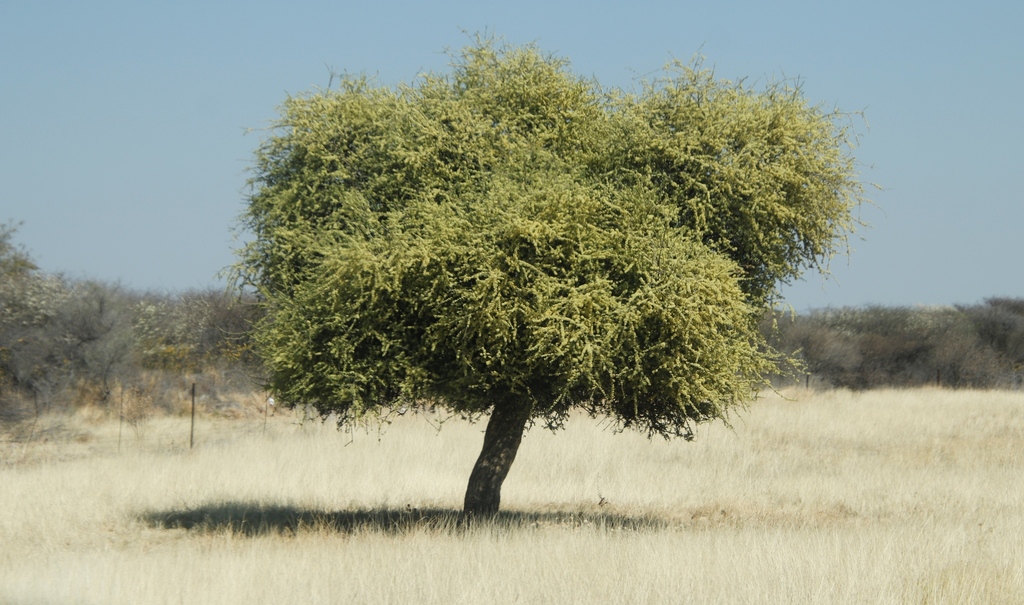
Shepherds tree
Boscia albitrunca
Boscia albitrunca, commonly known as the shepherd tree or shepherd's tree (Afrikaans: witgat, Sotho: Mohlôpi, Tswana: Motlôpi, Venda: Muvhombwe, Xhosa: Umgqomogqomo, Zulu: Umvithi), is a protected species of South African tree in the caper family. It is known for having the deepest known root structure of any plant at: -68 metres (223 ft).
The species epithet "albitrunca" refers to the white trunk it oftentimes develops. Traditionally, the shepherd tree was used by Dutch settlers, boers, to create a variant of coffee from the roots of the tree. It is an evergreen tree native to southern and tropical Africa, living in the hot, dry, and often seasonally brackish low-lying areas, sometimes on abundant lime or occasionally on rocky terrain. It is a common tree of the Kalahari, bushveld and lowveld. It is one of the most important animal forage trees in the Kalahari.
From the article Boscia albitrunca on Wikipedia (CC BY-SA), quoted section by section
Description
This tree grows up to 10 m (33 ft) tall but is usually much smaller. It has a prominent, sturdy white trunk frequently with strips of rough, dark-coloured bark. The crown is often browsed by antelope and any grazers capable of reaching the foliage, resulting in a conspicuous flattened underside, or browse-line. The leaves are narrow, oblanceolate, and stiff, with veins obscure except for the distinct midrib. The flowers are small, greenish-yellow, lacking petals, starburst-shaped, and clustered. The fruits, on a jointed stalk, are about 10 mm (0.4 in) in diameter and are brittle-skinned with a whitish flesh and large endocarp. A specimen found in the central Kalahari in 1974 had roots extending to 68 m (223 ft) deep, making it the plant with the deepest known roots thus far found.
Where it lives
Recorded sightings
—
geo-referenced records in GBIF, from museums, herbaria and field observers.
Drag the globe to turn it. Dots are where records exist, not a range map; darker means more records.
In the stacks
Searching the stacks…
Every page naming Boscia albitrunca in the Biodiversity Heritage Library →
This page is assembled live from iNaturalist, GBIF, Wikipedia, the Source Library and the Internet Archive. It is not yet part of the hand-edited codex. iNaturalist taxon 70065.